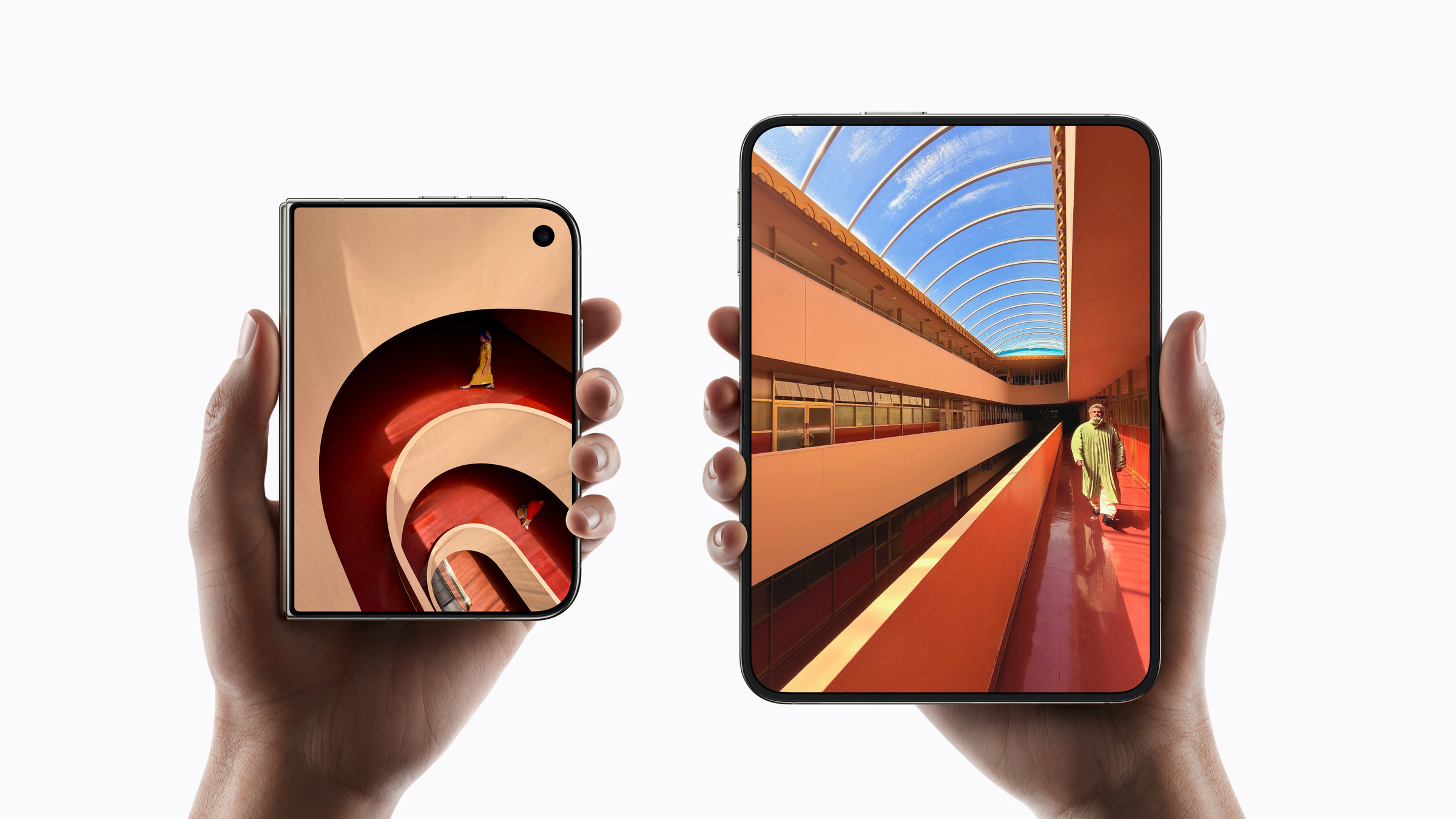
Apple unveiled its first foldable iPhone on September 9th. Called the iPhone Duo, it unfolds to reveal a 7.6-inch display, costs from €2,299, and will be released later than the rest of the generation: pre-orders begin on October 16th, with deliveries starting on October 23rd.
Seven years after the first foldable Android device, Apple is entering the category – and doing so with a device that deliberately positions itself alongside the Pro series rather than above it. The iPhone Duo has the largest display ever in an iPhone, but in return for this, it forgoes Face ID, a telephoto camera, and a card slot. How it fits into the overall generation is explained in the overview of the entire series. This page summarizes what Apple provides in the German specifications.
Key Facts at a Glance
| Detail | Info |
|---|---|
| Price from | 2,299 euros (256 GB) |
| Pre-order | October 16, 2 PM CEST |
| Delivery | October 23, 28 more countries from October 30 |
| Inner display | 7.6 inch OLED, 1878 × 2670, 430 ppi, nano texture |
| External display | 5.4 inch OLED, 1398×2034, 460ppi |
| Chip | A20 Pro |
| Memory | 256 GB to 2 TB |
| Cameras | 2 x 48 MP rear cameras, 12 MP external camera, FaceTime camera below the internal display |
| Unlock | Touch ID in the side button |
| Dimensions opened | 164.6 × 117.8 × 5.2 mm |
| Dimensions closed | 84.1 × 117.8 × 11.3 mm |
| Weight | 254 g |
| SIM | exclusively eSIM |
| Colors | Night sky, starry white |
Prices and dates: five weeks after the Pro series
The iPhone Duo starts at €2,299, making it the most expensive iPhone Apple has ever sold. The next tier follows the exact same logic as the Pro models: €250 for the upgrade to 512 GB, €500 for 1 TB, and €750 for 2 TB.
| Capacity | Price |
|---|---|
| 256 GB | 2,299 euros |
| 512 GB | 2,549 euros |
| 1 TB | 3,049 euros |
| 2 TB | 3,799 euros |
From the entry-level model to the top-of-the-line version, the price range is €1,500 – as much as a complete iPhone 18 Pro. The matching case costs €89 and is available in navy blue and sand.
Apple is taking a different approach to the launch. According to the company, pre-orders will be accepted starting October 16th at 2 PM CEST in more than 63 countries, with deliveries beginning on October 23rd. 28 more countries will follow on October 30th. This leaves 44 days between the presentation and the sales launch, and exactly five weeks between the market launches of the Pro and Duo series. All other events of the evening can be found in the overview of the September keynote.
Design: thinner than any iPhone, but only when unfolded
When open, the device measures 164.6 × 117.8 millimeters and is 5.2 millimeters thick – thinner than any other iPhone. When folded, it measures 84.1 × 117.8 millimeters and is 11.3 millimeters thick, which is about 2.5 millimeters thicker than the iPhone 18 Pro. It weighs 254 grams, which is 43 grams more than the smaller Pro model.
The housing and hinge cover are made of titanium, with the cover being 3D-printed. The front features Ceramic Shield 2, the back Ceramic Shield. Water and dust resistance is rated IP68, tested to a depth of six meters for 30 minutes – a rating that foldable competitors have not yet consistently achieved. Detailed information on the layer structure of the foldable display can be found in the report on the internal construction.
The buttons remain: volume, side button, and camera controls. There is no action button.
Displays: two screens, one aspect ratio
The foldable OLED display measures 7.6 inches internally and has a resolution of 1878 × 2670 pixels, while the external display is 5.4 inches with a resolution of 1398 × 2034 pixels. Both support ProMotion with up to 120 Hz, Always-On, Dynamic Island, and 3,000 nits peak brightness outdoors.
One detail is easily overlooked in the data sheets: The pixel density of the inner display is 430 ppi, while that of the outer display is 460 ppi. The larger screen therefore has a slightly lower resolution than the smaller one – this is hardly noticeable at the viewing distances at which an unfolded device is typically used, but it explains why Apple uses a nanotexture coating for the inner display. This coating was previously only available on the Studio Display and the iPad Pro, and it reduces reflections across the large surface.
Also new is support for the Apple Pencil with USB-C – the first iPhone to accept a stylus. Apple notes in a footnote that this feature will be available later this year. The report on the iOS 27 foldable interface shows how the interface behaves when opening and closing the iPhone.
Chip and Performance
Inside, it uses the same A20 Pro chip as the Pro models: a 6-core CPU consisting of two super cores and four efficiency cores, a 7-core GPU with Neural Accelerators, a dual 16-core Neural Engine, and hardware-accelerated ray tracing. As with all iPhones, Apple remains silent about the amount of RAM.
That's the real message of the specifications: Apple isn't skimping on computing power with the Duo; the compromises lie elsewhere.
Cameras: two lenses, no telephoto lens
The rear camera features two 48MP modules. The main Fusion camera has a 26mm focal length and a fixed aperture of f/1.6, complemented by a 48MP ultrawide lens with a 13mm focal length and an f/2.2 aperture. Apple also extracts a 12MP image from the main camera, capturing a 52mm optical image, resulting in a 4x optical zoom range. Digital zoom extends up to 10x.
What's missing is the list that shows the difference compared to the Pro series: no true telephoto lens, no variable aperture, no LiDAR scanner, no ProRAW and ProRes recording. A direct comparison with the iPhone 18 Pro illustrates what this means in everyday use.
There are two cameras on the front. On the outside, there's a 12MP center-stage camera with an f/2.2 aperture, and on the inside, a FaceTime camera under the display with an f/1.8 aperture, limited to 1080p at 30 or 60 frames per second. So, when video calling with the phone unfolded, the recording resolution is lower than with the external camera.
Two features are unique to this device: Duo Preview displays the camera image simultaneously on the external display, allowing the person on the other end to see themselves. And because the device can be unfolded and stood upright, it replaces a tripod for selfies and video calls.
Battery: two cells, three runtime specifications
Apple uses two lithium-ion batteries, one in each half of the casing, and specifies the battery life accordingly.
| Info | Duration |
|---|---|
| Typical use | up to 24 hours. |
| Video playback, external display | up to 44 hours. |
| Video playback, internal display | up to 31 hours. |
| Video playback streamed, outside | up to 37 hours. |
| Video playback streamed, indoors | up to 26 hours. |
The 44 hours of battery life on the external display exceeds anything Apple claims for the Pro models – but this only applies as long as the device remains closed. When opened, the battery life drops by almost 30 percent, and the stated 24 hours of typical usage is less than that of the iPhone 18 Pro.
Charging is slower than with the Pro series: 50 percent takes about 20 minutes with a 60-watt power adapter, compared to around 15 minutes for the iPhone 18 Pro. It takes 30 minutes via MagSafe, and wireless charging is possible at 25 watts, both via MagSafe and Qi2.
Touch ID instead of Face ID
The iPhone Duo unlocks via a fingerprint sensor in the side button – the first iPhone since the iPhone SE to do without Face ID. Apple Pay, therefore, uses Touch ID. The reason lies in the available space: a TrueDepth system would require room on both sides of the screen. The report on Face ID in the third generation describes how this could change in a later generation.
Wireless connectivity: eSIM without alternative
For cellular connectivity, Apple uses its own C2 modem; for Wi-Fi, Bluetooth, and Thread, the N1 chip; and the second-generation Ultra Wideband chip. The USB-C port supports DisplayPort and USB 3 with speeds up to 10 Gbps.
There is no card slot, in any market. The device exclusively accepts eSIM, supports two active profiles simultaneously, and stores eight or more. In Germany, Austria, and Switzerland, this isn't a problem because all major providers issue eSIMs – however, the process changes when switching providers or abroad.
Where the reporting was wrong
Before the unveiling, figures were circulating that the finished device did not match. The most significant error was in the design: 4.5 to 4.8 millimeters were expected when opened and 9 to 9.5 millimeters when closed – in reality, it measures 5.2 and 11.3 millimeters, respectively. The device is therefore noticeably thicker than anticipated.
The storage options went in the opposite direction: instead of the expected three tiers up to 1 TB, there are four up to 2 TB. The colors are called Night Sky and Starry White, not Silver and Dark Blue, although the number of two colors was correct. And the name, which had been circulating in reports for months as iPhone Ultra and before that as iPhone Fold, is iPhone Duo.
The reports were correct regarding Touch ID, the lack of a telephoto camera, the pure eSIM equipment, and MagSafe, which is included despite the slim design.
Why the duo is positioned next to the Pro series and not above it
The price suggests a hierarchy that the features don't reflect. The most expensive iPhone has a weaker camera, shorter typical battery life, slower charging, and an older unlocking method. What it offers in return is screen space—so much so that the question isn't whether it's the better iPhone, but whether it can replace a second device.
That's precisely where the equation comes into play. Those who currently carry both an iPhone and an iPad mini are essentially trading two devices for one; the comparison is with the iPad mini. However, those who only occasionally unfold the large display are paying an €850 premium over the iPhone 18 Pro for a feature that's rarely used in everyday life – and getting less camera in return. We therefore expect that the device will sell less on its form factor and more on the question of how many devices someone already carries around.
Who is the iPhone Duo intended for?
This device makes sense if you actually use the large display daily: two apps side-by-side, longer reading sessions, documents on the go, video calls without a tripod. In that case, the form factor replaces a second device, and the extra cost becomes less of an issue.
The picture is less convincing for those who prioritize the camera. Without a telephoto lens and variable aperture, the system falls short of the Pro models, which are also significantly cheaper. Those torn between the Duo and the thinnest classic iPhone can find a comparison with the iPhone Air; those who haven't yet decided can use the iPhone buying guide to sort the range by budget and intended use.
And those who want to wait have an argument: First generations of foldable devices are traditionally the most expensive and least mature, and the report on a possible iPhone Duo Max outlines which variants could follow in the future.
What weighs more heavily on you – the largest iPhone display ever or the better camera at half the price? Let us know in the comments whether this duo will replace one of your devices or add another.