This article may contain affiliate links. Learn more on our Partner Program page.
Same chip, same ports, same battery life – and yet a €400 to €500 difference. For the first time, the MacBook Pro offers two display options side-by-side, and the deciding factor isn't performance. It's display, touch, and weight.
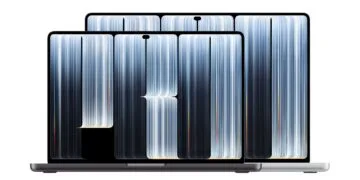
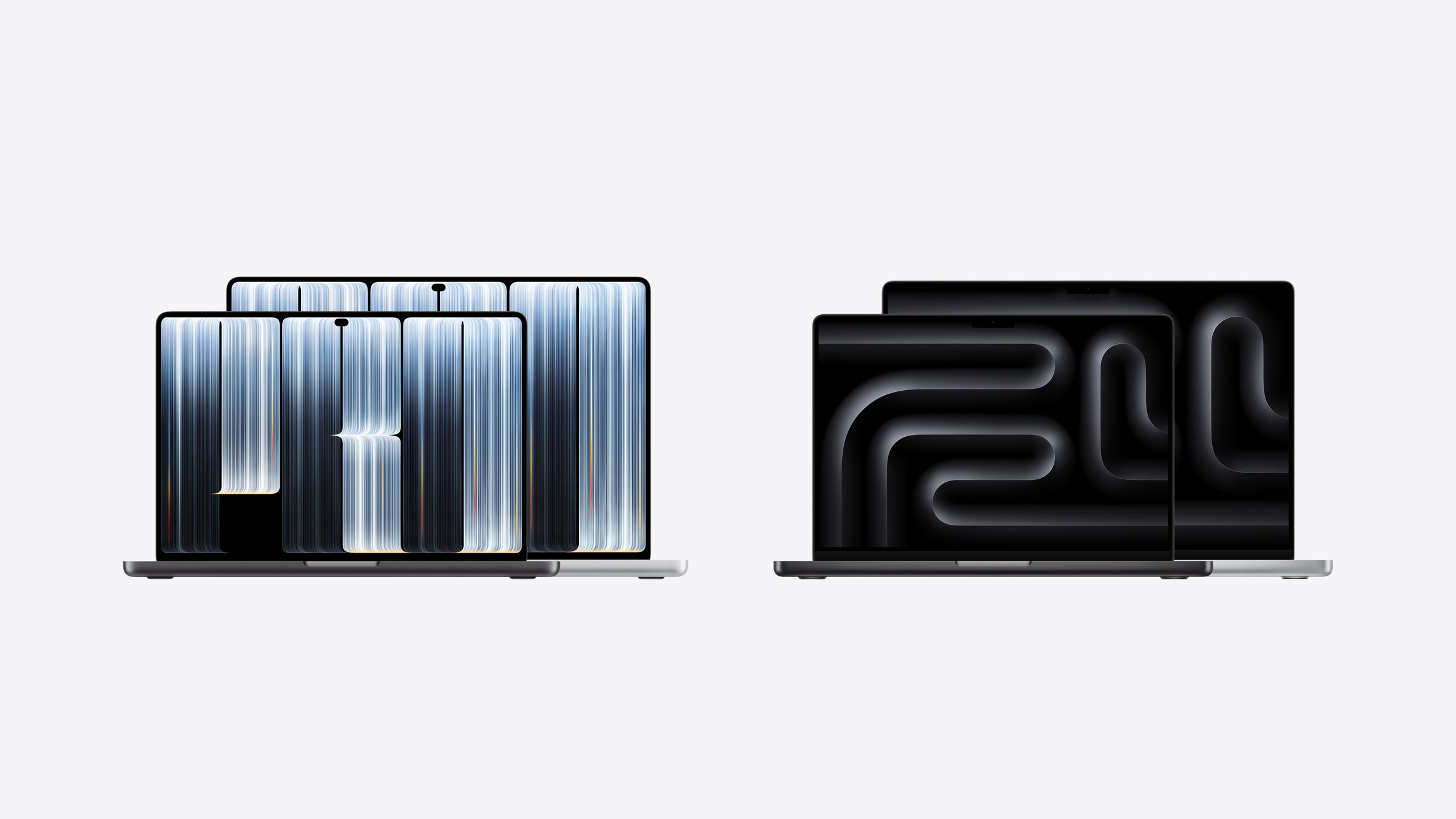
With the MacBook Pro featuring a PROLED XDR display, Apple introduced a second top-of-the-line model on October 28, 2026, joining the existing model. The version with a Liquid Retina XDR display (Mini-LED) remains in the lineup. Both are available in 14-inch and 16-inch sizes, both with either the M5 Pro or M5 Max processors.
All values in this comparison are taken from Apple's German technical specifications for the MacBook Pro with PROLED XDR display and the MacBook Pro with Liquid Retina XDR display; the prices are from the Apple Stores in Germany, Austria, and Switzerland. The entry-level model with the M6 chip is only available with a Mini-LED display and is therefore not included here. For an overview of the MacBook Pro M6, see how it compares to the other MacBook Pro models.
Key Facts at a Glance
- Chips, RAM, ports and battery life are identical in both versions.
- PROLED XDR brings tandem OLED with 10,000,000:1 contrast, 2000 nits peak brightness, Adobe RGB, touch and Dynamic Island.
- The OLED model is approximately 220 grams (14 inches) or 320 grams (16 inches) lighter.
- Only PROLED XDR is available with up to 16 TB SSD storage; Mini-LED is limited to 8 TB.
- The surcharge is 400 euros (14 inch) and 500 euros (16 inch), in Switzerland it is a consistent 500 francs.
The differences at a glance
| 14 inch with M5 Pro | Mini-LED | PROLED XDR |
|---|---|---|
| Display | Liquid Retina XDR (Mini-LED) | PROLED XDR (Tandem OLED) |
| Resolution | 3024 × 1964 pixels | 3024 × 1986 pixels |
| Contrast | 1.000.000:1 | 10.000.000:1 |
| Peak brightness HDR | 1600 nits | 2000 nits |
| Peak brightness SDR | 1000 nits (outdoors) | 2000 nits (outdoors) |
| Color space | P3 | P3 and Adobe RGB |
| Refresh rate | up to 120 Hz | 10 to 120 Hz |
| Touch | no | Yes |
| Display cutout | Notch | Dynamic Island |
| Weight | 1.60 kg | 1.38 kg |
| Battery / Video streaming | 72.4 Wh / up to 22 hours. | 72.6 Wh / up to 22 hours. |
| Maximum SSD capacity (with M5 Max) | 8 TB | 16 TB |
| Price from (Germany) | 2.899 € | 3.299 € |
Display: The real difference
The two variants differ most significantly in their displays. Mini-LED uses a backlight composed of many small zones, while OLED controls each pixel individually. This is reflected in the contrast ratio, which Apple specifies as 10,000,000:1 for the PROLED XDR display, ten times higher than that of the Mini-LED display.
Brightness also increases. Both displays deliver up to 1000 nits continuously in full-screen mode. Peak brightness rises from 1600 to 2000 nits for HDR content and from 1000 to 2000 nits outdoors for SDR content. Adobe RGB is also included as a second color space alongside P3, complete with corresponding reference modes for photography and printing. Medical DICOM modes and a dedicated HDR photography mode are also exclusive to the PROLED XDR.
Nanotextured glass is available as an option for both variants.
Touch and Dynamic Island
Only the OLED model can be operated with a finger. The display supports multi-touch gestures; the keyboard and trackpad remain the same. Instead of the notch of the mini-LED version, there's a Dynamic Island at the top with live activity, call, and music controls.
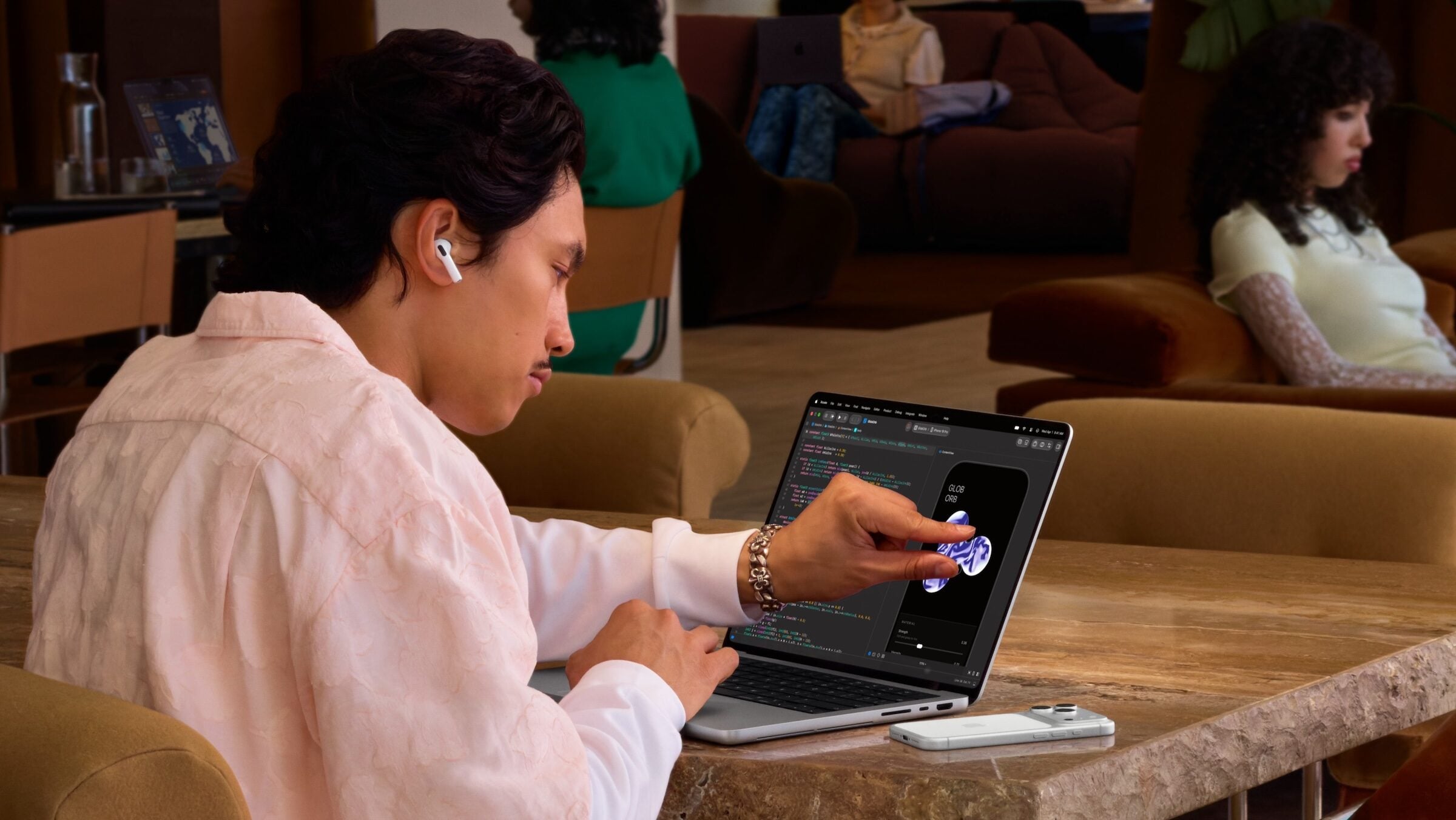
There is a limitation for German-speaking users. According to Apple, Spotlight only appears in Dynamic Island if Siri AI is available and enabled, and Siri AI does not yet run in German on Macs. Therefore, Dynamic Island will not use this feature for the time being if German is the system language.
Weight and Dimensions
The new case is lighter, flatter, and has a smaller footprint in both sizes:
| 14-inch Mini-LED | 14-inch PROLED XDR | 16-inch Mini-LED | 16-inch PROLED XDR | |
|---|---|---|---|---|
| Height | 1.55 cm | 1.50 cm | 1.68 cm | 1.60 cm |
| Width | 31.26 cm | 31.08 cm | 35.57 cm | 35.55 cm |
| Depth | 22.12 cm | 21.63 cm | 24.81 cm | 24.42 cm |
| Weight M5 Pro | 1.60 kg | 1.38 kg | 2.14 kg | 1.82 kg |
| Weight M5 Max | 1.62 kg | 1.40 kg | 2.15 kg | 1.84 kg |
| Diagonal | 14.2 inches | 14.2 inches | 16.2 inches | 16.3 inches |
The difference is most noticeable in the 16-inch model: at 1.82 kilograms, it weighs only about 200 grams more than the 14-inch model with mini-LED.
The two versions can also be distinguished from the back. On the MacBook Pro with PROLED XDR, the Apple logo on the lid lights up again – a detail that disappeared with the 2016 MacBook Pro redesign. The Mini-LED model retains its previous design with a non-illuminated logo.
Performance, storage and battery: no difference
In terms of performance, there's no difference between the two variants. Both use the same configurations of the M5 Pro and M5 Max, with identical memory bandwidth and the same RAM options up to 128 GB. The only difference is in storage: the M5 Max allows the OLED model to be ordered with up to 16 TB of SSD storage, while the Mini-LED model offers up to 8 TB.
According to Apple, the battery life is the same for both models. The 14-inch model with the M5 Pro achieves up to 22 hours of video streaming, while the 16-inch model achieves up to 24 hours. Neither model includes a power adapter; the recommended minimum wattage is specified in the MacBook power adapter guide.
The ports are identical: three Thunderbolt 5 ports, HDMI, SDXC, MagSafe 3, and a headphone jack, plus support for up to three external displays with the M5 Pro and up to four with the M5 Max. Apple only mentions Genlock for filming and video stabilization for the camera on the OLED model.
Prices in Germany, Austria and Switzerland
In Germany and Austria, both versions cost the same. The surcharge for PROLED XDR is €400 for the 14-inch model and €500 for the 16-inch model – regardless of the chip.
| Model | Mini-LED (DE/AT) | PROLED XDR (DE/AT) | Mini-LED (CH) | PROLED XDR (CH) |
|---|---|---|---|---|
| 14-inch, M5 Pro | from €2,899 | from €3,299 | from CHF 2299 | from CHF 2799 |
| 14 inch, M5 Max | from €4,799 | from €5,199 | from CHF 3899 | from CHF 4399 |
| 16-inch, M5 Pro | from €3,399 | from €3,899 | from CHF 2799 | from CHF 3299 |
| 16 inch, M5 Max | from €5,099 | from €5,599 | from CHF 4199 | from CHF 4699 |
In Switzerland, the surcharge for all four models is 500 francs.
For users upgrading from older MacBook Pro
Those who own a MacBook Pro with an M1 Pro, M2 Pro, M3 Pro, or M4 Pro face two separate questions. The performance jump to the M5 Pro or M5 Max is the same for all variants. The choice between Mini-LED and PROLED XDR does not change this.
The only new features for those switching from the OLED model are the additional ones: the display, the touch controls, and the lighter casing. Those satisfied with their current display and primarily using the device at a desk can get the same performance with the Mini-LED for 400 to 500 euros less.
For whom is the extra cost worthwhile?
I believe the PROLED XDR is the right choice if the display is an integral part of your work. Photographers working in Adobe RGB and anyone editing HDR footage will benefit significantly from the higher contrast and new reference modes. The model is also worthwhile for those who travel frequently – its lighter weight is another major advantage.
For everyone else, there's little to argue against Mini-LED. Performance, battery life, and ports are the same, and touch operation is new enough on the Mac that it doesn't yet require any particular workflow. Especially with the 14-inch model and M5 Pro, 400 euros is a lot of money for a display that's barely noticeable in many everyday situations. The Mac buying guide answers which Mac is right for you overall.
Would you spend an extra 400 euros for OLED, touchscreen, and a weight reduction of around 200 grams – or is the Mini-LED model still the more sensible MacBook Pro for you? Let us know in the comments when the extra cost would be worthwhile for you.
Frequently Asked Questions: MacBook Pro PROLED XDR vs. Mini-LED
No. Both variants are available with the same configurations as the M5 Pro and M5 Max, with the same memory bandwidth and the same RAM options. The performance is identical.
In Germany and Austria, the surcharge is €400 for the 14-inch model and €500 for the 16-inch model, both with the same chip. In Switzerland, the surcharge is CHF 500 for all models.
The 14-inch model with the M5 Pro weighs 1.38 kilograms instead of 1.60 kilograms, and the 16-inch model weighs 1.82 kilograms instead of 2.14 kilograms. Both are also thinner and have a slightly smaller footprint.
No, according to Apple, it's the same. The 14-inch model with M5 Pro achieves up to 22 hours of video streaming, the 16-inch model up to 24 hours, with both display variants.
No. Touch controls and Dynamic Island are only available on the MacBook Pro with a ProLED XDR display. The Mini-LED version retains the notch.
No, Apple offers both versions in parallel. The mini-LED display is also available in the new entry-level model with the M6 chip.
For image editing, PROLED XDR offers more: significantly higher contrast, up to 2000 nits peak brightness, and in addition to P3, the Adobe RGB color space with corresponding reference modes. The Mini-LED display only covers P3.