This article may contain affiliate links. Learn more on our Partner Program page.
The 14-inch MacBook Pro launches with the M6 chip – as the entry-level model, in the familiar enclosure. It features two additional cores, Wi-Fi 7 and Bluetooth 6, while the display and ports remain the same. In Germany, the starting price increases by €100.
On October 27th, Apple unveiled the 14-inch MacBook Pro with the M6 processor via a press release in its Newsroom. It replaces the entry-level model with the M5 and is the first MacBook Pro of the M6 generation. The complete specifications can be found on Apple's German MacBook Pro datasheet, which also lists the models with the M5 Pro and M5 Max.
The key points of the presentation are summarized in the news article about the MacBook Pro with M6. Here you'll find all the data, prices, and release dates for the entry-level model in one place, along with a comparison to what was expected. Further articles are compiled on the MacBook Pro page.
Key Facts at a Glance
- The MacBook Pro with M6 is only available in a 14-inch size and in one chip variant: 12-core CPU and 12-core GPU, each with two more cores than with M5.
- In Germany and Austria, it costs from €2,299, and in Switzerland from CHF 1,899. The M5 model was last priced at €2,199.
- New features include Wi-Fi 7 and Bluetooth 6. The display, ports, and battery life of up to 24 hours remain the same.
- The full memory bandwidth of 170 GB/s is only available with 24 GB of RAM or more.
- Pre-orders open from October 28th at 6:10 PM, available in stores from November 6th.
Equipment overview
| MacBook Pro 14″ with M6 | |
|---|---|
| CPU | 12 cores: 2 super cores, 4 performance cores, 6 efficiency cores |
| GPU | 12 cores with Neural Accelerators |
| Neural Engine | Dual 16-core |
| RAM | 16 GB (153 GB/s), optionally 24 or 32 GB (170 GB/s) |
| SSD | 1 TB, optionally 2 or 4 TB |
| Display | 14.2″ Liquid Retina XDR, 3024 × 1964 pixels, up to 120 Hz, nano texture optional |
| Connections | 3 × Thunderbolt 4, HDMI, SDXC, MagSafe 3, Headphone jack |
| External Displays | up to two |
| Wireless | WLAN 7, Bluetooth 6, Thread |
| Battery | 72.4 Wh, up to 24 hours of video streaming |
| Weight | 1.55 kg |
| Colours | Space Black, Silver |
| Price DE/AT | from €2,299 |
| Price CH | from 1899 CHF |
The M6 in the MacBook Pro
The MacBook Pro uses the M6 in its higher-performance version, the same one Apple uses in the 12-core iMac. There is no 10-core variant. The Mac line already knows this chip from the Mac mini with the M6 and M5 Pro; the differences between it and the previous generation are shown in the comparison of the M6 and M5.
Compared to the 14-inch model with the M5 processor, Apple claims up to 30 percent more graphics performance and up to 25 percent faster AI tasks on the device. In specific applications, the improvements range from 1.2 times faster for image editing in Affinity to 1.3 times faster for rendering in Blender, compiling in Xcode, and processing prompts for local language models. According to Apple, the Neural Engine alone is up to 1.9 times faster than in the M5.
The differences compared to the 13-inch MacBook Pro with M1 are significantly greater. Apple cites up to 2.5 times faster compilation in Xcode, up to 3.3 times faster image processing in Affinity, up to 11.7 times faster rendering in Blender, and up to 13 times faster first response for prompts with local language models.
RAM and SSD
The RAM starts at 16 GB and goes up to 32 GB, the SSD starts at 1 TB and goes up to 4 TB. According to the data sheet, the storage bandwidth depends on the configuration: with 16 GB it's 153 GB/s, the 170 GB/s mentioned in the press release is only available with 24 or 32 GB.
For office work, studying, and photo editing, 16 GB is sufficient. Those using local AI models or large projects benefit doubly from more memory – both in terms of quantity and bandwidth. A separate overview details how RAM requirements vary depending on the use case with Apple Silicon.
Display, camera and audio
The 14.2-inch display has a resolution of 3024 × 1964 pixels at 254 ppi. In XDR mode, it achieves a sustained brightness of 1,000 nits in full-screen mode and up to 1,600 nits peak brightness with HDR content, and up to 1,000 nits outdoors with SDR content. ProMotion adaptively controls the refresh rate up to 120 Hz, and the contrast ratio is 1,000,000:1. An optional display with a nanotexture is available to reduce reflections.
The 12 MP camera with Center Stage supports desktop view. It also features a six-speaker system with 3D audio and Dolby Atmos, as well as three studio-quality microphones.
Connections and external displays
The ports remain unchanged: three Thunderbolt 4 ports, HDMI, an SDXC card slot, MagSafe 3, and a 3.5 mm headphone jack with support for high-impedance headphones. Thunderbolt 5 remains exclusive to the M5 Pro and M5 Max models.
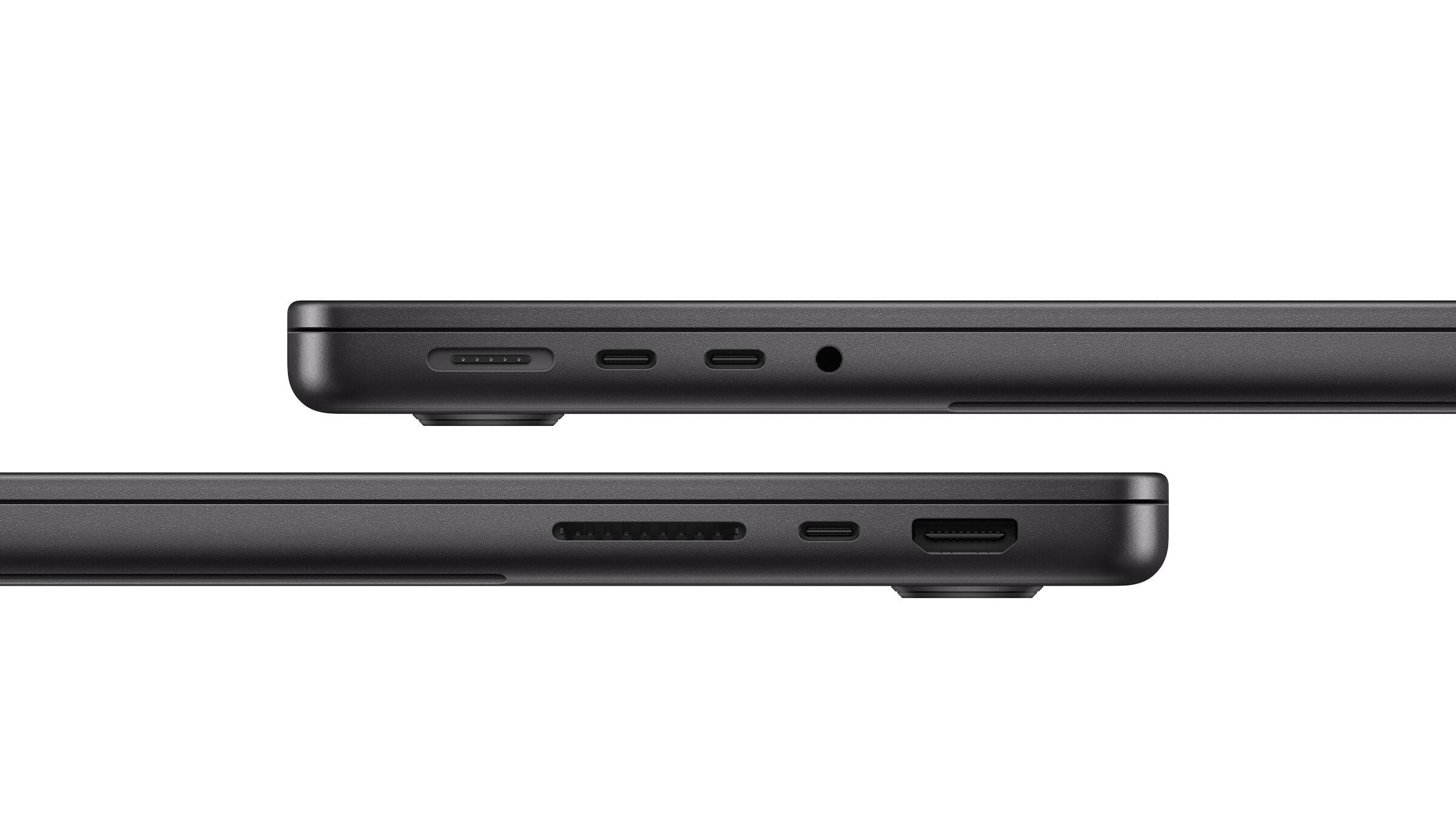
Two external displays can be connected, supporting up to 6K at 60Hz or 4K at 165Hz – via any combination of Thunderbolt and HDMI. Alternatively, the M6 can drive a single display at up to 8K at 60Hz, 5K at 120Hz, or 4K at 240Hz. The limitations of the other models are detailed in the overview of how many external displays a Mac supports.
WLAN 7, Bluetooth 6 and Thread
Wireless connectivity is provided by Apple's N1 chip with Wi-Fi 7 and Bluetooth 6, plus Thread for compatible smart home devices. The model with the M5 chip had Wi-Fi 6E and Bluetooth 5.3.
Battery, charging and power supply
The battery has a capacity of 72.4 watt-hours. Apple claims up to 24 hours of video streaming and up to 16 hours of wireless web browsing. The 24 hours is the same as the M5 model – Apple estimates this to be an improvement of up to four hours compared to the M1 model, and up to 14 hours more compared to Intel models.
A power adapter is not included; the box only contains a 2-meter USB-C to MagSafe 3 cable. Apple recommends at least 60 watts, while fast charging to 50 percent in 30 minutes is available starting at 96 watts. The wattage requirements of other models can be found in the overview of suitable MacBook power adapters.
Cases and colors
The case is 1.55 cm high, 31.26 cm wide, and 22.12 cm deep, and according to Apple, it is made from 100 percent recycled aluminum. At 1.55 kg, the M6 model is lighter than the 14-inch variants, the M5 Pro (1.60 kg) and M5 Max (1.62 kg). It is available in Space Black and Silver.
macOS 27 and Siri AI
The MacBook Pro ships with macOS 27 Golden Gate, which includes Siri AI. German is not yet among the supported languages – it was also missing from the latest language update for Siri AI. The other Apple Intelligence features work in German.
Prices, pre-order and market launch
The MacBook Pro with M6 can be ordered starting Wednesday, October 28th, at 6:10 PM German time, and will be available in stores from Friday, November 6th. Apple has announced 35 countries and regions for the launch, including Germany, Austria, and Switzerland.
| Price | |
|---|---|
| Germany and Austria | from €2,299 |
| Education sector Germany | from €2,179 |
| Switzerland | from 1899 CHF |
| For comparison: M5 model last (DE) | 2.199 € |
Both prices are for the same basic configuration with 16 GB and 1 TB. The M5 price is the last valid price after the June price adjustment.
From rumor to device
Since the summer, it had been rumored that the entry-level model would be released in the fall with the existing chassis and a standard M6 processor, while the new design would initially be reserved for the more expensive models. This has indeed been the case for the entry-level model. There are no more powerful versions of the M6; above that sits the MacBook Pro with the M5 Pro and M5 Max.
According to a report from July, the new design for the entry-level model is expected to follow with the M7 in the first half of 2027. This has not been confirmed. If the timeline holds true, the M6 model would be a short-lived generation at the top of the entry-level class.
Who is the MacBook Pro M6 intended for?
The MacBook Pro with M6 is aimed at those who want more performance, an XDR display, and more ports than the MacBook Air offers—for example, for photo editing, small-scale video editing, or software development. Those upgrading from a MacBook Pro with an M1 or an Intel model will see the biggest upgrade. Owners of an M5 model can skip this generation.
I consider the price premium the real drawback. For €100 more, you get two cores, Wi-Fi 7, and Bluetooth 6, but neither longer battery life nor Thunderbolt 5 – and if you want the full storage bandwidth, you'll have to add 24 GB. If you primarily need a portable Mac for office and study purposes, the MacBook Air is worth considering. Our Mac buying guide compares the models side-by-side.
Would you go for the 24GB RAM option on the MacBook Pro M6 to get the full memory bandwidth, or is the 16GB of the base configuration sufficient for you? Let us know in the comments which configuration you're planning to use.
Frequently Asked Questions: MacBook Pro M6
In Germany and Austria, it costs from €2,299 with 16 GB of RAM and a 1 TB SSD; in the education sector, it starts at €2,179. In Switzerland, the starting price is CHF 1,899.
Pre-orders open on October 28th at 6:10 PM, and it will be available in stores from Friday, November 6th. Germany, Austria, and Switzerland are among the 35 launch countries.
No, the MacBook Pro with the M6 processor is only available with a 14-inch display. Apple offers the 16-inch model exclusively with the M5 Pro and M5 Max processors.
No, the box only contains the USB-C to MagSafe 3 cable. Apple recommends at least 60 watts; fast charging to 50 percent in 30 minutes is available from 96 watts.
Not for most users. The improvements come in the form of two cores in both the CPU and GPU, Wi-Fi 7, and Bluetooth 6. Battery life, display, and ports remain the same. The upgrade is significantly more noticeable for those upgrading from a MacBook Pro with an M1 processor or an Intel model.
Up to two displays, each with up to 6K at 60 Hz, can be driven via any combination of Thunderbolt and HDMI. Alternatively, it can drive a single display with up to 8K at 60 Hz.
For office work, studying, and photo editing, yes. However, with 16 GB, the memory bandwidth is only 153 GB/s; the advertised 170 GB/s is only available with 24 GB or more. Therefore, more RAM is recommended for local AI models and large projects.