This article may contain affiliate links. Learn more on our Partner Program page.
The smallest desktop Mac is getting an update after almost two years – and Apple is packing two chip generations into the same case. The M6 promises up to four times the AI performance, while the M5 Pro adds up to 18 CPU cores. Pre-orders are available now, with shipping starting September 22nd.
Since October 2024, the Mac mini with the M4 and M4 Pro processors has remained unchanged in the lineup, while the notebooks had long since moved on to the M5 generation. Apple is now closing this gap with a combination that seems unusual at first glance: The base model jumps directly to the new M6, while the more powerful variant gets the M5 Pro. The details are in the announcement on the Apple Newsroom – and the explanation for this mix lies in Apple's own chip planning, in which the M6 Pro and M6 Max were dropped in favor of the M7 series.
Key Facts at a Glance
- The Mac mini comes with the new M6 in the base model and the M5 Pro as a more powerful variant.
- The M6 features a 12-core CPU and a 12-core GPU, each with two more cores than the M4.
- For the first time, the Mac mini features Neural Accelerators in every GPU core – Apple claims up to four times the AI performance compared to the M4.
- Both models will feature Wi-Fi 7, Bluetooth 6 and 2.5 Gb Ethernet, with 10 Gb as an option.
- Pre-orders start today, delivery begins on September 22nd.
What the M6 can do in its base model
The M6 features a 12-core CPU, two more cores than the M4. Apple claims it offers the fastest single-threaded performance in the world. The GPU also grows by two to 12 cores and, for the first time in the Mac mini, includes Neural Accelerators in each core – the processing units that handle AI tasks directly within the graphics unit.
This results in the key figures Apple is touting: up to four times the AI performance, twice the graphics speed, twice the memory speed, and 40 percent more CPU performance. All figures refer to a Mac mini with an M4 chip, 10-core CPU, 10-core GPU, 32 GB of RAM, and a 2 TB SSD. In addition, there's a new dual-16-core Neural Engine that outperforms its predecessor by up to a factor of two.
The RAM starts at 16 GB and can be configured to 32 GB, with a memory bandwidth of up to 170 GB/s. Apple claims up to 4.8 times the speed of the M4 when processing prompts in LM Studio, and 1.5 times faster when working with spreadsheets in Microsoft Excel.
The M5 Pro is aimed at large local models
The more powerful variant comes with up to 18 CPU cores and up to 20 GPU cores, plus an improved shader core and third-generation ray tracing. Neural Accelerators are also included in every GPU core.
The real difference lies in the storage: up to 64 GB with a bandwidth of 307 GB/s. This allows for significantly larger AI models to be run locally, complex 3D scenes to be edited, and ProRes RAW files to be cut. Apple claims 1.4 times the performance of the M4 Pro when rendering with ray tracing in Blender, and 1.5 times the performance of the M4 Pro when processing images in Affinity.
| Feature | Mac mini with M6 | Mac mini with M5 Pro |
|---|---|---|
| CPU | 12 cores | up to 18 cores |
| GPU | 12 cores | up to 20 cores |
| RAM | 16 GB, up to 32 GB | up to 64 GB |
| Memory bandwidth | up to 170 GB/s | 307 GB/s |
| Thunderbolt | 3 × Thunderbolt 4 | 3 × Thunderbolt 5 |
| Price (Germany) | from 1,049 euros | from 1,999 euros |
Ports: Thunderbolt 5 remains exclusive to the Pro version
Both models support Wi-Fi 7 and Bluetooth 6, and Ethernet speeds have been increased to 2.5 Gbps, with 10 Gbps being configurable. The front panel features two USB-C ports with USB 3.0 and a headphone jack that now also supports high-impedance headphones. The rear panel differs between the two models: the M6 has three Thunderbolt 4 ports, while the M5 Pro has three Thunderbolt 5 ports, along with HDMI and Ethernet ports in both.
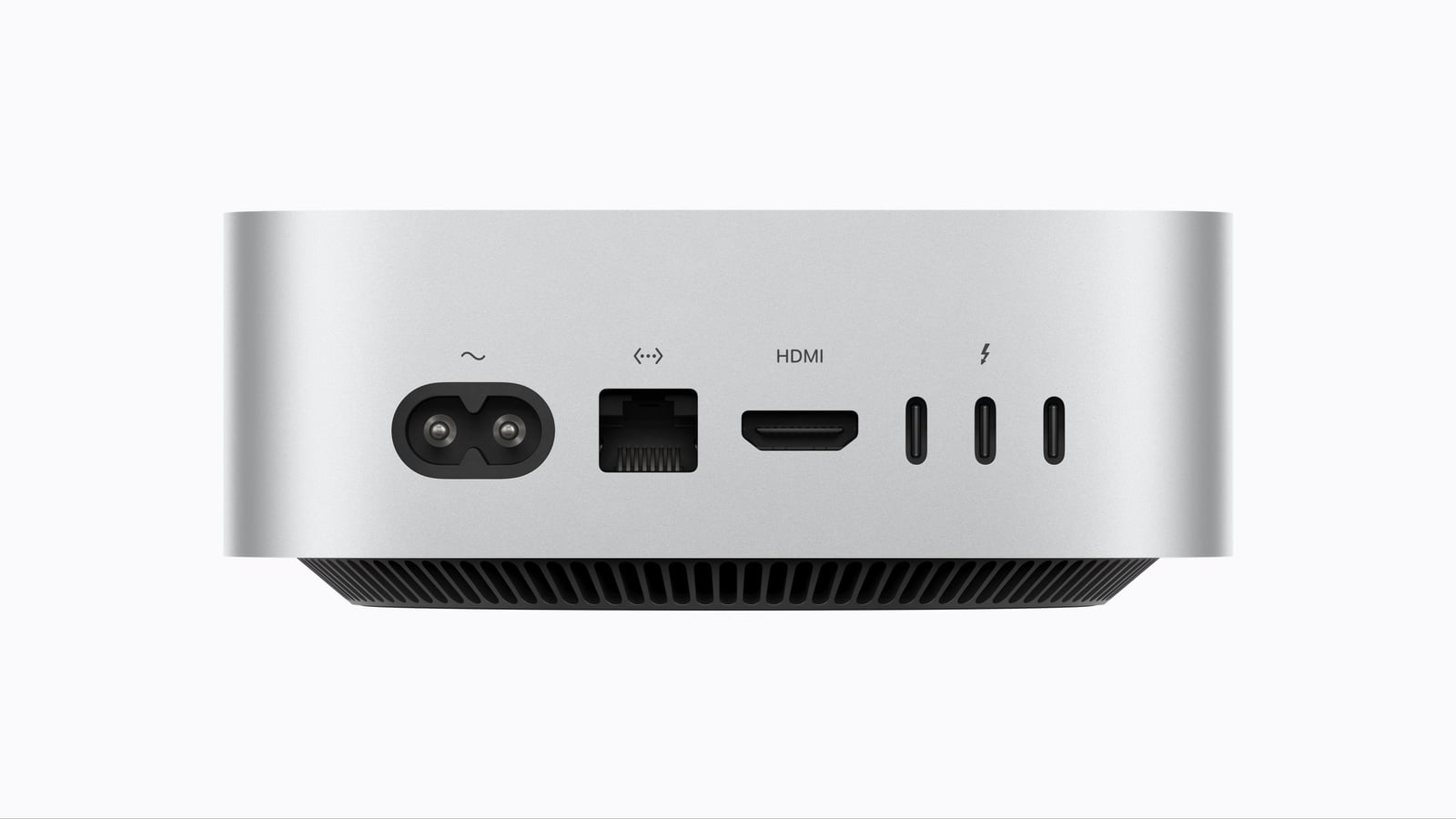
Thunderbolt 5 also allows multiple Mac minis to be linked together to run large AI models entirely locally. This perfectly aligns with the niche in which the device has already established itself – we've described why the compact enclosure has become the preferred machine for local models. Also new is Genlock over USB-C, which precisely synchronizes a display and camera, including an iPhone 17 Pro.
Siri AI is coming to the Mac – the hurdle is language
The Mac mini ships with macOS 27, whose feature set has been finalized since its unveiling in June. Siri AI is integrated into Spotlight and the system-wide context menus, accesses personal context in messages, emails, and photos, and can be queried about screen content via keyboard shortcuts.
For buyers in Germany, the crucial detail is a footnote: Siri AI will be released later this year as a beta with macOS 27, initially for devices set to English. Additional languages are expected to follow quickly. The limitation is therefore linguistic, not regional – unlike on the iPhone and iPad, where regulatory reasons are delaying the launch. Those using their Mac mini in German are thus waiting for language support, not for official release. Apple Intelligence itself already supports German.
Prices and availability
Pre-orders are available starting today in 30 countries and regions, with delivery to customers, Apple Stores and authorized dealers beginning on September 22.
In Germany, the Mac mini with M6 starts at €1,049, while the version with M5 Pro starts at €1,999. In the US, the starting prices are $899 and $1,699 respectively, with education customers paying $799 and $1,599.
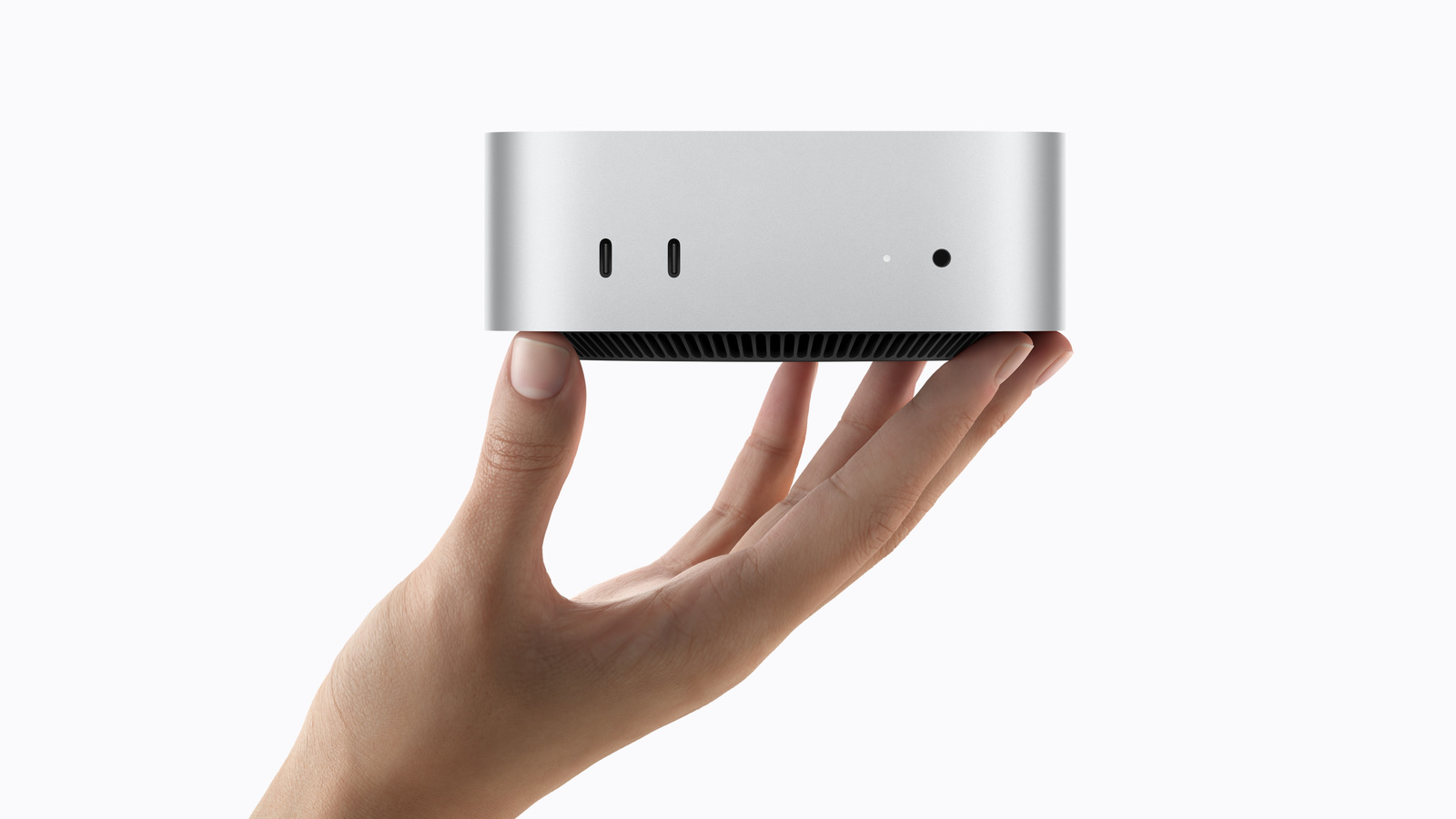
The casing remains unchanged, retaining the form factor introduced in 2024. Apple states that the Mac mini is made from 50 percent recycled material, including aluminum and 100 percent recycled rare earth elements in all magnets.
Why the unequal pairing had to happen exactly like this
A combination of two chip generations might seem like a compromise, but it's the logical consequence of a decision Apple made months ago: There simply isn't a Pro version of the M6 because the company discontinued development of the M6 Pro and M6 Max and shifted resources to the M7 series. The M5 Pro is therefore not the second-best choice, but the only available high-end option – the same setup Apple already used with the Mac Studio, featuring the M4 Max and M3 Ultra.
In practical terms, this means that the difference between the two models lies less in the chip generation than in storage capacity, bandwidth, and Thunderbolt version. Those who run large files locally or work with ProRes RAW will need the 64 GB of RAM and 307 GB/s bandwidth. For anything less, the M6 is the more modern chip. Our buying guide for the Mac mini, Mac Studio, and iMac shows where the boundaries lie with the larger desktops.
The small desktop becomes an AI tool
What's striking is how consistently Apple has geared the device towards continuous AI tasks: Neural Accelerators in every GPU core, a doubled Neural Engine, and clustering via Thunderbolt 5. Fittingly, the quote accompanying the launch didn't come from top management, but from chief developer Johny Srouji, whose rise to the top was through Apple's chip development department. The Mac mini is thus definitively no longer an affordable entry-level Mac, but a tool for people who need continuous computing power.
Is the 32GB M6 sufficient for you – or are you going straight for the 64GB M5 Pro because you're using local models? Let us know your configuration in the comments.
- Apple HomePad: Camera should automatically switch profiles
- Hide email address: Apple scraps domain switching
- iOS 27 Beta 7: The home stretch before release