This article may contain affiliate links. Learn more on our Partner Program page.
The iMac jumps directly from the M4 to the M6 – and the price in Germany remains unchanged. Both models get two more cores, Wi-Fi 7, and 2.5 Gigabit Ethernet. What remains unchanged is at least as revealing: the case and display are untouched, and the colors retain their original names.
On October 27th, Apple unveiled the new iMac via press release in its newsroom. The M5 was long considered the next chip for the all-in-one, but Apple ultimately skipped a generation. The complete specifications of both models can be found on Apple's German iMac datasheet, and prices are available in the German Apple Store.
The core of the announcement – two more cores for the same price – is summarized in the article about the iMac with M6. Here you'll find all the data, prices, and release dates for the device in one place, along with a comparison to what was expected in the months leading up to the launch. Further articles about the device are compiled on the iMac page.
Key Facts at a Glance
- Two models: M6 with 10-core CPU and GPU (two Thunderbolt ports) and M6 with 12-core CPU and GPU (four ports).
- In Germany and Austria they cost 1,799 and 1,999 euros, in Switzerland 1,499 and 1,699 francs.
- New features include WLAN 7, Bluetooth 6 and 2.5 Gigabit Ethernet – standard on the 12-core model, optional on the 10-core model.
- Pre-orders open from October 28th at 6:10 PM, available in stores from November 6th.
- The casing and 24-inch display remain the same as the M4, and the seven colors have the same names.
The two models at a glance
Apple continues to differentiate its models based on the number of ports. Anyone wanting more storage, a second external display, or nanotexture glass will inevitably end up with the larger model.
| M6 with 10-core CPU | M6 with 12-core CPU | |
|---|---|---|
| CPU | 2 Super cores, 3 Performance cores, 5 Efficiency cores | 2 Super cores, 4 Performance cores, 6 Efficiency cores |
| GPU | 10 cores | 12 cores |
| RAM | 16 GB, optional 24 GB | 16 GB, optionally 24 or 32 GB |
| SSD | 256 GB, optionally 512 GB or 1 TB | 256 GB, optionally up to 2 TB |
| Connections | 2 × Thunderbolt / USB 4 | 4 × Thunderbolt 4 |
| External Displays | one | up to two |
| Ethernet | optional 2.5 Gbit | 2.5 Gbit as standard |
| Nanotextured glass | – | optional |
| Keyboard | Magic Keyboard, Touch ID optional | Magic Keyboard with Touch ID |
| Weight | 4.42 kg | 4.44 kg |
| Price DE/AT | 1.799 € | 1.999 € |
| Price CH | 1499 CHF | 1699 CHF |
The M6 in the iMac
Both configurations feature a dual 16-core Neural Engine, Neural Accelerators in each graphics core, hardware ray tracing, and a memory bandwidth of up to 170 GB/s. The desktop line already knows the M6: it has been used in the Mac mini M6 and M5 Pro since August.
Apple compares the M6 to the M4 in several ways, each measuring something different. In Excel, the iMac is said to be up to 1.5 times faster, and up to twice as fast in image editing with Affinity and in games with ray tracing. For processing prompts in LM Studio, Apple claims up to five times the speed – the Neural Engine alone, according to Apple, calculates up to twice as fast, with the GPU's Neural Accelerators and the higher memory bandwidth contributing the rest.
The performance gaps compared to older devices are even greater. Apple claims up to 2.5 times faster Excel performance and up to 3.3 times faster graphics compared to the iMac with the M1 processor, and up to 18 times more performance compared to the best-selling iMac with an Intel processor. The comparison of the M6 and M5 chips reveals the detailed differences between the two chip generations.
Display, camera and audio
Apple hasn't changed anything about the casing. The 24-inch display has a resolution of 4480 × 2520 pixels at 218 ppi, reaches 500 nits, covers the P3 color gamut, and supports True Tone. The actual diagonal measurement is 23.5 inches. Nano-texture glass remains available only for the 12-core model.
The 12 MP camera with Center Stage supports desktop view, and the six-speaker system and the three-microphone array remain unchanged. The dimensions are 54.7 × 46.1 cm, and the stand is 13 cm deep.
Ports, Ethernet and external displays
The 10-core model has two Thunderbolt/USB 4 ports and can drive one external display at up to 6K at 60Hz or 4K at 165Hz. The 12-core model has four Thunderbolt 4 ports and can drive two displays at up to 6K – or a single display at 8K at 60Hz, 5K at 120Hz, or 4K at 240Hz. For information on the limitations of other models, see the overview of how many external displays a Mac supports.
Ethernet speeds have been upgraded from Gigabit to 2.5 Gbit. The 12-core model comes standard with this port, while the 10-core model offers it as an optional add-on in the configurator. Both models feature a 3.5 mm headphone jack with support for high-impedance headphones and include a 143 W power supply.
RAM and SSD
Both models start with 16 GB of RAM and a 256 GB SSD. The 10-core model tops out at 24 GB and 1 TB, while the 12-core model offers 32 GB and 2 TB. According to Apple, the SSD reads and writes up to twice as fast as its predecessor.
How much storage is useful depends primarily on the applications. 16 GB is sufficient for office work, photos, and streaming; those who want to use local AI models should plan for more – the RAM requirements of Apple Silicon vary considerably depending on the use case.
WLAN 7, Bluetooth 6 and Thread
Apple's N1 chip handles wireless connectivity, offering Wi-Fi 7 and Bluetooth 6, as well as Thread for controlling compatible smart home devices. The M4 iMac only had Wi-Fi 6E and Bluetooth 5.3.
Colors and accessories
Apple offers seven colors for both models, with the same names as the M4: blue, purple, pink, orange, yellow, green, and silver. The keyboard and mouse are color-coordinated, as before, and charge via USB-C.
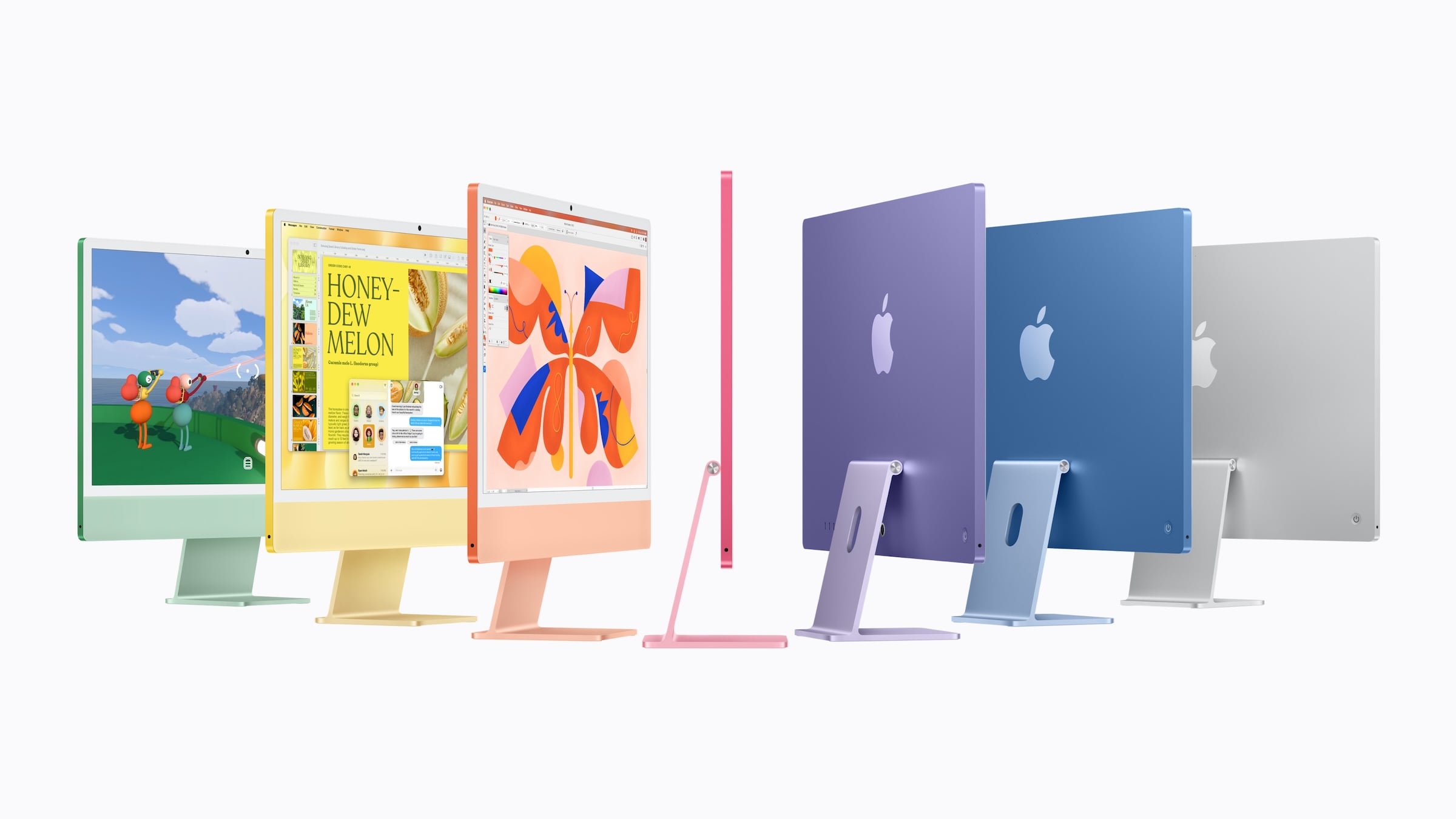
The 12-core model comes with the Magic Keyboard with Touch ID, while the 10-core model includes the Magic Keyboard without a sensor. Touch ID can be added to the 10-core model in the configurator, and both models also offer the option of adding a keyboard with a numeric keypad and the Magic Trackpad. For wall or swivel arm mounting, Apple offers an iMac with an integrated VESA adapter.
macOS 27 and Siri AI
The iMac ships with macOS 27 Golden Gate, which includes Siri AI. German is not yet among the supported languages – it was also missing from the latest language update for Siri AI. However, the other Apple Intelligence features do work in German.
Prices, pre-order and market launch
The iMac can be ordered from Wednesday, October 28th, at 6:10 PM German time, and will be available in stores from Friday, November 6th. Apple has announced 35 countries and regions for the launch, including Germany, Austria, and Switzerland.
| Model | Germany | Education Germany | Switzerland |
|---|---|---|---|
| M6 with 10-core CPU | 1.799 € | 1.739 € | 1499 CHF |
| M6 with 12-core CPU | 1.999 € | 1.879 € | 1699 CHF |
In Austria, the same Euro prices apply as in Germany. The M4 iMac was recently priced at €1,799 and €1,999, respectively, with 16 GB and 256 GB of RAM – the two additional cores come at no extra cost. This is not a given after the price hike in June, which increased the iMac's price.
From rumor to device
For much of the year, rumors circulated about an iMac with an M5 processor, including the discovery of code suggesting a possible iMac with an M5 Max, which was interpreted as a comeback for the iMac Pro. Neither materialized: Apple skipped the M5 generation for the iMac, and there is no larger model.
In August, a report mentioned new colors and a market launch by the end of the year for the iMac with the M6 chip. The timeframe was correct, but the color palette was not – Apple is using the same seven names as for the M4. However, the switch to the N1 chip with Wi-Fi 7 and Bluetooth 6 did occur.
Rumors about an iMac with an OLED display concern a later generation. The M6 model will retain the familiar Retina display.
Who is the iMac M6 intended for?
The iMac remains the go-to computer for anyone who wants a screen, speakers, camera, keyboard, and mouse all in one – for the home office, family use, or business. Those still using an iMac with an M1 or Intel processor will now get the biggest upgrade for the same price as before. However, those who already own an M4 iMac can safely skip this generation.
I think the 12-core model is the more sensible choice. Touch ID, four ports, built-in Ethernet, and the option of nanotexture glass justify the €200 price difference more than the two extra cores. If you already have a monitor, keyboard, and mouse, you'll be better off with a Mac mini – the Mac buying guide compares both options.
Would you opt for the 10-core iMac M6 or spend an extra 200 euros for Touch ID, four ports, and Ethernet? Tell us in the comments which model you'd choose.
Frequently Asked Questions: iMac M6
In Germany and Austria, the model with a 10-core CPU costs €1,799, and the model with a 12-core CPU costs €1,999, both with 16 GB of RAM and a 256 GB SSD. In Switzerland, the prices are CHF 1,499 and CHF 1,699, respectively. Apple lists the prices for the education sector at €1,739 and €1,879.
Pre-orders open on October 28th at 6:10 PM, and it will be available in stores from Friday, November 6th. Germany, Austria, and Switzerland are among the 35 launch countries.
The 12-core model has two more cores in both the CPU and GPU, four Thunderbolt ports instead of two, 2.5 Gb Ethernet, and Touch ID as standard. It also supports two external displays and offers up to 32 GB of RAM, a 2 TB SSD, and nanotexture glass as options.
For most users, probably not. The case and display are the same; the improvements are two cores, Wi-Fi 7, Bluetooth 6, and faster Ethernet. The leap is significantly greater for anyone still using an iMac with an M1 or Intel processor.
Both models are available in blue, violet, pink, orange, yellow, green and silver – the same seven color names as the M4. The keyboard and mouse are color-coordinated.
The 10-core model drives an external display with up to 6K resolution at 60 Hz. The 12-core model can drive two displays with up to 6K resolution or a single display with up to 8K resolution at 60 Hz.
Yes, with 2.5 Gbit instead of the previous Gigabit. It's standard equipment on the 12-core model, and can be added to the 10-core model via the configurator.