
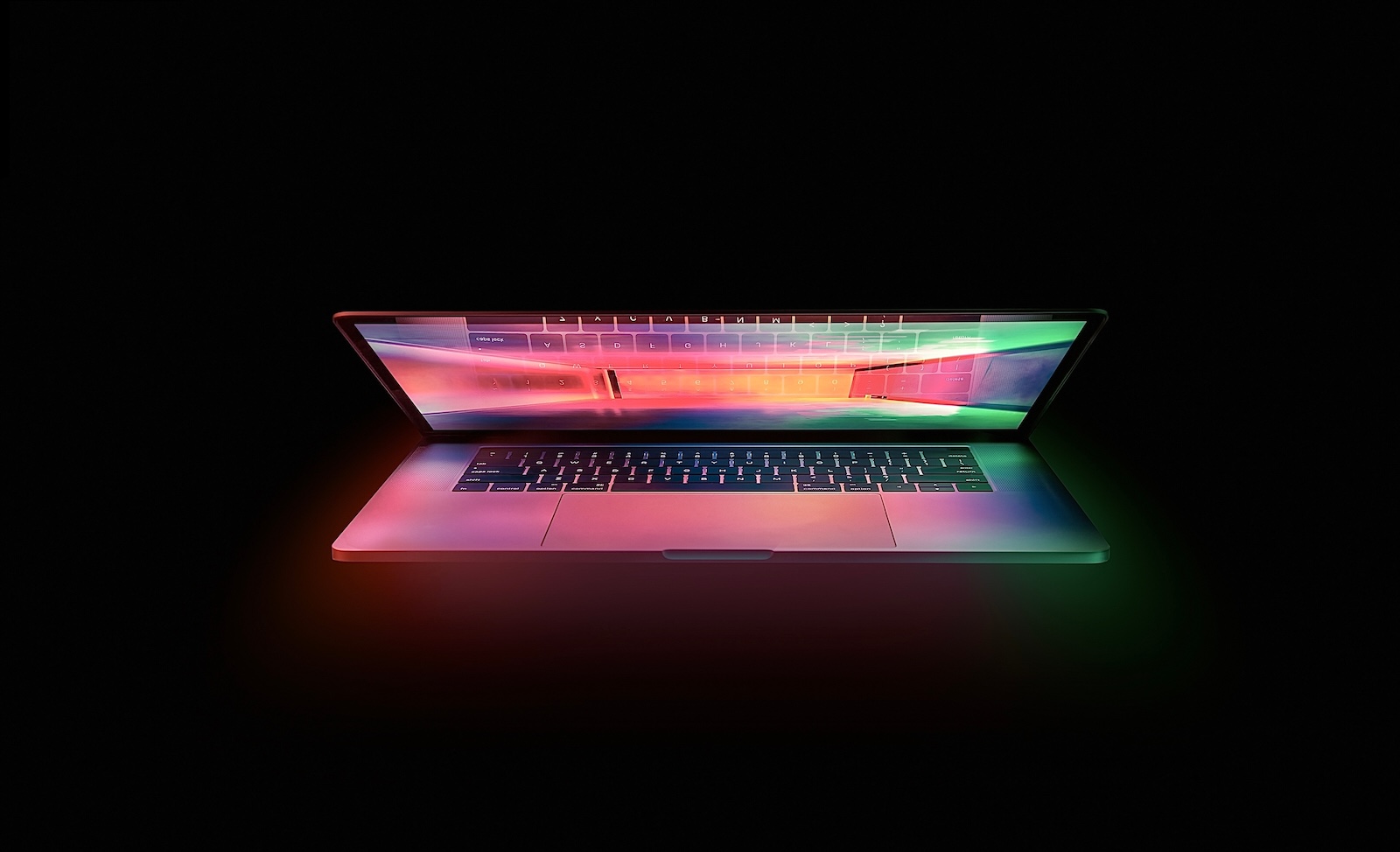
Apple is apparently planning a completely new MacBook class above the MacBook Pro. The so-called MacBook Ultra is expected to be the first MacBook with an OLED display and touchscreen – a device unlike any other. Estimates for the likely market launch now vary: from as early as fall 2026 to early 2027.
The MacBook Pro was last updated in March 2026 with the M5 Pro and M5 Max chips. Externally, little has changed since the 2021 redesign. Meanwhile, according to Bloomberg reporter Mark Gurman, Apple is working on a completely new laptop that isn't meant to replace the MacBook Pro, but rather to surpass it. Gurman calls the device "MacBook Ultra"—a name that would fit with the existing Ultra branding of Apple Watch Ultra, CarPlay Ultra, and the M Ultra chips. This hasn't been confirmed; Gurman himself believes it's possible Apple will stick with the traditional Pro designation, but considers the Ultra name more likely. The fact that Apple might expand two product lines with such a new tier was already hinted at when... The iPhone Ultra and MacBook Ultra first appeared together.
One thing is certain: this MacBook will be fundamentally different from all previous Macs. The current division is between MacBook Air and MacBook Pro, and within the Pro line between 14-inch and 16-inch models – both decisions based on performance and form factor, not display technology. The MacBook Ultra would be the first to occupy a higher position.
Key Facts at a Glance
| Detail | Expectation |
|---|---|
| Product | New top-tier MacBook above the MacBook Pro |
| Name | “MacBook Ultra” (not confirmed) |
| Display | Tandem OLED with oxide TFT, first-ever touchscreen |
| Panel supplier | Samsung Display exclusive, manufactured in Asan (South Korea) |
| Chip | M5 Pro and M5 Max instead of the previously expected M6 generation |
| Design | Thinner, lighter, Dynamic Island instead of Notch |
| 5G | Possible, via Apple's C2 modem |
| Release | Autumn 2026 or early 2027 (forecasts differ) |
| Price | Significantly more expensive than the MacBook Pro, estimated to start at around 3,000 euros. |
Positioning: Four MacBook lines
With the MacBook Ultra, Apple would be offering four MacBook tiers for the first time:
| Model | Starting price | Target group |
|---|---|---|
| MacBook Neo | 799 € | Beginners, students |
| MacBook Air | from €1,399 | Everyday life, mobile use |
| MacBook Pro | from €2,199 | Professionals, creatives |
| MacBook Ultra | from around €3,000 (estimated) | High-end professionals, creatives |
The prices mentioned have been in effect since the June 2026 pricing round, in which Apple raised prices for Macs, iPads, and the Vision Pro. The MacBook Pro with M5 Pro and M5 Max remains available for purchase. The Ultra does not replace it, but rather complements it – similar to how the Apple Watch Ultra exists alongside the Series.
Gurman believes it's possible that Apple is deliberately introducing the OLED model as an additional high-end variant. Such a division would have two advantages: It would spread demand across two price segments, thus easing the strain on component supplies. At the same time, higher margins could be achieved without further increasing the entry-level price of the MacBook Pro.
Display: OLED and touchscreen
First OLED in a MacBook
The MacBook Ultra is expected to use a tandem OLED display—the same technology Apple introduced in the iPad Pro in 2024. Two layered OLED panels provide extreme brightness, deep blacks, and a 2,000,000:1 contrast ratio. Current MacBook Pros, in contrast, use Mini-LED (Liquid Retina XDR). The switch offers better color accuracy, a thinner design, and improved energy efficiency - at a higher price.
Samsung Display has now got the manufacturing process so well under control that the yield remains consistently above 90 percent; Individual process steps even reach 95 percent efficiency. Within the industry, this range is considered the "golden yield" and marks the threshold at which economically viable mass production becomes possible.
Production takes place on the 8.6-inch line at the Asan site in the South Korean province of Chungcheongnam-do. Designated A6, the line was converted from a decommissioned LCD production facility and processes base glass measuring 2290 × 2620 millimeters, while the sixth generation, used for smartphone panels, only requires 1500 × 1850 millimeters. This allows significantly more notebook-sized screens to be cut from a single sheet of glass, reducing waste and consequently the unit cost – precisely the point where OLED technology in laptops has thus far failed. The design combines two emission layers with oxide transistors, which are more energy-efficient than the previously common LTPS technology. Lower unit costs for large panels are also the reason why this model could usher in the OLED revolution for the entire laptop industry.
Reports on the production start date differ. An industry report from early summer indicated July as the start of panel deliveries, with approximately two million units planned for the current year, distributed between 14- and 16-inch variants. According to the same report, the diagonal sizes could also be slightly larger at 14.3 and 16.3 inches, presumably due to narrower bezels. A more recent report from Korea, however, places the start of mass production around August and estimates the initial shipment at approximately 250,000 panels – a conservative figure that suggests a staggered market launch rather than widespread availability from day one.
Only one supplier for the panel
The touch OLEDs for both screen sizes will reportedly come exclusively from Samsung Display. LG Display and BOE were not shortlisted due to yield issues, according to the supply chain. Back in June, the field of OLED suppliers for Apple had already narrowed down to Samsung and LG – leaving only one of these names for the flagship model.
This concentration has a downside: Without a second source of supply, any disruption in Asan would immediately impact the market launch. However, some leeway remains, as Samsung is currently operating one of two Gen 8.6 lines; the second could be activated if needed, doubling capacity. Most importantly, a later market launch would not be due to the displays – the display side is ready for production.
First touchscreen in a Mac
The MacBook Ultra would be the first Mac with touchscreen support. Apple has insisted for years that touchscreens don't belong on laptops – this stance has changed. Reports indicate that Apple is working on a reinforced hinge design to minimize wobbling when typing on the display.
The degree to which touch functionality is now considered certain is demonstrated by an unusually clear statement from the supply chain: Instant Digital, a leaker known for his accurate predictions, declared on Weibo that it is 100 percent confirmed that the MacBook display supports touch input. Such an absolute statement is rare even for leakers and is likely based on concrete evidence from manufacturing. While official confirmation from Cupertino is still pending, the evidence is mounting: The fact that a supplier is starting production of touch-sensitive panels suggests that development is at an advanced stage.
macOS 27 is expected to bring system-wide touch support. When you touch an element on the screen, the interface dynamically adapts and displays larger, touch-optimized controls. Pinch-to-zoom and faster scrolling will also be supported. The notch disappears, replaced by a Dynamic Island, similar to the one found on the iPhone. This creates more screen space and enables context-sensitive displays directly on the screen.
Three tracks in macOS 27
Beyond general touch support, macOS 27 „Golden Gate” several smaller functions that function as Preparing for new hardware Let's read. First, Sidecar—the feature that uses an iPad as a second Mac screen—now allows direct touch input: macOS elements can be tapped and operated with a finger. Second, the pull-to-refresh gesture familiar from the iPhone comes to the Mac; a swipe refreshes content in apps like Safari, Mail, News, Podcasts, and Calendar—on a touch display, the same gesture would be a natural fit directly on the screen. Third, the new Siri-powered "Search or Ask" feature in Spotlight appears as a dark, pill-shaped surface, which would be fitting for a display with Dynamic Island.
Individually, these are minor details, but taken together, the three clues point in the same direction. macOS 27 is currently available as a developer beta; the final version is expected in September.
Chip: surprisingly M5 Pro and M5 Max
There has recently been a surprising turn of events regarding the chip. For a long time, the OLED MacBook was considered the device that would usher in Apple's next generation of chips – with an M6 Pro or M6 Max. A recent report, however, reverses this expectation: The top-of-the-line model is said to be released with the already familiar M5 Pro and M5 Max chips.
The reason lies in a change to Apple's Mac roadmap. According to this plan, Apple will release the M6 this year only as a base chip for the entry-level segment, discontinuing the M6 Pro and M6 Max and postponing the next high-performance models to the M7 series. The freed-up development resources will be invested in accelerating the AI performance of the next generation. An M6 Pro or M6 Max simply no longer exists in this plan. Therefore, for the flagship model, Apple will initially stick with its existing high-end chips, which are still manufactured using the 3-nanometer process.
The older classification persists, however: Even the Korean display report from the end of July lists the M6 Pro and M6 Max as the power source for the top model. This report is based on the display supply chain and contributes nothing new regarding the chips, which suggests it's more likely to be outdated information than a new finding.
This results in a paradoxical situation: The separate, more affordable entry-level MacBook Pro with the regular M6 – without OLED and without a touchscreen – would be Apple's first Mac built on the more modern 2-nanometer process, while the significantly more expensive top-of-the-line OLED model uses the older 3-nm chips of the M5 generation. Apple is therefore launching a completely redesigned premium MacBook that runs on the same chip level as the current MacBook Pro.
Apple is expected to close the gap between design leaps and chip stagnation with the successor: This is slated to launch with the upcoming M7 Pro and M7 Max chips, is reportedly in an advanced testing phase, and is not expected before the end of 2027. The M7 series is specifically designed for AI tasks – with improved neural accelerators, a more powerful graphics unit, and higher memory bandwidth. Apple's Mac roadmap, which includes eleven new models by 2028, demonstrates just how closely the models are now being planned.
Design: Thinner, lighter, new casing
The MacBook Ultra is expected to be the first complete redesign of the MacBook Pro since 2021:
- Thinner casing, inspired by the M4 iPad Pro
- Lighter, without compromising on ports or battery
- Dynamic Island instead of Notch
- The 14-inch and 16-inch models will remain; internally, the two variants are codenamed K114 and K116.
- Narrower display bezels thanks to flexible OLED panels
According to reports, Apple has developed a reinforced hinge technology to keep the touchscreen stable. The casing remains a classic clamshell design – not a convertible, not a hybrid.
5G connectivity
The MacBook Ultra could be the first Mac with cellular connectivity. Apple introduced its first proprietary cellular modem (C1) in the iPhone 16e and the C1X in the iPhone Air. The MacBook Ultra is expected to use the C2 modem – the same chip rumored to be used in the iPhone 18 Pro.
This would make 5G internet access directly on the MacBook possible for the first time, without a hotspot or tethering. However, it's not certain whether 5G will actually be included in the MacBook Ultra or postponed to later models.
Release: Autumn 2026 or early 2027?
The greatest uncertainty lies in the market launch. Gurman had originally projected a launch for the second half of 2026, with a likely announcement in October or November 2026. In April 2026, he revised his forecast, now considering early 2027 more probable – although late 2026 remains the optimistic end of his timeframe and is therefore not off the table. An industry report by the market research firm Omdia has reopened the discussion, even suggesting a launch in the third quarter of 2026 is possible. Both scenarios are plausible – each for different reasons.
What speaks in favor of a start in autumn 2026?
- The displays are ready. The yield is over 90 percent, and mass production is scheduled to start in the summer. A later start would therefore not be due to the displays themselves.
- Autumn is Apple's classic MacBook Pro launch window. Major new releases traditionally arrive towards the end of the year – the M1 Pro and Max were released in October 2021, the M3 series in late October 2023, the M4 series in late October 2024, and the M5 in October 2025. A market launch in October or November 2026 would be in line with the usual pattern, while a purely September release would be unusual.
- The new Ultra line could alleviate the shortage. As an additional, higher-priced tier, the OLED model spreads demand across two price segments – thus relieving pressure on the limited supply of components.
- Two Mac generations per year are nothing new. The fact that the M5 Pro and M5 Max models were only released in March 2026 doesn't rule out another high-end Mac in the same year. Apple demonstrated this in 2023: Back then, the MacBook Pro with M2 Pro and M2 Max arrived in January, and the models with M3, M3 Pro, and M3 Max in October – two generations within a single calendar year, and all within the same product line. With the MacBook Ultra, the second release would even be in its own, higher class.
What speaks in favor of early 2027
- The global memory chip crisis. The shortages of RAM and SSD storage are affecting not only desktop Macs but also Apple's premium notebooks. Gurman cites precisely this delay caused by the memory shortage as the main reason for his correction – even Apple, with its long-term supply contracts, cannot escape the global scarcity.
- A single panel supplier. Samsung is supplying the touch OLEDs without a second source. If mass production only starts in August with around 250,000 panels, there will be little buffer for sufficient quantities to support a global market launch before an autumn release date.
- Gurman's assessment carries significant weight. As the most reliable voice on Apple products to date, he still considers early 2027 more likely than late 2026 – even in his most recent reports.
- September doesn't fit with Mac logic. Omdia's Q3 release window would mathematically mean September – traditionally the month for iPhones and Apple Watches. A brand-new high-end notebook in this already crowded window would be unusual, which is why several observers are skeptical of the early date.
One detail unites both sides: software is not the bottleneck. The adjustments for the new touchscreen in macOS 27 are still scheduled for completion in fall 2026. However, the notebook can only be shipped once sufficient components are available – and that's precisely what will determine whether it's fall 2026 or early 2027.
Price: Premium is getting more expensive
When Apple introduced OLED displays in the iPhone X (2017) and the iPad Pro (2024), they each raised prices by around 20 percent. A similar price increase for the MacBook Ultra is likely – especially since a tandem OLED display with an additional touch layer is more expensive to manufacture than a mini-LED screen.
The current lineup serves as a starting point: The 14-inch MacBook Pro has started at €2,199 since the June price update, and the 16-inch model at €3,399. A 20 percent increase over the 14-inch model translates to roughly €2,600. Since the MacBook Ultra is positioned as a separate tier above the Pro series, a starting price between €3,000 and €3,500 seems more realistic; top configurations are likely to cost well over €5,000. Confirmed prices are not yet available, and the price range depends directly on how storage prices develop before the market launch.
Who is the MacBook Ultra intended for?
The MacBook Ultra isn't an upgrade for everyone, but rather a product for users who want the absolute best technology and are willing to pay for it. HDR video editing on an OLED panel, direct touch interaction on the screen, and cellular connectivity without having to use an iPhone – that's the target audience.
Anyone who recently purchased a MacBook Pro with an M5 Pro or M5 Max processor has nothing to worry about: these devices will remain available and are more than sufficient for the vast majority of professional workflows. Since the top-of-the-line model is expected to use the same chip generation, the difference will lie in the display and the casing, not in the processing power.
If you're already waiting for a new high-end MacBook and have the budget, it's worth looking at the coming months: Depending on the scenario, the MacBook Ultra will be released in autumn 2026 or early 2027. This timeframe is manageable – and if Apple takes more time, there should be enough stock available at launch to meet demand. For buyers in Germany, Austria, and Switzerland, the price remains the biggest question: The OLED surcharge is compounded by a price increase that has already taken place, and both add up to the first MacBook, which could break the €3,000 mark even at the entry level. (Image: Shutterstock / akay007)
- iPhone and Satellite Features: These Countries Are Included
- Apfelpatient Weekly #16
- Apple Glasses: All the rumors at a glance
- Apple Watch Ultra 4: All the rumors at a glance
- Apple Watch Series 12: All the rumors at a glance
- iCloud in iOS 27: All new features at a glance
- iPhone 20: All the rumors about the anniversary model
- iPhone Ultra (iPhone Fold): All rumors and facts at a glance
- Apfelpatient Weekly #15
- Apple Music vs. Spotify: Which streaming Service is worth it?
- iPhone Ultra (iPhone Fold): All rumors and facts at a glance
- iPad mini 8: All the rumors at a glance