
This article may contain affiliate links. Learn more on our Partner Program page.
Two more cores, Wi-Fi 7, and a dual Neural Engine – for this, Apple is charging €100 more in Germany than for the previous M5 model. The casing, display, battery, and ports remain unchanged. The comparison shows where the price increase actually goes and where the M6 even offers less than its predecessor.
Apple unveiled the 14-inch MacBook Pro with the M6 processor via press release on October 27th. Pre-orders in Germany began on October 28th at 6:10 PM, and it will be available in stores starting November 6th. Apple has removed the M5 model, originally slated for release in October 2025, from its online store; the 14-inch model is now only available with the M6, M5 Pro, and M5 Max processors.
The M6 thus replaces only the entry-level model of the MacBook Pro, and it costs 100 euros more than the M5 did most recently. This comparison is based on the technical specifications of the MacBook Pro and Apple's support data sheet for the MacBook Pro with M5. All prices, dates, and configuration options for the new model are collected in the MacBook Pro M6 overview.
Key Facts at a Glance
- The M6 has 12 CPU and GPU cores instead of 10, but only two instead of four super cores.
- New features include the dual 16-core Neural Engine, WLAN 7, Bluetooth 6 and Thread; with 24 or 32 GB, the memory bandwidth increases from 153 to 170 GB/s.
- The casing, weight, display, battery, ports and the two colors are identical.
- In Germany, the M6 costs from 2,299 euros, the M5 most recently 2,199 euros – the surcharge applies across all storage levels.
- For owners of an M5, the switch is not worthwhile, but for those switching from M1 or Intel, it is.
All differences at a glance
| MacBook Pro M5 | MacBook Pro M6 | |
|---|---|---|
| CPU | 10 cores (4 Super, 6 Efficiency) | 12 cores (2 Super, 4 Performance, 6 Efficiency) |
| GPU | 10 cores with Neural Accelerators | 12 cores with Neural Accelerators |
| Neural Engine | 16 cores | Dual 16 cores |
| Memory bandwidth | 153 GB/s | 153 GB/s (16 GB), 170 GB/s (24 and 32 GB) |
| RAM | 16, 24 or 32GB | 16, 24 or 32GB |
| SSD in Germany | 1, 2 or 4 TB | 1, 2 or 4 TB |
| Wireless | WLAN 6E, Bluetooth 5.3 | WLAN 7, Bluetooth 6, Thread |
| External Displays | 2.4K up to 144 Hz | 2.4K up to 165 Hz |
| Battery | 72.4 Wh, up to 24 hours of video | 72.4 Wh, up to 24 hours of video |
| Weight | 1.55 kg | 1.55 kg |
| Price DE (16 GB, 1 TB) | €2,199 (last price) | 2.299 € |
Chip: more cores, fewer super-cores
Apple has reconfigured the CPU in the M6. The M5 had four supercores and six efficiency cores, while the M6 has two supercores, four performance cores, and six efficiency cores. In effect, it has two more cores overall, but two fewer supercores. Nevertheless, Apple claims it's the fastest CPU core in the world and offers improved performance for both single and multiple parallel tasks.
The GPU grows from ten to twelve cores. The M5 already had Neural Accelerators in each graphics core; with the two additional cores, the M6 adds even more. New is the Dual 16-Core Neural Engine, which Apple claims is up to 1.9 times faster than the M5's.
In the press release, Apple cites these values compared to the M5 and the 13-inch MacBook Pro with M1:
| Application | M6 versus M5 | M6 versus M1 |
|---|---|---|
| Time until the first token appears at LLM prompts | up to 1.3 times faster | up to 13 times faster |
| Rendering with ray tracing in Blender | up to 1.3 times faster | up to 11.7 times faster |
| Image editing in Affinity | up to 1.2 times faster | up to 3.3 times faster |
| Compiling in Xcode | up to 1.3 times faster | up to 2.5 times faster |
According to Apple's footnote, the reference point is the most powerful M5 model with 32 GB of RAM and a 4 TB SSD. Apple also cites up to 30 percent more performance for the graphic. For AI tasks such as processing LLM prompts, the same announcement lists two figures: up to 25 percent in the body text and up to 1.3 times in the bulleted list.
Storage: same tiers, bandwidth only from 24 GB upwards
RAM and SSD configurations remain the same. In Germany, both generations start with 16 GB and 1 TB, expandable to 32 GB and 4 TB. The upgrades for 24 GB and 32 GB are €220 and €440, respectively, just like with the M5.
Regarding memory bandwidth, it's worth taking a look at the data sheet. With 16 GB, the M6 operates at 153 GB/s, exactly the same speed as the M5; the 170 GB/s advertised by Apple is only available with 24 or 32 GB. The guide to Apple Silicon memory breaks down how much RAM is needed for different usage profiles.
Radio and displays
With the M6, Apple's N1 chip is introduced to the entry-level model. It brings Wi-Fi 7, Bluetooth 6, and Thread; the M5 still used Wi-Fi 6E and Bluetooth 5.3. The M5 Pro and M5 Max models already had Wi-Fi 7.
For external displays, the limit remains two monitors via any combination of Thunderbolt and HDMI; both models already supported two monitors via a single Thunderbolt port. The only difference, according to the datasheets, is that in dual-monitor mode, Apple specifies up to 165 Hz for 4K on the M6 and up to 144 Hz on the M5. The limitations of other Macs are shown in the overview of how many external displays a Mac supports.
What remains the same with the MacBook Pro
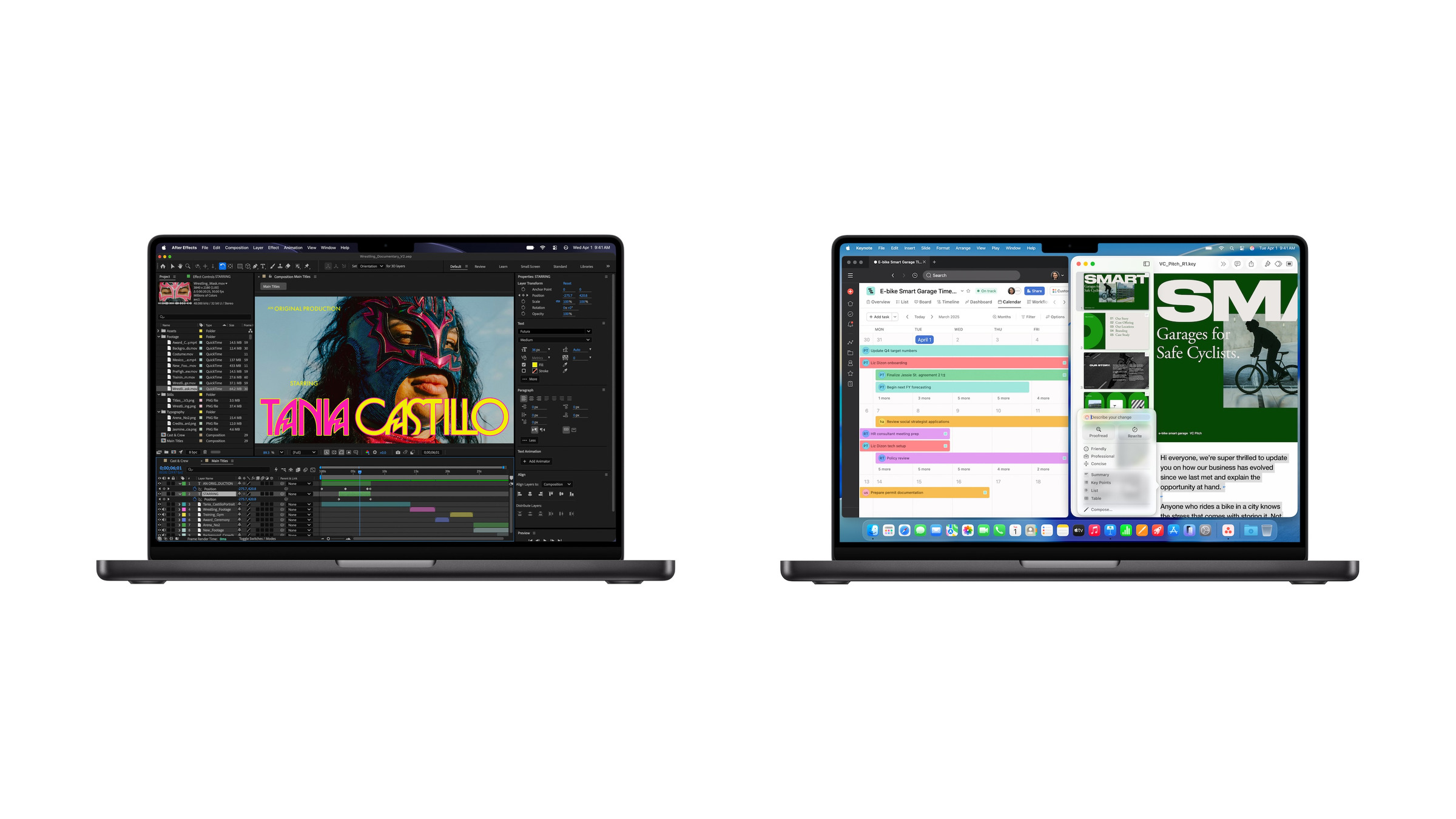
The casing is identical: 1.55 cm high, 31.26 cm wide, 22.12 cm deep, 1.55 kg, available in Space Black or Silver. Apple has also retained the 14.2-inch Liquid Retina XDR display with a 120 Hz refresh rate and up to 1,600 nits brightness for HDR content; the nanotexture option still costs €165.
The ports remain the same: three Thunderbolt 4 ports, HDMI, SDXC card slot, headphone jack, and MagSafe 3. Like the M5, the battery has a capacity of 72.4 watt-hours and, according to Apple, is sufficient for up to 24 hours of video streaming or 16 hours of Wi-Fi use.
A power adapter is still not included in the box in Germany, just like with the M5. Apple recommends at least 60 watts; fast charging starts at 96 watts.
The 70-watt power adapter costs €65, the 96-watt model €85. Which power adapter is compatible with which device can be found in the overview of wattage ratings for MacBook power adapters. It ships with macOS 27, which includes Siri AI. However, this also applies to the M5 model.
Prices in Germany, Austria and Switzerland
In Germany and Austria, the MacBook Pro with M6 costs the same; in Switzerland, it costs 1,899 Swiss francs. Students and teachers in Germany pay 2,179 euros. The price listed for the M5 is the last price valid in Germany.
| Configuration | M6 DE | M6 AT | M6 CH | M5 last (DE) |
|---|---|---|---|---|
| 16 GB, 1 TB | 2.299 € | 2.299 € | 1,899 CHF | 2.199 € |
| 24 GB, 1 TB | 2.519 € | 2.519 € | 2,099 CHF | 2.419 € |
| 32 GB, 1 TB | 2.739 € | 2.739 € | 2,299 CHF | 2.639 € |
From the M5 to the M6: For whom the switch is worthwhile
Anyone who owns a MacBook Pro with an M5 processor has, in my opinion, no reason to upgrade. The device is a year old, the display, battery, and casing are identical, and Apple's own measurements show a 20 to 30 percent performance increase – compared to the top-of-the-line configuration. This is most noticeable when running local AI models and compiling larger projects.
The situation is quite different for those upgrading from a MacBook Pro with an M1 or Intel processor. Compared to the M1, Apple claims up to 13 times faster AI responses and up to 11.7 times faster rendering, plus four hours more battery life, 16 GB of RAM as standard, and an additional Thunderbolt port.
For new buyers, the M6 remains the obvious choice, even with a €100 price premium. An M5 from remaining stock at a retailer is only worthwhile if it's offered at a significantly lower price. Those needing a lot of RAM should also do the math: the M6 with 32 GB costs €2,739, while the MacBook Pro with the M5 Pro and 24 GB costs €2,899 – but it does offer Thunderbolt 5 and support for up to three external displays. The Mac buying guide compares the other Mac models.
Would you pay the extra €100 for Wi-Fi 7 and two more cores – or would you rather look for an M5 in stores while it's still available? Let us know in the comments at what price difference the M5 would be the better choice for you.
Frequently Asked Questions: MacBook Pro M6 vs. M5
The M6 has 12 CPU and GPU cores instead of 10, a dual 16-core Neural Engine, Wi-Fi 7, Bluetooth 6, and Thread. The case, display, battery, ports, and weight are identical.
Yes. In Germany, the MacBook Pro with the M6 processor starts at €2,299, while the M5 model most recently cost €2,199. The €100 surcharge also applies to the 24GB and 32GB RAM versions.
Not for most M5 owners. Apple claims up to 20 to 30 percent more performance compared to the M5, measured against the top-of-the-line configuration. The jump is significantly greater for those upgrading from M1 or Intel models.
No. Both have a 72.4 watt-hour battery and, according to Apple, can provide up to 24 hours of video streaming and up to 16 hours of Wi-Fi usage.
Like the M5 model, it supports up to two external monitors, optionally via Thunderbolt or HDMI. Two monitors can support up to 6K at 60 Hz or 4K at 165 Hz, a single monitor up to 8K at 60 Hz.
Not in Germany; the box only contains the USB-C to MagSafe 3 cable. Apple recommends at least 60 watts, with fast charging starting at 96 watts. The 70-watt power adapter costs €65, and the 96-watt adapter costs €85.
No. Since the introduction of the M6 on October 27th, Apple has only offered the 14-inch model with the M6, M5 Pro, or M5 Max. The M5 model is only available through remaining stock at retailers.