
This article may contain affiliate links. Learn more on our Partner Program page.
Since its release, the iPhone Duo has been my main device. With cases, chargers, and MagSafe accessories, many things work differently with the foldable format compared to a regular iPhone. Some things that were taken for granted for years suddenly don't fit anymore. And, of all things, a small kickstand has become my most important accessory.
The iPhone Duo, when folded, is shorter and wider than previous iPhones, and when unfolded, it features a large inner display. Both of these factors change which accessories are actually useful. I've already written about my initial impressions after the first few days. This review covers everything I'm using and what I've returned.
I bought all four cases Apple offers for the Duo, meaning both models in both colors. In addition, I have my charging stations, MagSafe accessories from previous iPhone generations, and the Apple Pencil. All articles about the foldable iPhone are compiled on the iPhone Duo topic page. This overview will grow as I test more Duo accessories, so I'll add them here.
Key Takeaways
- Apple offers two cases: the iPhone Duo Case for 89 euros and the iPhone Duo Folio with stand for 149 euros.
- I only use the two folios now. I sent the cases back because they made the Duo too bulky for my liking.
- The Folio's stand replaces any stand I might need, especially for standby while working.
- MagSafe chargers work, but MagSafe wallets protrude at the bottom due to their short design.
- Nomad and Pitaka already offer cases for the Duo. I've already tested Pitaka's aramid case; the Nomad review will follow.
Apple cases: Folio beats Case
Apple sells two cases for the Duo. The iPhone Duo Case is a two-piece design made of polycarbonate with a matte finish that covers both halves of the device. It costs €89 and is available in navy and sand. The iPhone Duo Folio with kickstand is made of technical fabric, costs €149, and is available in navy and taupe. According to Apple, both cases attach using integrated magnets and can be charged with MagSafe, Qi2, and Qi chargers without removing the case.
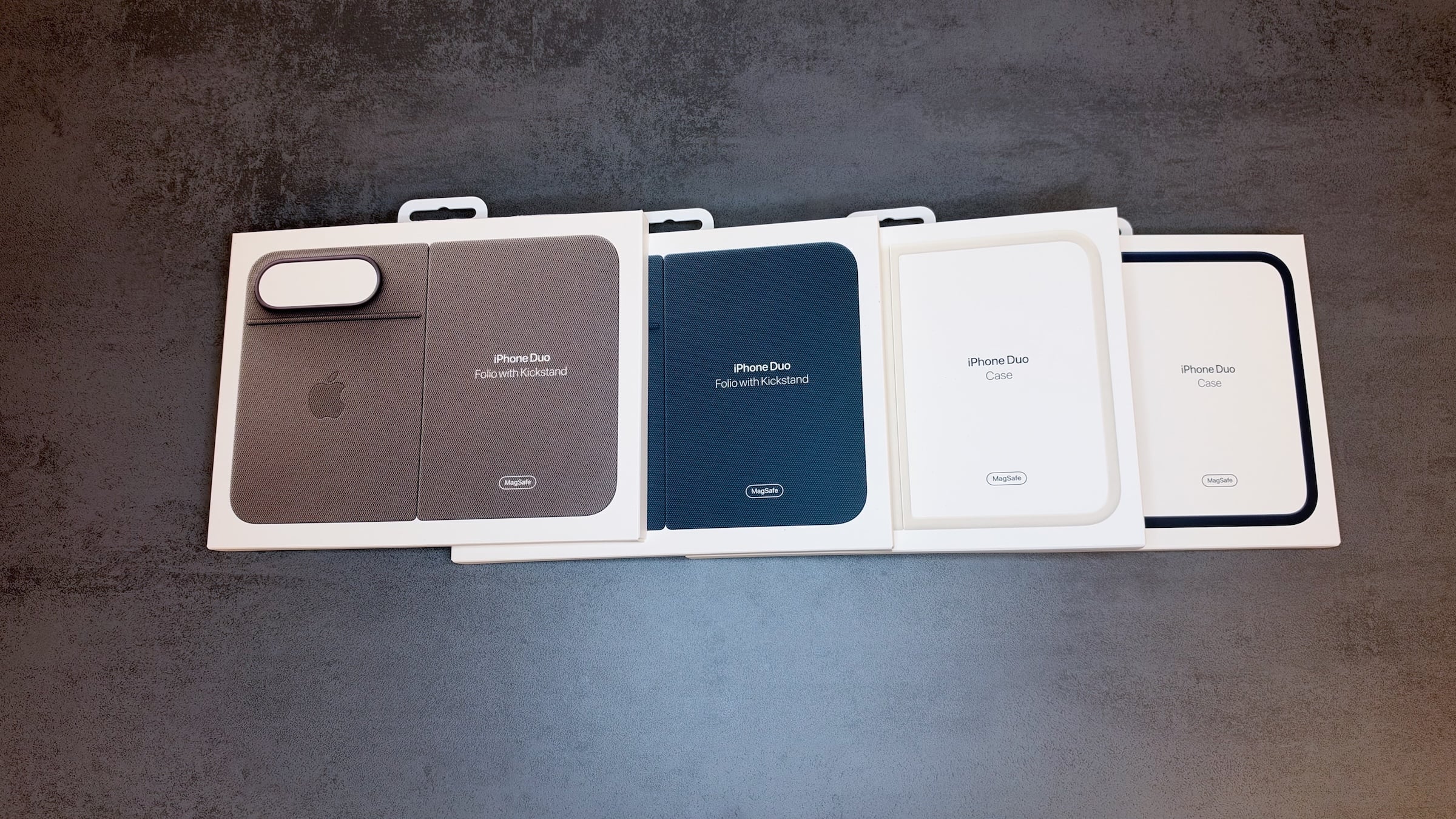
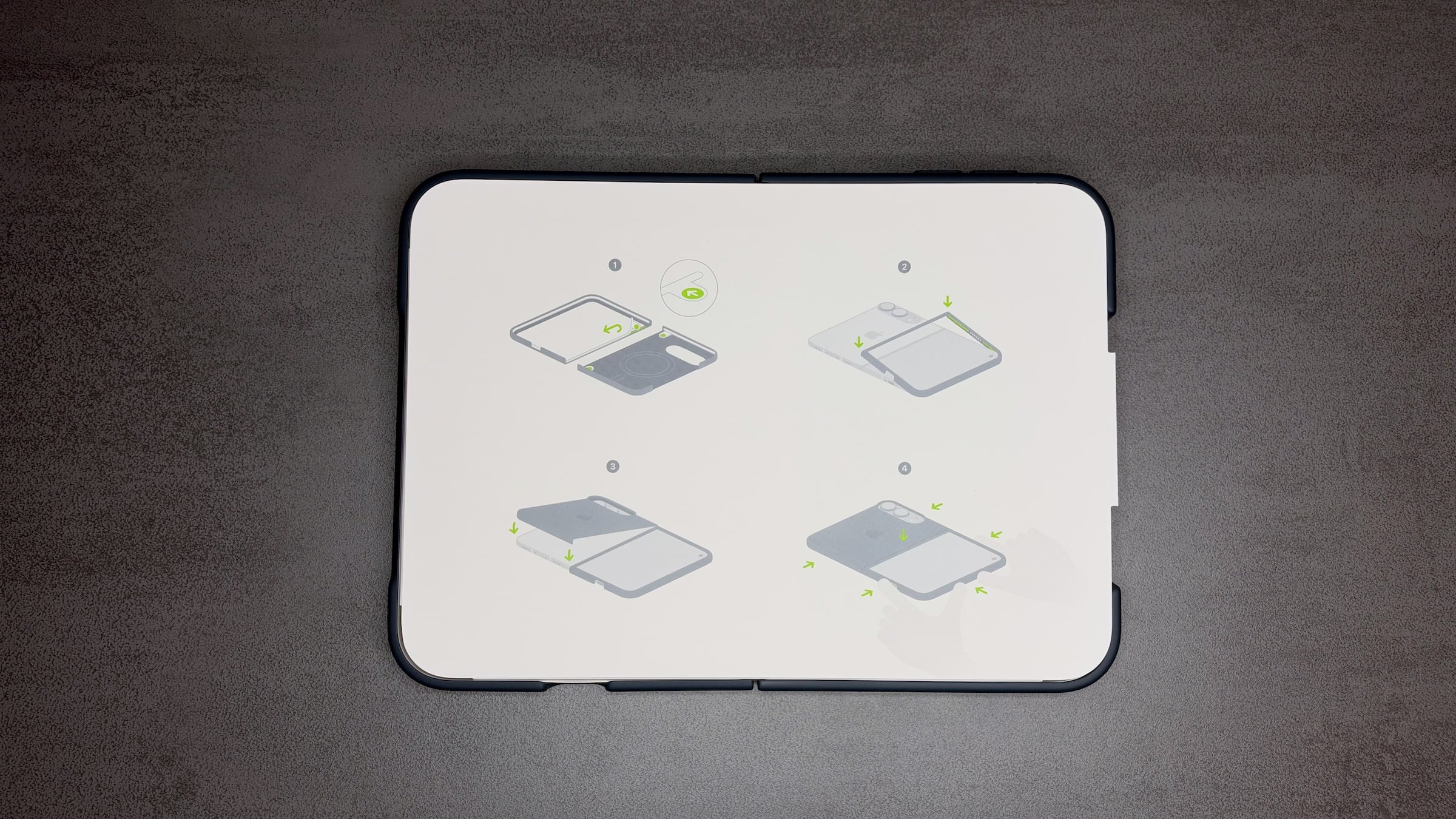
I had all four, meaning both models in both colors. The case protects the front, back, and edges, but the hinge on the back is exposed, at least when the phone is closed. Despite this, I returned both cases. I didn't like the design, and above all, the case significantly bulked up the phone. It didn't offer any real added value in everyday use. This is just my personal preference: If you value edge protection, the case is a good choice. Apple only mentions integrated magnets for attachment on the product page. However, the case also uses adhesive strips: Before attaching it, you peel off a protective film from both halves to reveal the adhesive surface. I experienced this myself when I installed it.
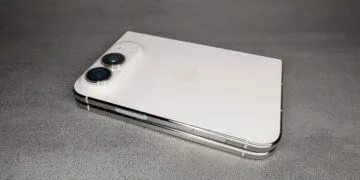
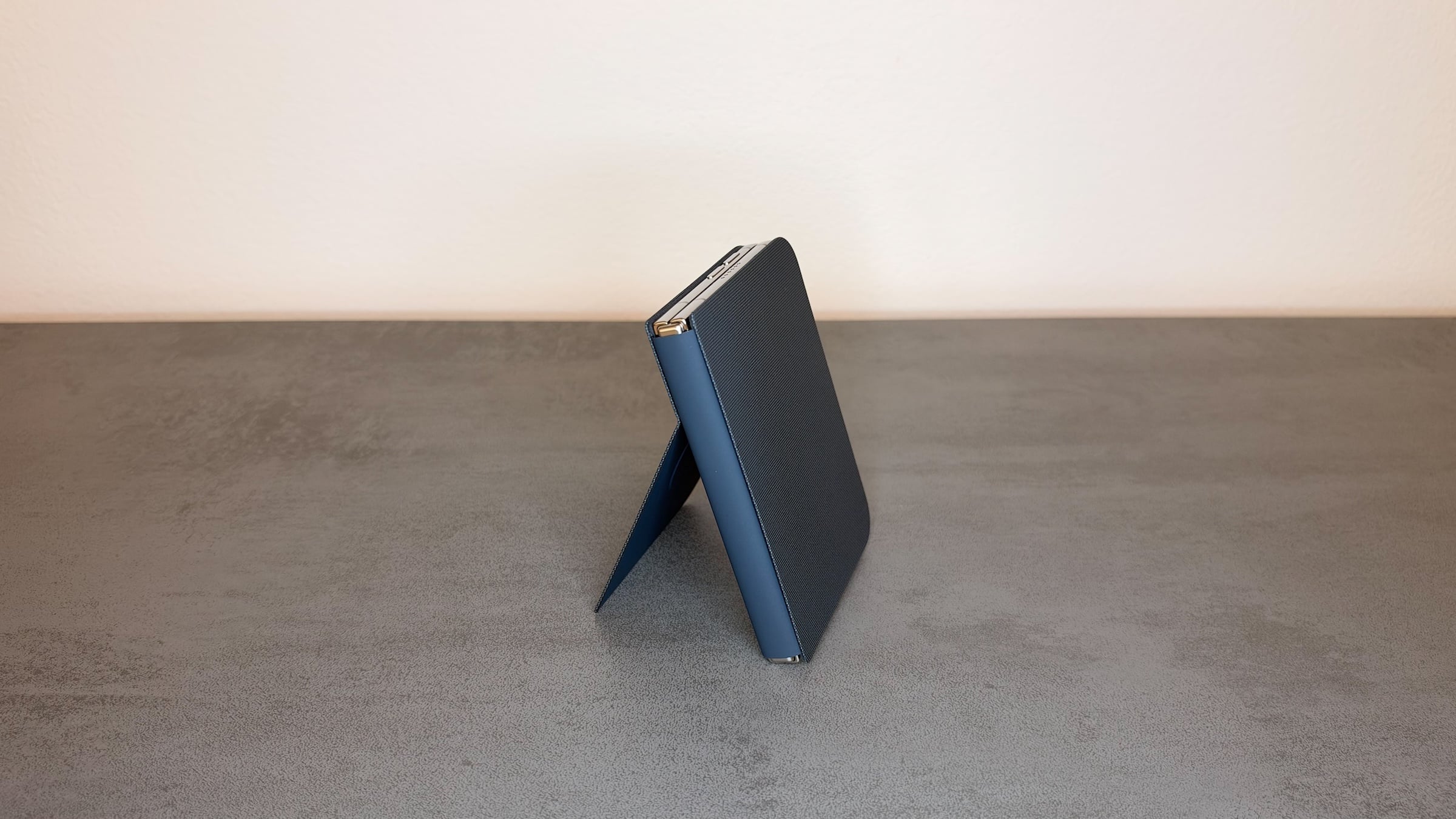
I kept both folios and switch between them depending on my mood, because I like both colors. The folio doesn't protect the edges, but it does cover the hinge on the back. It's only held in place magnetically. When opening it, it occasionally slips a bit or comes loose slightly, depending on how you open the duo. I haven't noticed any wear and tear so far. However, that could also be because I use both folios.
I originally wanted to use the Duo without a case. The only reason I don't is because of the kickstand. I accept the reduced protection, and AppleCare+ provides peace of mind.
Cases with a frame around the outer display can obscure its left edge. For this, Apple has included a "Shift Left Edge" toggle in the settings, which shifts the content slightly to the right.
The stand is the real argument
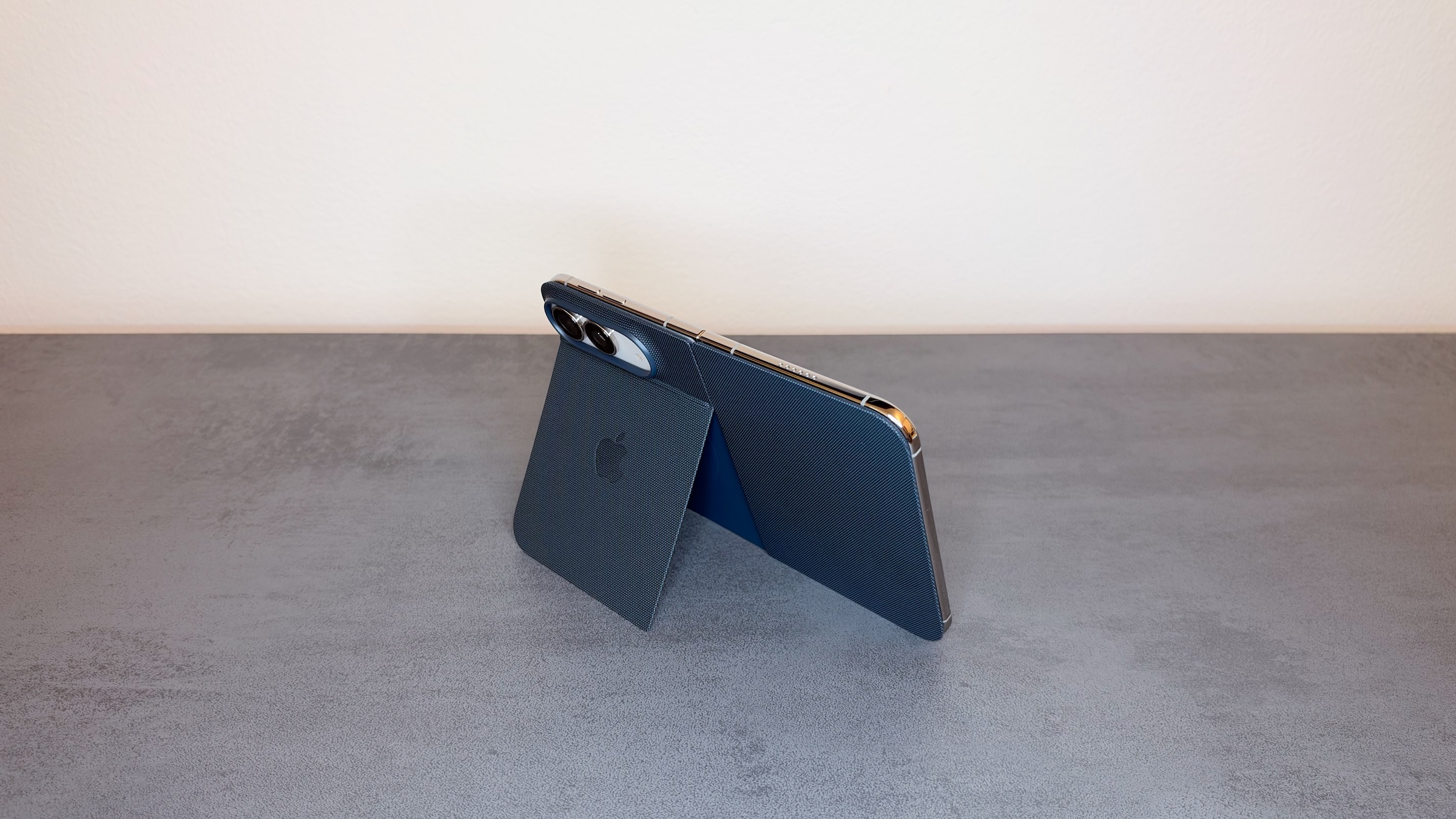
According to Apple, the Folio's kickstand can be positioned at various angles and folded away when not in use. I use it almost constantly. I prop the Duo up with it for standby mode while working, to play a video in the background, or to have an app open from which I need information.
Since 2019, I've been using the Lamicall stand for iPhone and iPad, and I now own several. It's inexpensive and stable, and I often place my iPad Pro on it when I take it out of the Magic Keyboard. Anyone using both devices should definitely get this model, as Lamicall's iPhone-only version isn't stable enough for a large iPad. This summer, I bought another Lamicall stand just to try it out. It's proven to be very functional. I used to keep every iPhone on a stand like this. With the Duo, I don't need one as long as the Folio is attached.
I don't use a mount in the car, and the Folio's stand takes over this role at my desk.
Nomad and Pitaka: the first duo shells
I've been using Nomad and Pitaka cases since around 2019 and have had cases from both manufacturers for every iPhone generation, most recently Nomad's cases for the iPhone 18 Pro and Pitaka's minimalist cases for the iPhone 17. I've always been satisfied. Both companies have different focuses, and both already offer cases for the Duo. I've already thoroughly tested Pitaka's case on the Duo; the Nomad review is still pending. Therefore, for now, only the manufacturer's specifications for Nomad's iPhone Duo cases are listed here.
Nomad offers, among other things, the Traditional Leather Folio for the iPhone Duo, made of Horween leather. It completely encloses the device, has raised edges around the display and camera, and a card slot for up to three cards. The Duo is held in place by microsuction pads and MagSafe magnets; according to Nomad, wireless charging works with both MagSafe and Qi2. There is also the simpler Magnetic Leather Back, a magnetic leather back cover.
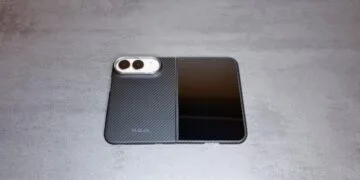
As usual, Pitaka uses aramid fiber for the Duo case. The Edge case for the Duo is available as a back cover only, as a front cover with glass over the outer display, or as a set of both. The inner display remains uncovered; there's no separate hinge protector. In everyday use, I was impressed with the set. The camera controls work perfectly, even with the aramid fiber button, as if nothing were obstructing them. The glass over the outer display reflects less light but attracts fingerprints more easily. Full details can be found in my review of the Pitaka case for the iPhone Duo, and the aramid fiber back cover for the Duo is available on Amazon.
Charging: via cable during the day, at the charging station at night
During the day, I charge the Duo with the cable, unfolded, because that's how Apple measured the fast charging of the iPhone Duo. A 15 to 20-minute charge is usually enough for me; that covers me for the evening.
At night, the Duo sits folded on my Nomad Base One Max. I really like the station, but Nomad no longer sells it. Now they only offer the stand versions, which also enable standby mode for older iPhones. I also tried the Duo on a Nomad stand: the magnet holds it closed, and it charges. I still wouldn't leave it there all night, though. It would probably stay in place, but to be honest, it doesn't look particularly nice.
Apple's own MagSafe charger also works flawlessly, even with the Folio. Apple specifies two positions for this: on the outside of the Folio or under the open kickstand. I tried both, and the Duo charged in both cases.
MagSafe: Chargers yes, wallets no
With MagSafe accessories, the Duo is where the wheat is separated from the chaff. Chargers and cases attach securely. My MagSafe wallets, however, have become useless on the Duo: If I place them at the point where the magnets grip properly, they protrude from the bottom of the device. I already described this in the section on the Duo's disadvantages compared to the Pro Max, and nothing has changed.
I haven't used any other MagSafe accessories with the Duo so far.
Apple Pencil and keyboard
The Duo only works with the Apple Pencil (USB-C). I don't use it constantly, but more and more often these days, most recently for drawing in Procreate Pocket. That works flawlessly. For retouching photos, however, I still reach for the iPad Pro with the Apple Pencil Pro, mainly out of habit. I've compiled the pencil, compatible cables, and cases for the Duo in an Amazon list of iPhone Duo accessories.
I don't use an external keyboard or mouse with the Duo and I don't miss it at all. The on-screen keyboard is perfectly adequate for me, both in portrait mode and in landscape mode with a split keyboard.
What's still missing on the market
What I miss most are my MagSafe wallets. I don't expect that to change. Cards have a standard length and therefore always stick out when the Duo is closed. One solution would be a card slot inside the case itself, like the one Nomad offers with their Traditional Leather Folio. Whether that's practical for everyday use, I can only say after testing it.
I'm curious to see how creative accessory manufacturers will be with this new form factor. I'll add more solutions here as soon as I've tested them.
The question remains: how much protection do you actually need for the most expensive iPhone? For me, the kickstand won out over edge protection. Would you forgo all-around protection for the kickstand, or does your Duo only leave the house with a full case? Let us know in the comments which case you use on your Duo and why.