
This article may contain affiliate links. Learn more on our Partner Program page.
Since October 27th, the cheapest MacBook Pro has featured an M6 chip – a newer chip than the one in the MacBook Air. The price difference between the two models in Germany is at least €600. This comparison reveals what the extra money is actually spent on in the Pro and when the Air remains the better choice.
Apple sells the MacBook Air with the M5 processor in 13-inch and 15-inch sizes, and the 14-inch MacBook Pro has been available with the M6 processor since October 27th. Above these are the Pro models with the M5 Pro and M5 Max, which are in a different price bracket for most buyers. This comparison therefore contrasts the two MacBook Air models with the MacBook Pro with the M6 processor and only mentions the Pro chips where they are a decisive factor.
This information is based on the technical specifications of the MacBook Air and MacBook Pro, as well as the German prices in the Apple Store. Pre-orders for the MacBook Pro with M6 processor begin on October 28th at 6:10 PM, and it will be available in stores from November 6th.
Key Facts at a Glance
- The MacBook Air starts at €1,399 (13-inch) and €1,699 (15-inch), the MacBook Pro with M6 at €2,299.
- The Pro version primarily offers a better display with 120 Hz and up to 1,600 nits, more ports, a 1 TB SSD as standard, and up to six hours more battery life.
- Wireless connectivity is no longer a difference: All three models have WLAN 7, Bluetooth 6 and Thread.
- The Air is fanless, significantly lighter, and easily sufficient for studying, office work, and photo editing.
- With the same storage capacity, the MacBook Pro costs 270 euros more than the 15-inch Air and 460 euros more than the 13-inch Air.
All differences at a glance
| MacBook Air 13″ | MacBook Air 15″ | MacBook Pro 14″ | |
|---|---|---|---|
| Chip | M5, 10-core CPU, 8- or 10-core GPU | M5, 10-core CPU, 10-core GPU | M6, 12-core CPU, 12-core GPU |
| Neural Engine | 16 cores | 16 cores | Dual 16 cores |
| Memory bandwidth | 153 GB/s | 153 GB/s | 153 GB/s (16 GB), 170 GB/s (from 24 GB) |
| RAM | 16, 24 or 32GB | 16, 24 or 32GB | 16, 24 or 32GB |
| SSD | from 512 GB to 4 TB | from 512 GB to 4 TB | from 1 TB to 4 TB |
| Display | 13.6″, 2560 × 1664, 500 nits | 15.3″, 2880 × 1864, 500 nits | 14.2″ XDR, 3024 × 1964, up to 120 Hz, up to 1,600 nits (HDR) |
| Connections | 2 × Thunderbolt 4, MagSafe 3, Headphones | 2 × Thunderbolt 4, MagSafe 3, Headphones | 3 × Thunderbolt 4, HDMI, SDXC, MagSafe 3, Headphone jack |
| External Displays | up to 2 | up to 2 | up to 2 |
| Speakers | 4 | 6 | 6 |
| Battery | 53.8 Wh, up to 18 hours of video | 66.5 Wh, up to 18 hours of video | 72.4 Wh, up to 24 hours of video |
| Weight | 1.23 kg | 1.51 kg | 1.55 kg |
| Colours | Sky Blue, Silver, Starlight, Midnight | Sky Blue, Silver, Starlight, Midnight | Space Black, Silver |
| Price DE from | 1.399 € | 1.699 € | 2.299 € |
Display: the biggest difference
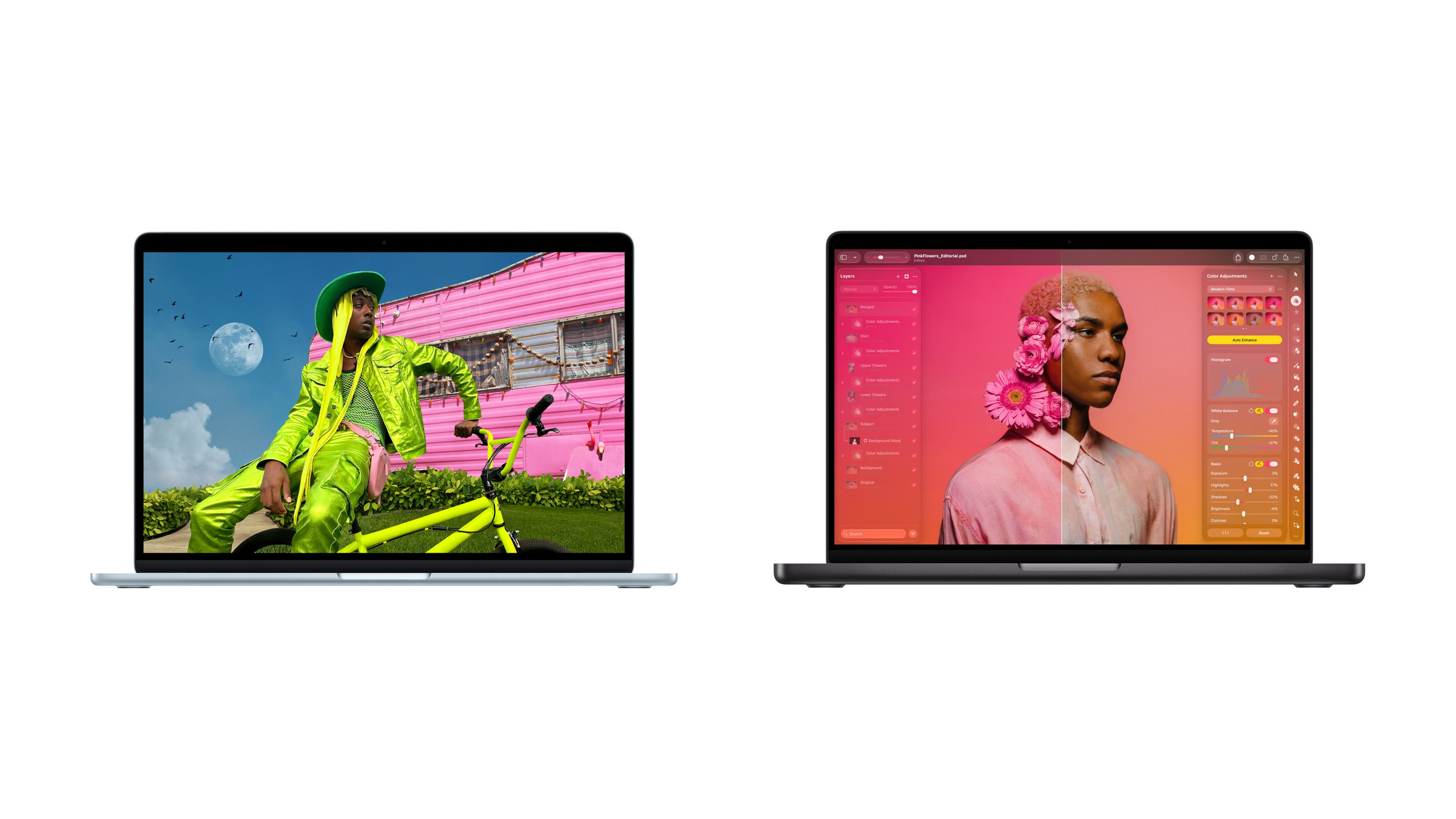
The most significant difference between the two series is the display. The MacBook Pro has a Liquid Retina XDR display with ProMotion up to 120 Hz, up to 1,000 nits of brightness for normal outdoor content, and up to 1,600 nits of peak brightness for HDR content. A display with a nanotexture coating is available as an option for €165 to reduce reflections.
Both MacBook Air models use a Liquid Retina display with 500 nits of brightness and no increased refresh rate. This is sufficient for text, web browsing, and photo editing, but the difference compared to the Pro is immediately noticeable outdoors and when watching HDR videos.
Performance: M5 vs. M6
The MacBook Air uses the M5 processor with ten CPU cores, the 13-inch entry-level model with eight GPU cores, and all other configurations with ten. The MacBook Pro has the newer M6 processor with twelve CPU and GPU cores and a dual 16-core Neural Engine. Apple claims a 20 to 30 percent performance increase compared to the M5, based on the top-of-the-line model with the M5.
The second difference lies in the design. According to Apple, the MacBook Air is fanless and therefore silent. For the MacBook Pro with M6, Apple promises consistent performance whether running on battery or AC power.
Those who regularly export videos, render 3D scenes, or run local AI models will benefit from the Pro. For office work, browsing, studying, and editing vacation photos, the Air is more than sufficient.
Connections and external displays
The MacBook Air has two Thunderbolt 4 ports, MagSafe 3, and a headphone jack. The MacBook Pro adds a third Thunderbolt port, HDMI, and an SDXC card slot. Users who frequently connect a projector, monitor, or camera memory card will save themselves the cost of an adapter with the Pro.
All three models are on par when it comes to external displays: Each supports up to two monitors. The Pro supports 4K at up to 165 Hz in dual-screen mode, while the Air supports up to 144 Hz. The overview of how many external displays a Mac supports shows the limits for other Macs.
Battery, weight and power supply
According to Apple, the MacBook Pro can stream video for up to 24 hours, while both MacBook Air models last up to 18 hours. When browsing the web over Wi-Fi, the battery life is 16 hours compared to 15 hours for the Pro. However, the 13-inch Air weighs about 300 grams less at 1.23 kg, while the 15-inch Air, at 1.51 kg, weighs almost the same as the Pro.
None of the three models in Germany include a power adapter in the box, only the MagSafe 3 cable. The 13-inch Air requires at least 30 watts, the 15-inch model 35 watts, and the MacBook Pro 60 watts. Fast charging is possible for the Air starting at 70 watts and the Pro at 96 watts. Which power adapter is compatible with which device can be found in the overview of wattage ratings for MacBook power adapters.
What they both have in common
Since the M6, the MacBook Pro has also featured Apple's N1 chip with Wi-Fi 7, Bluetooth 6, and Thread, which the MacBook Air already received with the M5. All models are available with 16, 24, or 32 GB of RAM, and the upgrade prices are identical: €220 for 24 GB and €440 for 32 GB.
The 12 MP Center Stage camera, Touch ID, and backlit Magic Keyboard are also identical. All models ship with macOS 27, which includes Siri AI.
Prices in Germany, Austria and Switzerland
In Austria, the same Euro prices apply as in Germany. Because the MacBook Pro starts with 1 TB and the Air with 512 GB, the table also includes the Air with a 1 TB SSD for a fair comparison.
| Configuration | DE and AT | CH |
|---|---|---|
| MacBook Air 13″, 8-core GPU, 16GB, 512GB | 1.399 € | 1,249 CHF |
| MacBook Air 13″, 10-core GPU, 16GB, 512GB | 1.509 € | 1,349 CHF |
| MacBook Air 13″, 10-core GPU, 16GB, 1TB | 1.839 € | 1,649 CHF |
| MacBook Air 15″, 16GB, 512GB | 1.699 € | 1,449 CHF |
| MacBook Air 15″, 16GB, 1TB | 2.029 € | 1,749 CHF |
| MacBook Pro 14″ M6, 16GB, 1TB | 2.299 € | 1,899 CHF |
MacBook Air or Pro: Which model should you buy?
In my opinion, the 13-inch MacBook Air remains the right choice for most buyers. It's lightweight, silent, has the same wireless technology as the Pro since the M5, and is easily sufficient for studying, office work, and occasional photo or video editing. Those who want more screen space should opt for the 15-inch model, which also comes with two speakers and a larger battery; the size comparison between the 13-inch and 15-inch MacBook Air clarifies the details.
The MacBook Pro is worthwhile if you actually need the display, ports, or sustained performance: for HDR photos and videos, working outdoors, with camera memory cards and projectors, or for long exports. The six extra hours of battery life for video streaming are a bonus, but not enough on their own to justify a €460 price difference compared to a similarly equipped 13-inch Air.
Anyone needing more than two external displays or Thunderbolt 5 for their MacBook Pro will have to opt for the M5 Pro, starting at €2,899. The Mac buying guide compares the other Mac models.
Would you spend around €460 more for the XDR display and HDMI than for a comparably equipped 13-inch MacBook Air – or is the Air sufficient for your everyday needs? Let us know in the comments what makes the difference for you.
Frequently Asked Questions: MacBook Air vs. MacBook Pro
The MacBook Pro has a Liquid Retina XDR display with up to 120 Hz and up to 1,600 nits for HDR content, plus HDMI, an SDXC card slot, and a third Thunderbolt port. It also features the M6 chip, a 1 TB SSD as standard, and up to 24 hours of video streaming (compared to 18 hours for the MacBook Pro). The MacBook Air is lighter, fanless, and less expensive.
The MacBook Air starts at €1,399 (13-inch) and €1,699 (15-inch) in Germany, while the MacBook Pro with M6 starts at €2,299. With the same configuration, 16 GB of RAM and 1 TB of storage, the 13-inch Air costs €1,839 and the 15-inch Air €2,029.
Yes. The MacBook Air with M5 processor, 16 GB of RAM, and a 512 GB SSD is easily sufficient for office applications, browsing, video conferencing, and photo editing. It's lightweight, fanless, and according to Apple, lasts up to 18 hours while streaming video.
No. According to Apple, the MacBook Air is fanless and therefore operates silently.
Both can drive up to two external monitors, even two via a single Thunderbolt port. Anyone needing more will have to opt for the MacBook Pro with M5 Pro, which supports up to three external displays.
The MacBook Pro with M6 offers up to 24 hours of video streaming and 16 hours of Wi-Fi connectivity. According to Apple, both MacBook Air models achieve up to 18 hours of video streaming and 15 hours of Wi-Fi connectivity.
Not in Germany, neither for the MacBook Air nor the MacBook Pro. The box only contains the USB-C to MagSafe 3 cable. The 13-inch Air requires at least 30 watts, the 15-inch Air 35 watts, and the MacBook Pro 60 watts.