
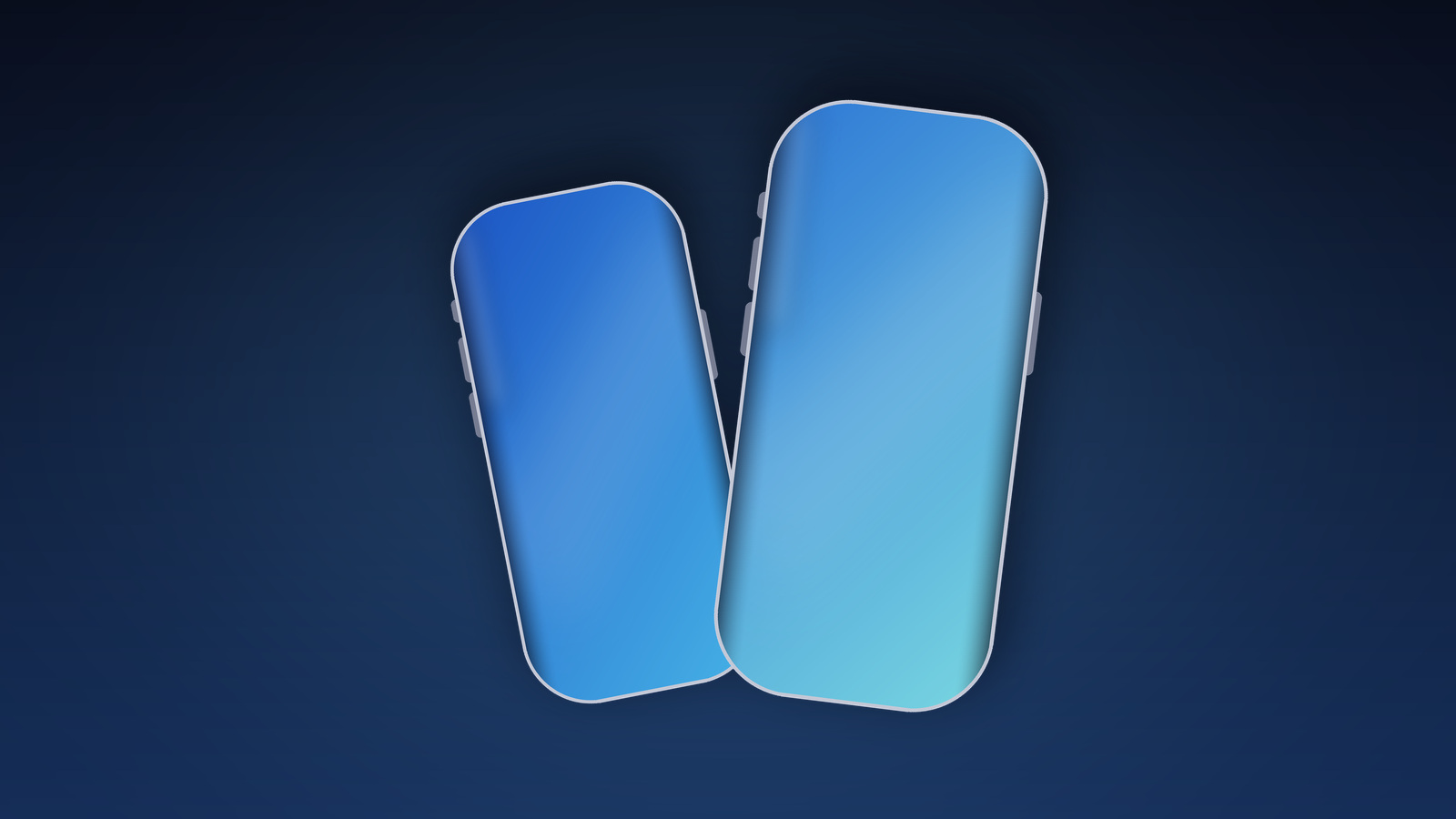
In 2027, the iPhone will celebrate its 20th anniversary, and Apple is preparing the most radical design change since the iPhone X. Internally, the project is known as "Glasswing"—named after a butterfly with transparent wings. It will feature a glass casing, a four-sided curved display, and buttons without mechanical components.
Apple only implements major design changes when the technology is viable. In 2017, the iPhone X, with Face ID and an edge-to-edge display, was released to mark the 10th anniversary and set the course for the following years. Ten years later, everything indicates that the next big step is imminent – and that it will land in the flagship model of the series.
Bloomberg reporter Mark Gurman has confirmed the internal codename Glasswing, clarifying that the hardware concept is specifically aligned with Apple's Liquid Glass software design system, which will be unveiled in 2025. Analyst Jeff Pu adds: Instead of a separate anniversary iPhone, the Pro model itself will showcase the new design language. The year will be packed anyway – six new iPhone models are expected to be released in 2027.
Key Facts at a Glance
| Detail | Expectation |
|---|---|
| Code name | Glasswing (internal at Apple), models V73 and V74 |
| Model name | iPhone 20 / iPhone XX / iPhone Pro – iPhone 19 will likely be skipped |
| Release | September 2027 |
| Chip | A21 (TSMC 2 nm, second generation), codename Naxos |
| Display | Liquid glass OLED with subtle, four-sided curvature |
| Display size | Approximately 6.41 inches for the Pro, approximately 6.96 inches for the Pro Max successor (marketed as 7 inches) – both panels are in testing, not final |
| Resolution | Approximately 2,686 × 1,236 and 2,912 × 1,340 pixels, pixel density similar to the iPhone 18 Pro at around 460 ppi |
| Housing | Mostly glass, frame possibly without metal band – not final |
| Building height | Controversial: a leak mentions iPhone Air-level thickness (5.6 mm), while the iPhone 18 Pro measures 8.75 mm |
| Front camera | Face ID in the prototype is located under the display, with the camera in a cutout; a smaller dynamic island solution is being tested in parallel |
| Modem | Apple modem (third generation), in the entire iPhone lineup |
| Controls | Haptic solid-state keys without mechanical components |
| Camera | New HDR sensor with up to 20 stops of dynamic range |
| Cooling | Enlarged steam chamber |
Codename Glasswing: The transparent butterfly
The internal codename reveals the central design concept. Glasswing refers to the glasswing butterfly, a species of butterfly native to Central America with transparent wings. Apple is using precisely this image internally for the 2027 iPhone – a device whose glass edges flow seamlessly into the display, appearing almost invisible.
Mark Gurman confirmed the codename in a Sunday edition of his newsletter, thus filling a gap: Until now, there was no clear connection between the hardware concept and Apple's Liquid Glass design system. The software interface is not only intended to function on the new display, but also to visually merge with it.
The chronology is revealing. Apple unveiled Liquid Glass at WWDC 2025 – at a time when, according to internal planning, Glasswing had already been in development for some time. The design language, therefore, didn't emerge by chance, but was deliberately tailored to the hardware concept. What appears to be two separate worlds externally is, internally, apparently a single, multi-year plan.
Strategy: The Pro model will become the anniversary model
For a long time, many observers assumed Apple would reserve the radical design for a specially created model – similar to the leap from the iPhone 8 to the iPhone X in 2017. A research note by Jeff Pu paints a different picture: The innovation focus for the second half of 2027 lies exclusively on the Pro models. The four-sided curved display and the under-display front camera thus define the Pro line itself.
This aligns with Gurman's original report, which already mentioned a bold new Pro model with significantly more glass. The logic is understandable: Apple's lineup has already been restructured several times – the iPhone Air replaced the iPhone Plus in 2025, and with the iPhone Duo, a foldable flagship model has been part of the range for the first time since September 2026. An additional special edition would make the series unwieldy.
A more recent report provides further details: The anniversary iPhone is expected to be released in two versions, roughly the same size as the current iPhone 18 Pro and iPhone 18 Pro Max, and thus directly succeeding them. Internally, they are codenamed V73 and V74. Anyone wanting the most advanced iPhone of its generation in 2027 will therefore opt for the Pro series.
Design: Liquid Glass and four-sided curvature
A display that slopes down on all four edges
The most striking feature is the new display. Several consistent reports mention an OLED panel that curves subtly downwards on all four edges. From the front, the device appears almost like a single block of glass without a visible frame – an impression that was already considered the hallmark of iPhone design under Jony Ive's leadership.
Gurman explicitly confirmed that Liquid Glass is not just a software concept, but a hardware one: The user interface is designed to appear as if it were an extension of the physical casing. Reports from the Korean supply chain further suggest a four-edge bending display.
The curvature is significantly more subtle than on previous Samsung or Huawei devices. Instead of an aggressive edge curve, Apple apparently combines minimal physical curvature with optical refraction and glass shaping. There's a technical reason behind this: true four-sided curvature causes problems with pixel density, touch sensitivity, and long-term stability, and a report already warns of potential image distortion at the edges.
Prototype and panel size
A concrete indication of the development status comes from the supply chain: A prototype with a fully curved display is already being tested, where the panel seamlessly blends into the frame at all four edges. Samsung Display is reportedly manufacturing a special micro-curved panel for this purpose, thinner and brighter than previous OLEDs. However, the prototype cannot be assigned to any specific model – it remains to be seen whether the display will be reserved for the anniversary model or rolled out across the entire Pro line in 2027.
The panel sizes have also been specified more precisely. According to a post on Weibo by Digital Chat Station, Apple is testing two new displays with diagonals of 6.41 and 6.96 inches; the larger one would be rounded up to a whole seven inches for marketing purposes. The smaller panel is expected to be used in the Pro model, the larger one in the Pro Max successor, which would thus have the largest display of any non-folding iPhone. The leaker had already mentioned both diagonals in July and August – this is consistent with the same source, not an independent confirmation.
The increases are modest. The iPhone 18 Pro, a standard rectangular model, measures 6.27 inches, while the Pro Max measures 6.86 inches; Apple markets both as 6.3 and 6.9 inches, respectively. This represents a diagonal increase of 2.2 and 1.5 percent – with virtually the same overall size, thanks to the elimination of bezels. This aligns with the fact that all models in the anniversary series are expected to receive larger displays.
Resolution: more area, same sharpness
The resolutions are new. The leaker cites approximately 2,686 × 1,236 pixels for the smaller model and approximately 2,912 × 1,340 for the larger one. Based on their diagonals, both achieve around 460 pixels per inch – the same value Apple lists for both models in the iPhone 18 Pro specifications. The 5.0 and 3.1 percent increase in pixels thus translates entirely into increased area, not sharpness, and the aspect ratio remains at approximately 2.17:1.
| Model | Diagonal (rectangle) | Resolution | Pixel density |
|---|---|---|---|
| iPhone 18 Pro | 6.27 inches | 2.622 × 1.206 | 460 ppi |
| Anniversary model, smaller (Leak) | 6.41 inches | approx. 2,686 × 1,236 | approximately 461 ppi (calculated) |
| iPhone 18 Pro Max | 6.86 inches | 2.868 × 1.320 | 460 ppi |
| Anniversary model, larger (Leak) | 6.96 inches | approx. 2,912 × 1,340 | approximately 461 ppi (calculated) |
Case: Glass instead of aluminum?
What would actually be new
Sources within the supply chain indicate that the relevant production facility has already been converted and is awaiting the start of processing; a glass housing is considered the preferred approach. The source explicitly does not mention any decision having been made.
It is now also known which facilities are involved: The glass production line for the iPhone Air has been retooled to handle more curved components. At 5.6 millimeters, the iPhone Air is the thinnest non-folding iPhone and required glass manufacturing with very thin materials and tight tolerances. Apple would therefore not need to build a new production line, but rather adapt an existing one – according to the same source, this will reduce manufacturing costs.
Since the iPhone 8, iPhones have had a glass back, simply because wireless charging doesn't work through metal. So, the new design wouldn't be the back, but the frame – instead of an aluminum or titanium band, the glass itself would wrap around the edges, connecting the front and back. Whether there's still a supporting metal structure underneath is unclear; descriptions speak of a predominantly glass device, not a completely glass one.
The heat problem and its compensation
The material strategy is far from settled. In May, it was reported that Apple was researching an improved titanium alloy for future Pro models – whereupon a second leaker dampened expectations: aluminum would be the only option for the foreseeable future because the heat from the AI processing had to be dissipated. According to Apple, the iPhone 18 Pro again uses an aluminum unibody design, which supports this view.
This is precisely where the problem lies. Glass conducts heat orders of magnitude less efficiently than aluminum. If the thermal stress caused by on-device AI was indeed the decisive argument for metal, Apple must compensate for this in a glass casing elsewhere – through an internal metal structure, vapor chamber cooling, or a more energy-efficient chip.
The cooling side now provides two pieces of evidence for this. Apple is said to have increased its orders for vapor chamber components, with a portion of the volume reportedly reserved for the anniversary model. At the beginning of August, it was added that the vapor chamber in the anniversary model would be larger. This completes the line of reasoning: glass on the outside, more active heat dissipation on the inside.
The timeframe also puts these reports into perspective. Apple's iPhone production typically only reaches full capacity a few weeks before the sales launch; for the iPhone 17, test production began in June, and mass production in August. Between the conversion of a factory and the first finished device, there is still about a year and several decision points for a model slated for fall 2027.
Building height: A contradiction that no one can resolve
In early August, the Weibo account Fixed Focus Digital mentioned three features of the anniversary model: the iPhone Air's thickness, a return to glass construction, and an enlarged vapor chamber. Two of these fit with the existing picture. The thickness does not.
The iPhone Air measures 5.6 millimeters. For a Pro model with a large battery, multiple cameras, and an enlarged vapor chamber, that would be an extremely tight specification – each of these components requires space, and the vapor chamber was only recently introduced as a solution to the heat problems of the glass casing. Having both at the same time makes little sense from a design perspective.
Furthermore, there's the initial situation. Before its market launch, a leak suggested that the iPhone 18 Pro would be noticeably thicker; in fact, according to Apple, it measures exactly the same as the iPhone 17 Pro at 8.75 millimeters. Going from the 17 Pro to 5.6 millimeters would be more than three millimeters less – for a device that is also supposed to accommodate a larger vapor chamber. It remains conceivable that the stated thickness refers to the perceived size of the iPhone Air and not the actual dimensions.
A second source has not yet been identified. While another Weibo account, Digital Chat Station, did post about the anniversary model that same week, they provided information on display sizes, not the device's height. Both leakers regularly report on the supply chain and are often correct regarding panel and manufacturing details, though their information is not necessarily confirmed. Therefore, the device height remains the sole source of information.
At the end of August, the same source followed up: The change in manufacturing process had significantly improved both heat dissipation and overall height. This statement directly addresses the design flaw – thinner and thermally superior at the same time – but doesn't resolve it. It lacks any point of reference: improved compared to which prototype, measured under which load. And it remains the same source that made the initial claim. This is consistency, not independent confirmation.
Front camera and Face ID under the display
For the Liquid Glass concept to work, the front of the device must also be unobstructed. Apple has been working for years to move the front camera and Face ID sensors under the display. With the Face ID system, the company seems to have reached its goal: In the prototype, the sensors disappear completely under the panel.
The situation is different for the selfie camera – it still sits in a hole-punch cutout. This is where the real technical bottleneck lies: the light must pass through the OLED layer and reach the sensor without any noticeable degradation in image quality. Previous attempts by Android manufacturers have shown that the quality measurably drops at this point.
A post from September 21st shifts the picture. According to Digital Chat Station, Apple is testing a smaller notch for both Pro models simultaneously, reminiscent of the Dynamic Island of the iPhone 18 Pro. Face ID is located precisely there on the current model: Apple describes the TrueDepth technology as part of the front camera. Apple is apparently testing several approaches concurrently.
This suggests three possible scenarios. First: Apple manages to integrate the selfie camera under the panel by launch, resulting in a completely uninterrupted front for the anniversary model. Second: A cutout remains, either as a single camera hole or a smaller Dynamic Island. Third: The completely bezel-less iPhone is delayed by one or two generations – display analyst Ross Young has repeatedly emphasized that a production-ready solution by 2027 is not guaranteed.
Haptic solid-state buttons
A second detail fits strategically with the glass design: Apple is planning to introduce haptic solid-state buttons without mechanical components for the first time. Instead of classic push buttons, pressure-sensitive surfaces would be used, simulating a press through haptic feedback. This would affect all controls – side button, volume buttons, action button, and camera controls.
The advantage isn't just aesthetic. Every additional physical cutout would undermine the idea of a continuous glass casing. Apple had already considered this concept in 2023 for the iPhone 15 Pro as part of Project Bongo and again targeted it for the iPhone 16 Pro – both plans were scrapped in late development stages.
Apple may have finally achieved its goal on the third attempt. The buttons have passed recent practical tests: with gloves, with wet hands, in extreme temperatures, and even in a case. The power supply is remarkable – an extremely low-power microprocessor keeps the buttons functional even when the iPhone is switched off or the battery is empty.
Chip: A21 manufactured using the second-generation 2nm process
Inside, the A21 chip, internally codenamed Naxos, is expected to power the device. It's based on TSMC's second-generation 2nm process, while the iPhone 18 uses the first 2nm generation. As usual, TSMC will handle the manufacturing, while simultaneously working on 1.4nm structures – available no earlier than 2028.
The chip is designed to offer more performance with lower energy consumption, thus laying the foundation for new AI features, advanced camera algorithms, and longer battery life. With each generation, Apple also shifts the proportion of calculations that run locally rather than in the cloud.
Modem: Apple's own solution across the entire lineup
For a long time, the cellular modems in iPhones came from Qualcomm. Now Apple has its own chips: The C1 debuted in the iPhone 16e, the C1X followed in the iPhone Air, and the C2 has been in the iPhone 18 Pro models since September 2026. However, this applies to the Pro Max everywhere except in the USA, where Apple continues to use a Qualcomm modem.
By 2027, the in-house development should be established across the entire product line. The lower energy consumption is more than just a convenience benefit: in a housing that offers less internal space and less efficient heat dissipation due to its curved glass design, every watt saved counts twice as much.
Camera: New HDR sensor with film camera level
On the camera side, a sensor upgrade is on the way, which Apple is already preparing for 2026. Reports indicate that the company is working on an HDR sensor with up to 20 stops of dynamic range – a value previously reserved for professional film cameras. This would allow details in very bright and very dark areas of the image to be captured simultaneously.
The variable aperture, which Apple introduced with the iPhone 18 Pro, is expected to be further refined in the anniversary Pro model. It operates in four steps from ƒ/1.48 to ƒ/4.0, mechanically controlling the amount of light and depth of field, and automatically adapting to lighting conditions. A 200MP telephoto camera, which has been discussed in parallel, is unlikely to arrive in 2027 – current reports point to 2028 or later.
Naming question: Is Apple skipping a number again?
Apple has already demonstrated how to stage an anniversary model through its name. In 2017, the company jumped directly from the iPhone 8 to the iPhone X – there was never an iPhone 9. The Roman numeral symbolized the anniversary and was one of the strongest marketing tools of the launch.
The internal codename Glasswing will certainly not be the marketing name – Apple has never incorporated codenames into the final product name. After the iPhone 18, the iPhone 19 would follow numerically, a rather underwhelming name for a design leap of this magnitude. Three scenarios are realistic.
| Scenario | What it speaks for | What speaks against it |
|---|---|---|
| iPhone 20 | The most direct parallel to the jump in 2017, conveying the anniversary cleanly and stylistically consistent with the Arabic numerals since 2019 | Less symbolic than a Roman version |
| iPhone XX | The most emotionally appealing solution, visually directly reminiscent of the iPhone X | Since the iPhone XR/XS, Roman numerals are no longer used; "XX" can be interpreted ambiguously in some markets |
| iPhone Pro / Pro Max | This aligns with the analyst's assessment, which only refers to Pro models; it follows the logic of the MacBook Pro | The most radical option completely abandons numbering in the pro segment |
An iPhone 19 as a classic continuation of the model line is considered unlikely. Apple's tradition shows that anniversary moments are deliberately staged – a simple incremental numbering would contradict this strategy. The decision is expected to be made shortly before the unveiling.
Release: September 2027
The first iPhone was unveiled on January 9, 2007, and released on June 29, 2007. The actual 20th anniversary therefore falls on June 29, 2027 – in the middle of the development cycle, but outside the traditional September release period.
It's not expected that Apple will abandon its established rhythm. Even for its 10th anniversary, the company strictly adhered to the September date and presented the iPhone X together with the iPhone 8 as usual, without an earlier summer announcement.
Price: Premium boost expected
There's no concrete price indication yet, but the latest round of speculation provides a starting point. Before the iPhone 18 Pro launched, price increases of up to $300 were circulating; in fact, Apple raised the entry-level price by $100 in the US and by €150 in Germany to €1,449. A year later, the Pro model with its anniversary design would be the natural opportunity to reposition the premium segment in terms of price.
The combination of a liquid glass display, under-display camera, solid-state buttons, new casing material, and A21 chip justifies a significantly higher starting price from Apple's perspective. The iPhone Pro and iPhone Pro Max distinction will likely remain, but both will be noticeably more expensive than their predecessors.
Why the casing material remains the crucial factor
Of all the components of the anniversary model, the glass casing is the least secure – and simultaneously the one on which the others depend. Four-sided curvature, solid-state buttons, and a borderless front only make sense as a package; if Apple abandons the glass in favor of aluminum, the rest loses its design rationale.
The signals so far point in both directions. In favor of glass are the retooled production facility, the codename, the increased orders for steam chambers, and the cost argument: adapting an existing line instead of building a new one saves money and time. Against it, Apple is again using aluminum for the iPhone 18 Pro, and heat dissipation is becoming more important, not less, with the increasing AI load. The leak regarding the build height exacerbates this conflict instead of resolving it.
All details relating to the casing material are therefore subject to the same caveat. Until Apple finalizes a variant with its suppliers – typically in the spring before launch – any detailed information on this topic remains a snapshot in time.
Who is the iPhone 20 intended for?
The anniversary iPhone will be more than just a typical annual update, as it combines several fundamental hardware innovations into a single generation. For users of an iPhone 15 Pro or older, the wait should be worthwhile: the leaps in display, camera sensor, chip, and design add up to one of the biggest generational changes in iPhone history. Those considering buying an iPhone 18 Pro now, however, will have to wait a full year.
One point to consider is durability. A casing whose load-bearing outer surface is made entirely of glass no longer has a metal edge to cushion a fall onto a corner – precisely where smartphones most often break. An anniversary model is meant to be a statement, and a continuous glass body would undoubtedly be one. Whether you'd want to use such a device without a case afterward is another question.
There's roughly a year until the unveiling in September 2027. During this time, plans can shift, technical hurdles can arise, and individual decisions can be reversed – the case material and the question of the cutout are prime examples. However, Apple's strategy of recent years demonstrates that design leaps are only implemented once they are technically mature.
Would you wait a year for the anniversary model if it ended up with a small notch in the display – or is the bezel-less front the real reason for you to skip the iPhone 18 Pro? Let us know your decision in the comments.