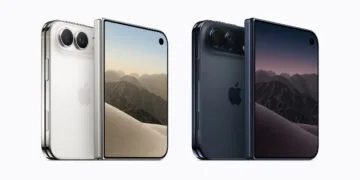
The iPhone 20 is expected to have a slight curve on all four edges. A new leak describes the next step: a display that slopes almost vertically at the sides, replacing the frame. Apple is reportedly waiting for Samsung to bring the technology to market.
With its 2027 anniversary model, Apple plans to make the iPhone virtually bezel-less from the front. The display is expected to be slightly curved on all four sides, as described in previous rumors about the iPhone 20. A new post from the Chinese leaker Instant Digital now paints a significantly more radical picture for the future.
In his post on Weibo, he describes an OLED technology that Samsung reportedly refers to internally as a fully wraparound, full-screen display. According to him, the iPhone 20 would only be an intermediate step.
Key Facts at a Glance
- Samsung is reportedly working on an OLED display that bends backwards at almost a right angle on all four edges.
- The bent display parts would form the sides of the device and replace the metal or plastic frame.
- According to the leak, the technology could also enable an iPhone without classic mechanical buttons.
- Apple should wait until Samsung has resolved its issues with color accuracy, sealing, and antennas.
- The iPhone 20, with its slightly curved display, would only be an intermediate step on this path.
Flat front, vertical edges
Unlike the curved waterfall displays of some Android smartphones, the main surface of Samsung's concept is intended to remain completely flat. The panel only bends sharply at the edges, specifically at all four edges and in the corners, at an angle of almost 90 degrees.
These angled sections would form the side walls of the smartphone. Cables and components that are currently located behind the black border around the display could be moved to the edges. Viewed from the front, virtually no visible border would remain.
What the iPhone 20 already has of this
The iPhone 20 was recently rumored to feature a Samsung display with a slight curve on all four sides . This design is expected to be used, even though a September report indicated that Apple is delaying two panel technologies for the anniversary model: COE without a polarizer and LTPO+.
| Feature | iPhone 20 (2027, according to reports) | Samsung's wraparound display (according to leak) |
|---|---|---|
| Curvature | slightly on all four edges | almost 90 degrees on all four edges |
| Main area | curved at the edges | completely flat |
| Timeframe | Autumn 2027 | not mentioned |
The difference is therefore fundamental. On the iPhone 20, the display extends to the edge; in the described concept, the display itself becomes the edge.
What's still holding things up?
According to Instant Digital, Apple is waiting for Samsung to finalize the technology. Three issues reportedly remain: optical distortion and color shifts in the corners, the protective layer of the OLED panel, which must withstand the extreme bend, and the space for the antennas when all sides are covered by the display.
The last point is particularly crucial for a smartphone. Current iPhones use the metal frame as an antenna, recognizable by the narrow seams in the casing. If the frame is eliminated, a new solution is needed.
Why I interpret the concept as a long-term goal
Instant Digital recently reported on an exclusive supply agreement between Apple and Samsung for the iPhone Duo displays. This time, however, only a single article with a concept graphic is available – without a document, without supplier confirmation, and without a timeframe. This serves as an indication of a development direction, but not as a product plan.
I still find the description plausible because it logically follows on from the 2027 anniversary model: first a slight curve, then the complete abandonment of the frame. However, I don't expect such an iPhone to appear before the end of the decade, especially since the panel technologies for the iPhone 20 are already being delayed.
Would you buy an iPhone with sides made entirely of screen – or do you prefer a solid frame for gripping and cases? Let us know your prediction in the comments.