
This article may contain affiliate links. Learn more on our Partner Program page.
A foldable iPhone with two displays that I use almost exclusively unfolded. Worrying about the battery seems natural. After almost three weeks as my main device, I have a clear picture: besides charging overnight, the iPhone Duo needs one charging stop for me, two on long days, and it doesn't last as long as my iPhone 18 Pro Max.
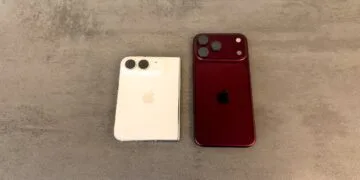
Since launch day, the iPhone Duo has been my main device, with the iPhone 18 Pro Max right next to it. After my first impressions from the first few days and the things I miss from the Pro Max, this time it's all about the battery. I didn't measure anything in a lab. This is how the device holds up in my everyday life, with my usage profile.
The key figures come from the iPhone Duo's EU label. According to it, the battery has a capacity of 4,883 mAh, split across two batteries, one in each half of the device. All other specs and prices are in the iPhone Duo overview.
Key Takeaways
- I start the day at 100 percent and usually charge once more, twice on long days.
- For me, the iPhone 18 Pro Max lasts significantly longer.
- The inner display uses the most battery, while the outer display is frugal.
- In the evening, I usually charge to 70 to 80 percent, which lasts me into the night.
- The Duo stays cooler than my Pro Max models and only gets slightly warm.
My usage profile
My Duo is unfolded almost all day. It's really only folded when I'm out and about; otherwise it lies around open. That way, I often work with two apps in Split View and find it much more comfortable to write longer texts on it.
As a result, my Duo is slowly starting to identify as an iPad mini.
The Duo is rarely idle. I listen to an enormous amount of Apple Music, around 10,000 minutes a month on average, and most of it on my iPhone. When I'm answering emails or writing, there's often a YouTube video playing on the side.
In between, there's chatting and phone calls. I keep apps open in the foreground on the display so I can keep checking them, and outside my own Wi-Fi networks the device runs on 5G. I deliberately don't use other Wi-Fi networks; I'd rather use 5G. All of this adds up to a lot of screen time. Dark Mode only helps so much, even though I have it on all the time.
The camera, on the other hand, I use fairly rarely; it hardly plays a role in my battery usage.
This is also reflected in the battery usage, which iOS breaks down by category. For me, Productivity & Finance comes first, followed by Entertainment, Social, and Information & Reading.
I keep the brightness at around 75 percent. That's down to the inner display: its matte surface combined with Dark Mode is comfortable to read, and I don't need more. On the iPhone 17 Pro Max, on the other hand, I usually had the brightness turned all the way up.
Charging once or twice a day
My day starts at 100 percent. Usually the Duo goes on the charger one extra time, typically in the evening. On especially long days, it's two charging stops of around half an hour each. Part of that is habit: I'd rather have a bit more battery and not take any chances.
The percentage at which I plug in the Duo varies from day to day. I usually charge to about 70 to 80 percent, and depending on when I go to bed, 40 to 50 percent of that is still left. Often, though, the Duo stays on the cable longer and then charges all the way to full.
So on many days, the full overnight charge is joined by almost a second full charge.
I also had to charge the iPhone 17 Pro Max once in the evening, but that was at full brightness and with much more camera use. With lower brightness, the Duo ends up with a similar number of charging stops, and more on long days.
Unfolded costs more
How much battery the Duo uses depends mainly on how long the inner display is on. Unfolded, the battery level drops noticeably faster. Folded, with the smaller outer display, the Duo is much more economical.
I really notice this when I'm out and about. Then the Duo usually stays folded, and the battery level drops noticeably more slowly than on a day at home or in the office when it lies around open. So anyone who mostly uses it folded will last much longer than I do.
Versus the iPhone 18 Pro Max
Here the gap is clear: for me, the iPhone 18 Pro Max lasts significantly longer. I don't need to charge it in the evening, even though its brightness is turned all the way up. The comparison isn't entirely fair, though: the Duo is my main device and is almost always unfolded, while the Pro Max gets less screen time.
| iPhone Duo | iPhone 17 Pro Max | iPhone 18 Pro Max | |
|---|---|---|---|
| Charging besides overnight | usually once, twice on long days | once in the evening | no |
| Battery life for me | shorter than 18 Pro Max | – | much longer than Duo |
| My brightness | around 75 percent | full | full |
| Heat in everyday use | slightly warm | sometimes hotter | sometimes hotter |
Apple's battery specs side by side
Apple's own figures confirm the picture, and they show how much the Duo's battery life depends on the display. The figures come from the tech specs for the iPhone Duo and the iPhone 18 Pro Max.
| iPhone Duo | iPhone 18 Pro Max | |
|---|---|---|
| Batteries | two | one |
| Typical use | up to 24 hours. | up to 29 hours. |
| Video playback | Up to 31 hours indoors, up to 44 hours outdoors | up to 43 hours. |
| Video playback (streamed) | Up to 26 hours indoors, up to 37 hours outdoors | up to 38 hours. |
| Fast charging via cable (from 60W, with adjustable voltage supply on the 18 Pro Max) | 50% in approximately 20 minutes. | 50% in approximately 15 minutes. |
| Fast charging via MagSafe (from 35W) | 50% in approximately 30 minutes. | 50% in 30 minutes. |
| Wireless | up to 25W with MagSafe and Qi2 | up to 25W with MagSafe and Qi2 |
According to Apple, the Duo is in the same league as the Pro Max for video playback when folded, but falls well behind when unfolded. Apple measured the Duo's typical use with both displays used equally. In my case, the focus is clearly on the inner display, and that's exactly what explains the gap to my Pro Max.
Who will notice the switch
For a foldable, the Duo offers good endurance, but not at Pro Max level. Anyone coming from a Pro Max who never had to plug in again in the evening will need to adjust. Anyone who already charged their Pro Max in the evening will have less of an adjustment, though a second charging stop may be needed on long days.
How I charge the Duo
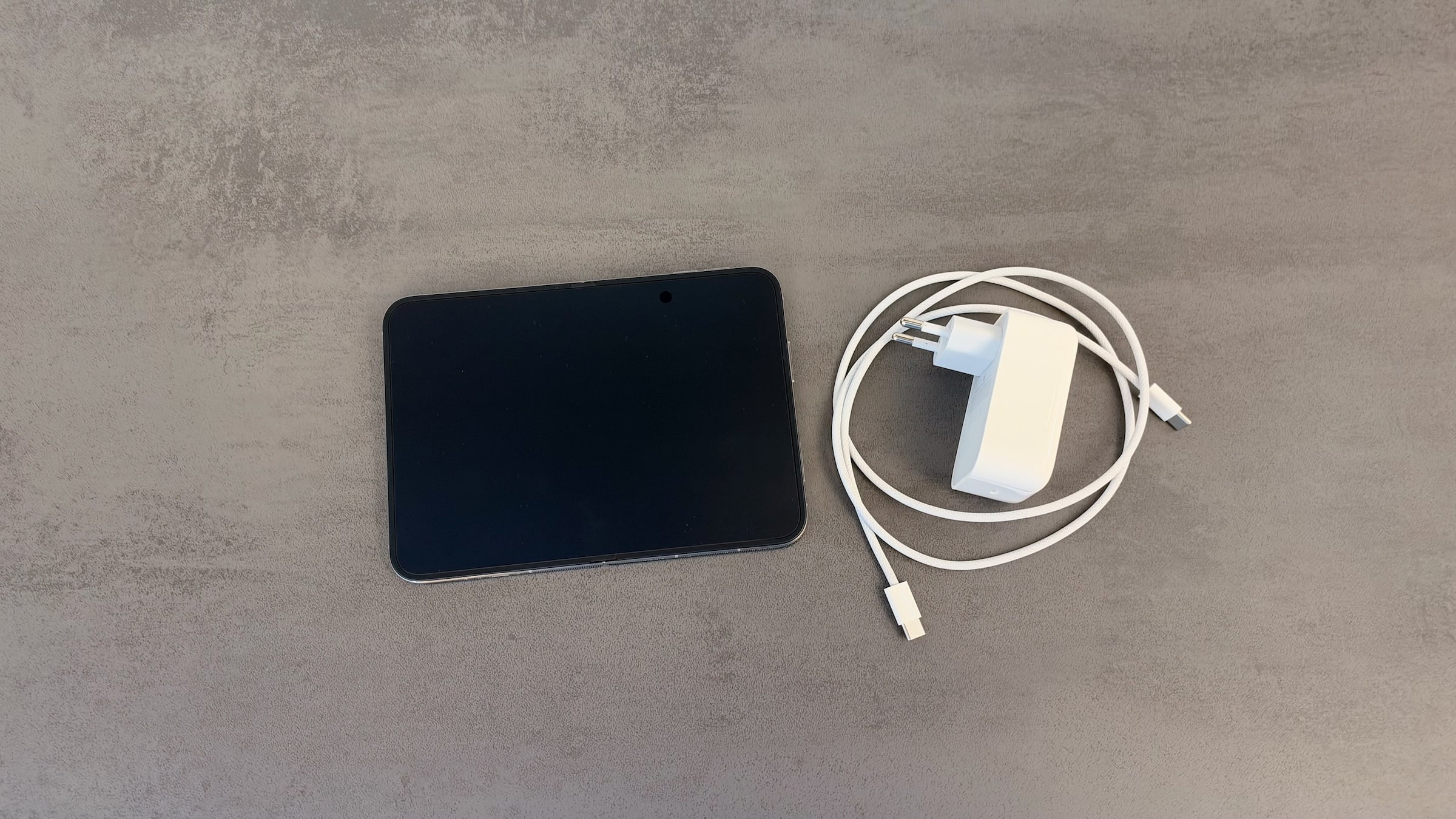
In between, I charge with a cable, usually in the evening, and with the device unfolded because it's faster that way. For this I use Apple's 40W Dynamic Power Adapter with 60W Max. If it needs to be quick, 15 to 20 minutes is enough to get me through the evening. If I have time, the Duo stays plugged in until it's full. Apple quotes around 20 minutes for 50 percent and measured that figure with the device unfolded. Fast charging the iPhone Duo with a cable requires a power adapter that delivers at least 60 watts.
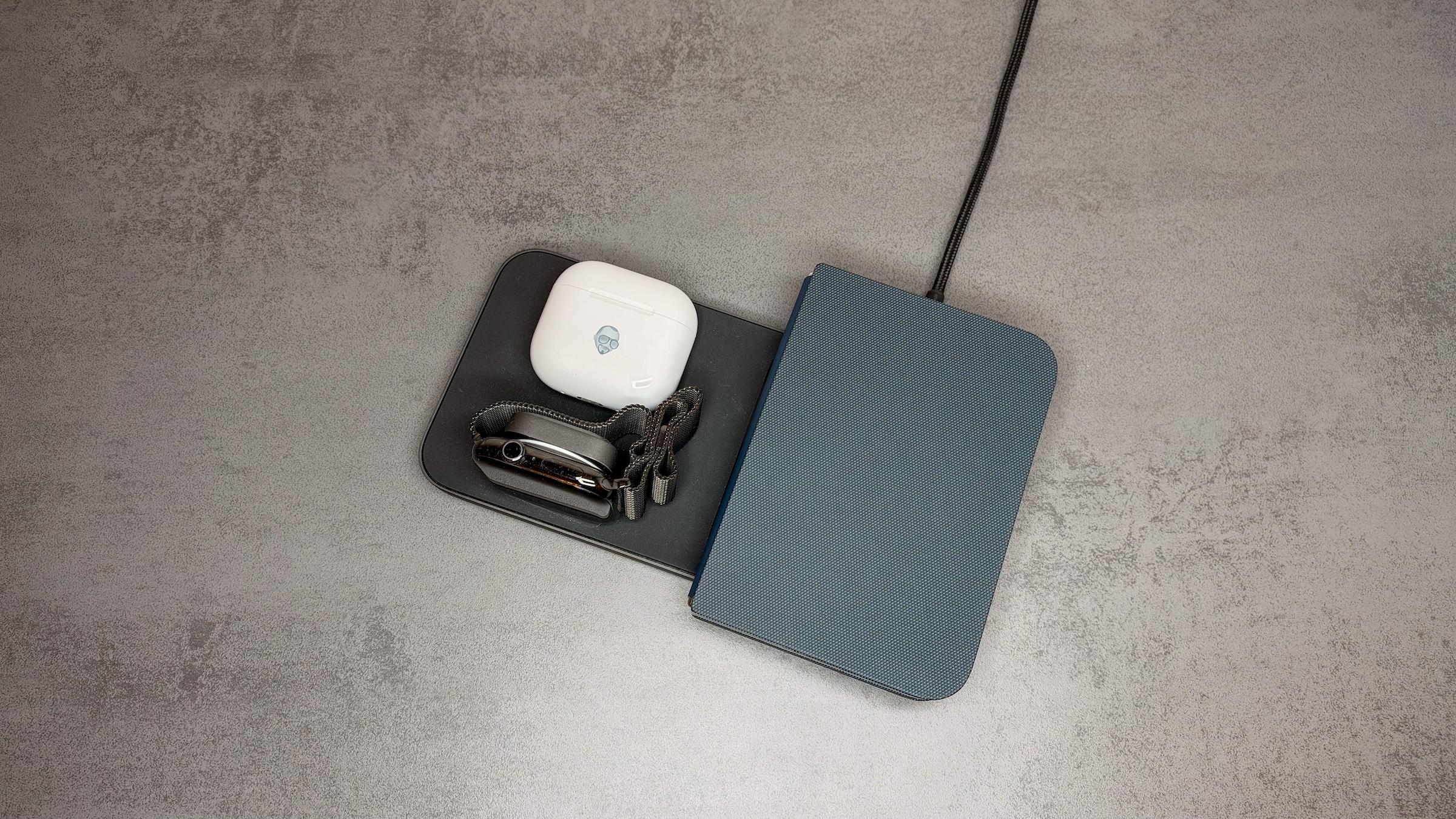
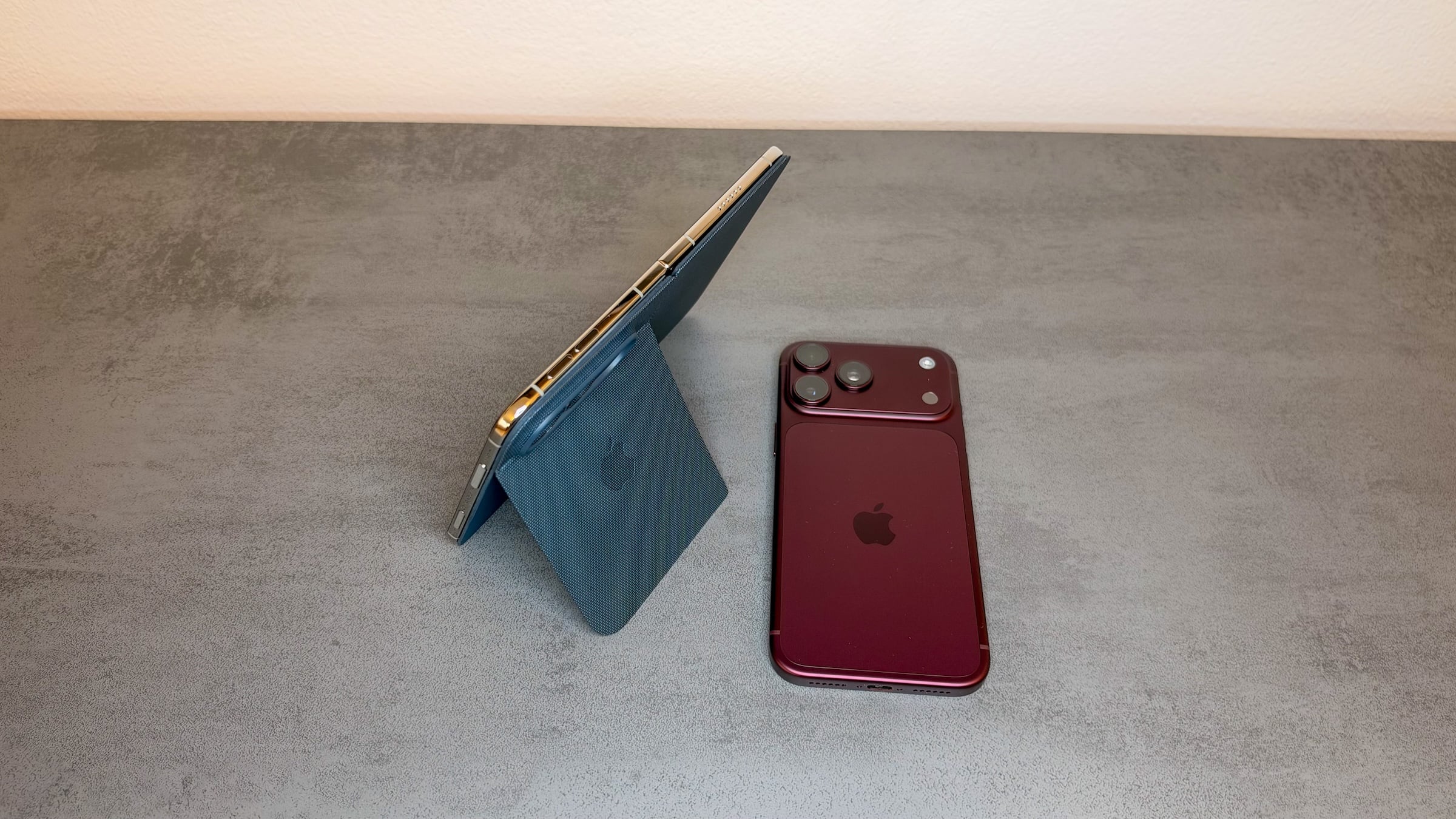
At night, the Duo charges wirelessly on a Nomad charging station. It works with the Duo without any problems, and the magnets hold it securely when folded. For StandBy, on the other hand, the Duo doesn't need a cable at all; it's enough to stand the device up half unfolded. When I'm on the road, I top it up in the car. So far I haven't needed a power bank and never carry one.
I hardly touch the settings. "Optimized Battery Charging" is on, I haven't set a charge limit, and I never use Low Power Mode. The only real saving measure is the lower brightness.
Cooler than the Pro Max models
One thing surprised me: so far, the Duo stays remarkably cool, even when topping up with a cable. It does get slightly warm, but my previous iPhone 17 Pro Max sometimes got much hotter, and that's still the case with the 18 Pro Max today.
With the Duo, Apple spreads heat across both halves of the device using a vapor chamber and a flexible graphite tube running through the hinge. When unfolded, the device therefore has a large surface area to dissipate heat.
I put the fact that the Duo stays cool even during fast charging down to its two batteries, one in each half. When folded, they sit on top of each other and probably heat each other up. When unfolded, each half can dissipate its own heat.
Unchanged since launch
My iPhone Duo has been in constant use since launch day, and battery life has stayed the same since day one. Neither iOS 27.1 nor iOS 27.2 has noticeably improved or worsened it.
As of November 12, 2026, Battery Health shows a Maximum Capacity of 100 percent for both batteries. The first battery is at 40 charge cycles, the second at 37, and iOS confirms that both are performing as expected. That the cycle count is already this high after just a few weeks fits my charging habits: on top of the overnight charge there are one or two charging stops, and the Duo often stays plugged in until it's full. That's nothing unusual for me: from launch day until they're replaced by their successor, so in roughly a year, my iPhones usually reach more than 600 charge cycles.
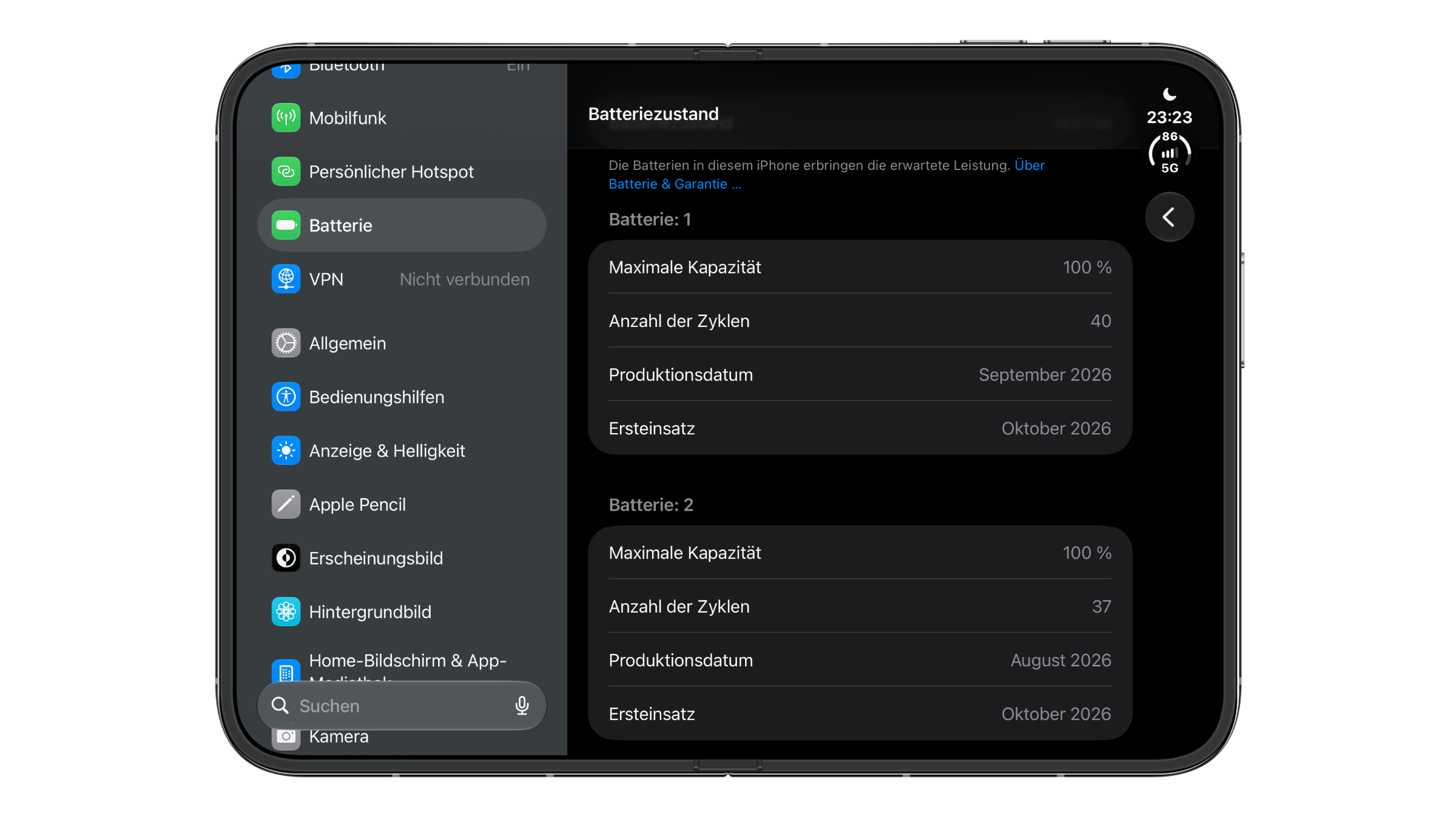
According to the EU label, the Duo's batteries are rated for at least 1,000 charge cycles. Measured against that, my device is still right at the beginning after the first few weeks, and I expect it to stay below that mark in its first year, even with my charging habits.
A full day is doable
With my usage profile, I usually need one charging stop besides the overnight charge, two on long days. In my experience, anyone who keeps the device folded more often, doesn't crank up the brightness, and doesn't constantly have music and videos running in the background will get through the day without any problems.
That's why battery life isn't a reason against the Duo for me. It's a compromise you should be aware of: you don't get the endurance of a Pro Max, but in return the Duo has the bigger display.
How much time does your Duo spend unfolded – and do you need to plug it in in the evening, or do you get by without? Tell me in the comments what your day with the battery looks like.