
This article may contain affiliate links. Learn more on our Partner Program page.
Apple and Samsung are now building their foldable phones in remarkably similar ways. On paper, they're very close, but the decision hinges on other factors: weight, battery life, price, and when the device will actually arrive.
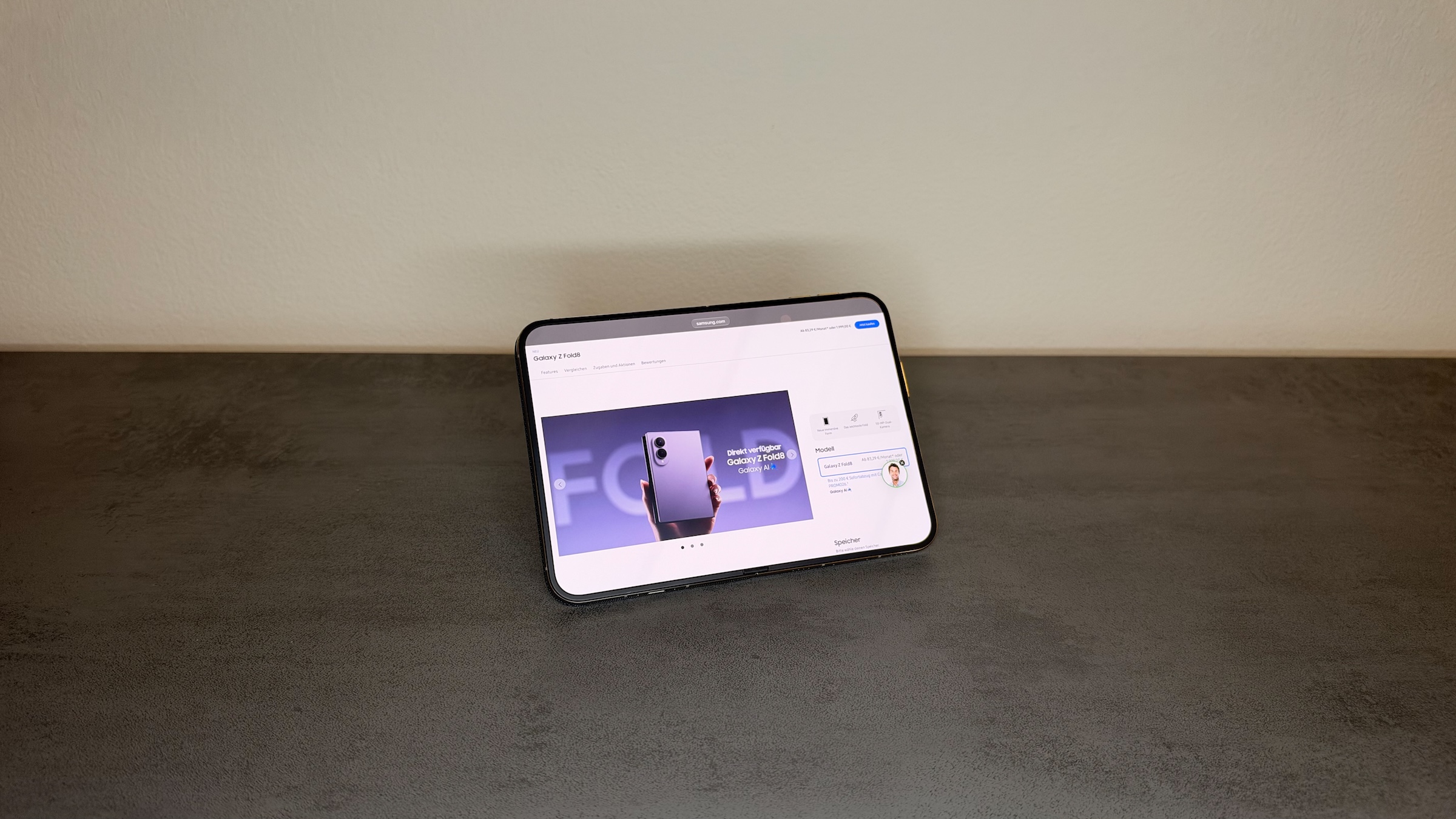
With the iPhone Duo, Apple launched its first foldable iPhone, while Samsung is now in its eighth generation with the Galaxy Z Fold8. Both open like a book, both have a 7.6-inch display inside, and both feature a wide design.
The comparison is based on Apple's technical data and Samsung's specifications, both for Germany. The larger Galaxy Z Fold8 Ultra is excluded, as it aims for a different design with an 8-inch internal display and a slim, tall form factor when folded.
Key Facts at a Glance
- The Galaxy Z Fold8 is thinner, lighter and, at €1,999, cheaper than the iPhone Duo at €2,299.
- The iPhone Duo offers better protection against dust, higher charging power, and up to 2TB of storage.
- Samsung states up to 26 hours of video playback for the main display, Apple up to 31 hours internally, and up to 26 hours for streaming.
- The iPhone Duo supports the Apple Pencil (USB-C), the Galaxy Z Fold8 is not compatible with the S Pen.
- The iPhone Duo is currently hard to get, but the Galaxy Z Fold8 is available immediately.
The differences at a glance
| Feature | iPhone Duo | Galaxy Z Fold8 |
|---|---|---|
| Entry price (256 GB) | 2,299 euros | 1,999 euros |
| Storage | 256 GB to 2 TB | 256 GB to 1 TB |
| Inner display | 7.6 inches, 1878 × 2670 pixels | 7.6 inches, 1848 × 2448 pixels |
| External display | 5.4 inches, 1398 × 2034 pixels | 5.5 inches, 1248 × 1972 pixels |
| Refresh rate | up to 120 Hz | up to 120 Hz |
| Unfolded | 164.6 × 117.8 × 5.2 mm | 161.4 × 123.9 × 4.5 mm |
| Folded | 84.1 × 117.8 × 11.3 mm | 81.9 × 123.9 × 9.7 mm |
| Weight | 254 g | 201 g |
| Chip | A20 Pro | Snapdragon 8 Elite Gen 5 for Galaxy |
| Rear cameras | 48 MP + 48 MP | 50 MP + 50 MP |
| Front cameras | 12 MP external, internally under the display | 10 MP outside, 10 MP inside |
| Battery | 4,883 mAh | 4,800 mAh |
| Indoor video playback (manufacturer's specification) | Up to 31 hours, streamed up to 26 | up to 26 hours |
| Charging by cable | up to 60 W | up to 45 W |
| Protection | IP68 | IP48 |
| Pen | Apple Pencil (USB-C) | no S Pen |
| SIM | eSIM only | Nano-SIM plus eSIM |
| Unlock | Touch ID in the side button | Fingerprint on the side |
Design: Almost the same size, 53 grams difference
The two devices differ in size by only a few millimeters. However, Samsung clearly has the edge in weight and thickness: 201 grams instead of 254, and 9.7 millimeters thick when folded instead of 11.3 millimeters.
The displays differ more in format than their inch measurements would suggest. The outer display of the iPhone Duo, with an aspect ratio of approximately 1.46, is wider than that of the Galaxy Z Fold8, which has an aspect ratio of approximately 1.58. The situation is reversed on the inner display: the iPhone Duo has an aspect ratio of approximately 1.42, while the Galaxy Z Fold8 uses the wider 4:3 aspect ratio.
In terms of protection, the iPhone Duo offers more with its IP68 rating, as it is also dustproof. The Galaxy Z Fold8 has an IP48 rating and is therefore not dustproof, only resistant to foreign objects larger than one millimeter. Regarding water resistance, Apple specifies up to 6 meters for up to 30 minutes, while Samsung specifies up to 1.5 meters for 30 minutes in fresh water. For those who frequently use their device at the beach or in dusty environments, this is a compelling reason to choose the iPhone Duo.
Displays in everyday life
Both manufacturers specify 3,000 nits peak brightness and 120 Hz for both displays; Apple for outdoor use, Samsung for specific areas. The inner display of the iPhone Duo also features a nano-texture coating, and the main display of the Galaxy Z Fold8 is also anti-reflective.
On my iPhone Duo, this nanotexture is my absolute favorite feature, especially outdoors in bright ambient light. The crease is visible and palpable on dark content in bright light, but I forget about it when I'm working. I use the large display about 95 percent of the time.
Battery, charging and update period
The battery capacities are almost identical at 4,883 mAh and 4,800 mAh. Apple states up to 31 hours of video playback and up to 26 hours of streaming for the iPhone Duo's inner display. For the outer display, these figures are up to 44 and 37 hours, respectively. Samsung claims up to 26 hours for the main display, measured, according to a footnote, with a 720p video stored on the device, even though the graphic on the product page refers to streaming.
In Tom's Guide's new battery test specifically tailored to the iPhone Duo, the iPhone Duo came out on top with a runtime of 13 hours and 20 minutes, while the Galaxy Z Fold8 lasted 10 hours and 6 minutes. According to Apple, when charging via cable with a 60W or higher power adapter, the iPhone Duo reaches approximately 50 percent in about 20 minutes. In the same test, despite its lower power output, the Galaxy Z Fold8 was ahead after 15 minutes with 43 percent compared to 42 percent, and after 30 minutes with 70 percent compared to 66 percent.
According to Apple, the iPhone Duo's battery is designed for at least 1,000 charge cycles, while Samsung specifies at least 1,200 for the Galaxy Z Fold8. Samsung guarantees security updates until July 31, 2033, while Apple states at least five years of updates in its EU data sheet, without specifying the type of updates.
Software: The actual platform change
I expect that in the end, the system will usually be the deciding factor, not the hardware. iOS versus Android means switching apps, services, and accessories, and those who use an Apple Watch or AirPods will remain on the same system with the iPhone Duo.
Samsung offers more in terms of multitasking. According to Samsung, up to three apps can run side-by-side on the Galaxy Z Fold8, in addition to pop-up windows and Samsung DeX. The iPhone Duo displays two apps side-by-side in Split View. However, it supports the Apple Pencil (USB-C), while the Galaxy Z Fold8, according to Samsung, is not compatible with the S Pen.
There's also a difference regarding AI, which particularly affects users in the EU. Siri AI is not yet available on iPhones in the EU, with the exception of Switzerland. Galaxy AI, on the other hand, is available on the Galaxy Z Fold8 in these countries.
Price and availability in Germany
The iPhone Duo starts at €2,299, and the Galaxy Z Fold8 at €1,999 in the Samsung shop, both with 256 GB of storage. Retail prices for the Galaxy Z Fold8 are significantly lower.
Availability is currently a key factor when buying an iPhone. The iPhone Duo remains in short supply; Apple is listing delivery dates online until the end of January. The Galaxy Z Fold8 is available from Samsung's stock.
Which foldable is right for whom?
I see the iPhone Duo as clearly superior if you're already part of the Apple ecosystem. The nano-texture, Apple Pencil, and tight integration with Mac, Apple Watch, and iCloud add more than 53 grams to the overall cost. For these buyers, the comparison with the iPhone 18 Pro is the more important factor.
The Galaxy Z Fold8 makes more sense for anyone using Android, wanting the lightest possible foldable phone, or who doesn't want to wait until January. In my opinion, switching solely for hardware reasons isn't worthwhile in either direction, as the devices are too similar.
Would you be willing to switch operating systems for a foldable device, or is the operating system always your primary consideration? Tell us in the comments what device you're currently using and where you've ended up.
Frequently Asked Questions: iPhone Duo vs. Galaxy Z Fold
It depends primarily on the system. The iPhone Duo offers IP68 water and dust resistance, 60 watts of charging power instead of 45 watts, and the Apple Pencil (USB-C). The Galaxy Z Fold8 is thinner, lighter, and cheaper.
The Galaxy Z Fold8 weighs 201 grams and is 4.5 millimeters thick when unfolded and 9.7 millimeters thick when folded. The iPhone Duo weighs 254 grams and measures 5.2 and 11.3 millimeters.
The Galaxy Z Fold8 starts at €1,999 in the Samsung shop, the iPhone Duo at €2,299 at Apple, both with 256 GB.
Apple claims up to 31 hours of internal video playback and up to 26 hours of streaming. Samsung claims up to 26 hours for the main display when playing locally stored video. In Tom's Guide's new battery test specifically for the iPhone Duo, the iPhone Duo lasted 13 hours and 20 minutes, ahead of the Galaxy Z Fold8 at 10 hours and 6 minutes.
The iPhone Duo has an IP68 rating and, according to Apple, is protected against water up to 6 meters deep for up to 30 minutes. The Galaxy Z Fold8 has an IP48 rating and, according to Samsung, is protected against water up to 1.5 meters deep in fresh water for 30 minutes, but not against dust, only against foreign objects larger than one millimeter.
The iPhone Duo supports the Apple Pencil (USB-C). According to Samsung, the Galaxy Z Fold8 is not compatible with the S Pen.
No, the iPhone Duo only works with eSIM. The Galaxy Z Fold8 accepts one nano-SIM and one eSIM, or it can run with two eSIMs.