After years of delays, a date has apparently been set. Apple is expected to unveil its smart home hub with a display on October 13, along with a new HomePod mini and a new Apple TV. The report describes the hub in detail – from its stand to guest mode.
Apple will reportedly launch its smart home initiative on Tuesday, October 13, according to a Bloomberg report. Mark Gurman cites sources familiar with the plans. For John Ternus, Apple's CEO since September 1, this would mark the company's entry into a product category it has repeatedly postponed for years.
Until now, only a timeframe was known: previous reports on the HomePad indicated a launch no earlier than October. Now the date has been added, along with a detailed description of the casing, operation, and person detection.
Key Facts at a Glance
- Three devices are scheduled to be released on October 13: a smart home hub with a display, a new HomePod mini and a new Apple TV.
- HomePod mini and Apple TV retain their design and get faster chips for Siri AI; the HomePod mini also gets new colors like pink and green.
- The hub is expected to have a square display of around 6 inches, available as a desktop device in the style of the iMac G4 and as a wall-mounted version.
- According to the report, it recognizes who is standing in front of it and displays relevant content – but it does not have facial recognition at the level of Face ID.
- Siri AI is at the center of all three devices, but so far it does not speak German.
Three devices in one day
In addition to the hub, two updates to existing devices are planned. The HomePod mini and Apple TV are expected to remain externally unchanged but will receive faster chips capable of running Siri AI. According to reports, the HomePod mini will also be available in new colors, including pink and green.
All three devices were originally planned for 2024. The report attributes the delay to Siri AI. Apple only rolled out the new assistant in mid-September with iOS 27. Image files from Apple's own materials, as well as a note in an Apple support document, now also support the release of the HomePod mini and Apple TV.
| Device | According to the report | Last generation so far |
|---|---|---|
| Smart Home Hub | new product category, table and wall version | – |
| HomePod mini | Same design, faster chip, new colors | Presented on October 13, 2020 |
| Apple TV 4K | Same design, faster chip | Published in 2022 |
The HomePod mini's release coincides with exactly six years to the day after the introduction of the first model. Apple TV generations are separated by roughly four years; findings in the tvOS code suggest an A19-generation chip.
This is what the hub is supposed to look like
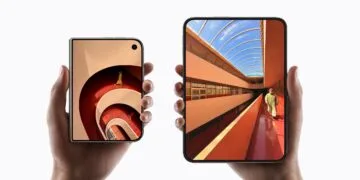
The display is expected to be square and measure around 6 inches, surrounded by a black border of about a quarter of an inch. Earlier reports had mentioned a 7-inch square display. The casing is said to be about as thick as an iPhone, made of gray aluminum, and will lack volume and power buttons.
In the desktop version, the screen sits on a polished metal arm above a round base with several rings of speaker openings. The display can be tilted forwards and backwards manually, and the underside is rubberized. The design is reminiscent of the 2002 iMac G4, which also had its screen mounted on a hemispherical base.
The wall-mounted version replaces the round base with a flat, square base beneath the display, which houses the speakers and microphones. Neither version has a battery; they are permanently connected via a USB-C cable.
What the hub should be able to do
According to reports, Apple envisions multiple hubs within a single household. These hubs would control smart home devices, enable video calls and announcements between rooms, play music, and display photos as slideshows. In the kitchen, they would play videos and allow users to search for recipes via voice command.
A front-facing FaceTime camera, along with voice recognition, detects who is speaking or approaching. The interface then adjusts to that person, and there's a mode for visitors that hides personal content. However, the facial recognition is said to work without a depth sensor and is less reliable than Face ID. Users can optionally enable additional verification via their iPhone, which also steps in if the Hub fails to recognize someone.
According to reports, the user interface blends elements of Apple Watch, Apple TV, and iPad. The home screen displays apps similar to the Watch, which then open in multi-column views like on the iPad. Among the apps reportedly included are Calendar, Messages, Photos, FaceTime, Notes, Reminders, Music, and Podcasts; widgets and custom wallpapers are also supported. The interface's structure was already evident in Apple's code.
What is to follow after October 13th
According to the report, this date is just the beginning. Apple is reportedly working on expanding its HomeKit smart home platform to include new device categories and is developing devices with third-party manufacturers that are designed for Siri AI. The larger HomePod is expected to be updated later, but the report does not specify a date.
A home security camera has been on Apple's agenda for some time. According to a recent report, it will include a sensor that can detect which room someone is in without recording video. Apple is also pursuing a higher-end model of the Hub with a 9-inch display mounted on a robotic arm that can rotate 360 degrees – an idea that surfaced in reports earlier this year.
How reliable is the date?
The report comes from Mark Gurman, whose predictions about Apple's product plans have been among the most reliable for years. The date is specific, and the description of the hub goes into details such as its rubberized underside.
For HomePod mini and Apple TV, there's a second piece of evidence: the devices themselves are documented by Apple's own image files. For the Hub, the evidence from Apple's material currently only extends to the user interface code; there are no product images.
Siri AI doesn't speak German yet
All three devices are designed for Siri AI. The assistant launched in mid-September in English only; Apple has announced French, Japanese, Korean, Portuguese, and Spanish for October. German is not among them, and Apple has not given a date for its release.
For buyers in Germany, Austria, and Switzerland, the launch coincides with a period in which the devices' core functionality is only available in English. The five new languages are already included in the iOS 27.2 beta, but German is still missing.
A screen in the kitchen that is supposed to read faces
I consider the release date reliable. The description is too detailed for a mere simulation, and Apple's own images are available for two of the three devices. The fact that the HomePod mini is supposed to be released exactly six years after its predecessor is a nice side note, but not additional proof.
The most critical point, in my opinion, is person recognition. A device hanging in the kitchen or hallway, displaying messages, calendar entries, and photos, reportedly recognizes people less reliably than Face ID. Therefore, iPhone verification is more than just a convenience option, and I would enable it from day one.
In this country, the language issue comes into play. Those who want to buy the Hub because of Siri AI will initially only get the assistant in English.
Would you allow a screen in your kitchen to recognize your face and display your messages – or would you require immediate confirmation via iPhone? Let us know in the comments how much access you would grant the hub.