This article may contain affiliate links. Learn more on our Partner Program page.
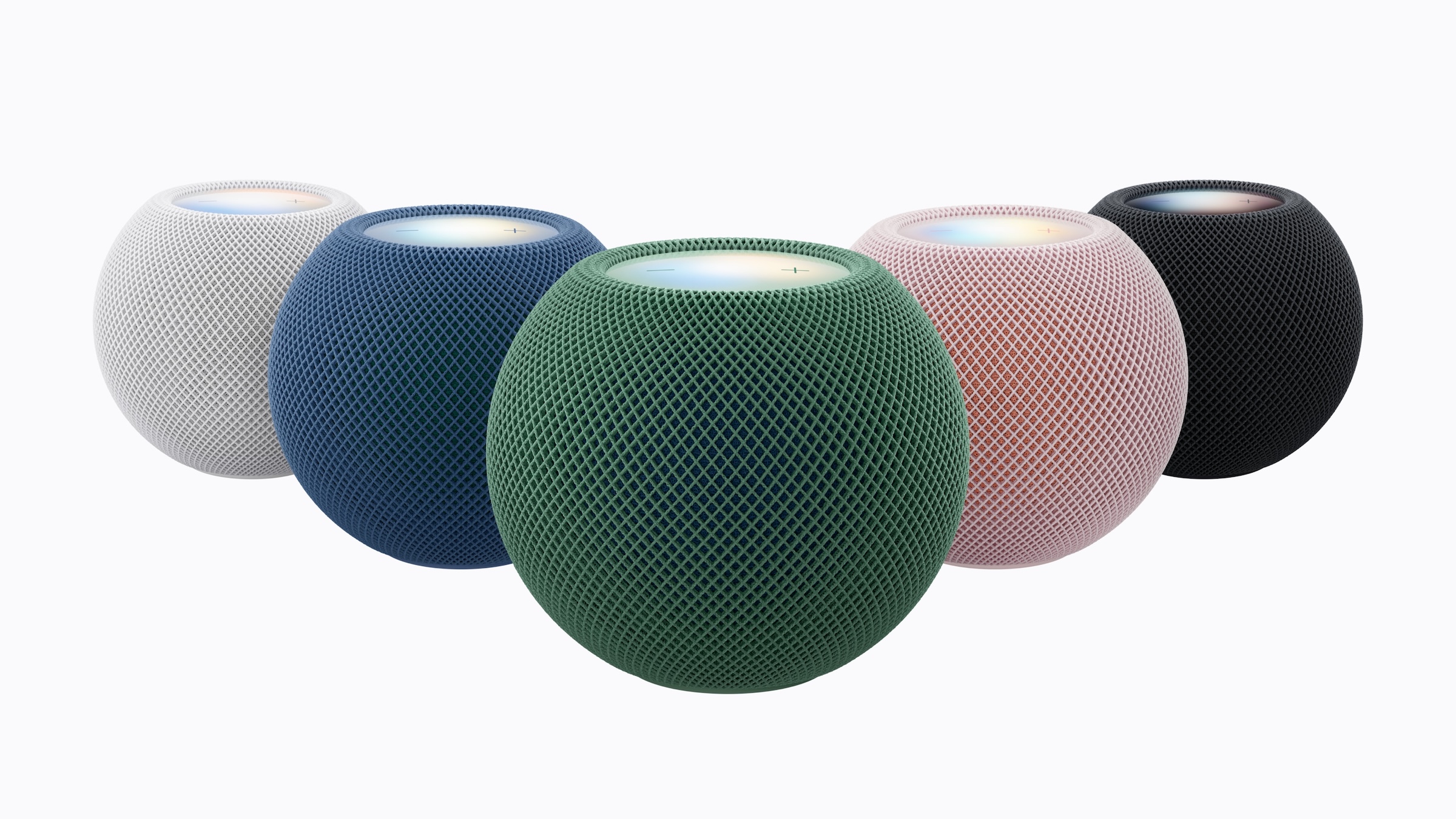
Almost six years after the first model, Apple has revamped the HomePod mini: with an S10 chip, five new colors, a top that lights up to the music, and for the first time, surround sound from four speakers. In Germany, it costs €169 and will be available on October 30th. Siri AI, which Apple is promoting, will follow later and not initially in Germany.
Apple unveiled the HomePod mini 2 on October 13 at the "Welcome home" event, together with the smart home hub HomeView and the new Apple TV 4K. The details are in the German announcement in the Apple Newsroom, and the technical specifications are in the German data sheet.
The first HomePod mini was released in October 2020 and remained unchanged except for new colors. By April 2026, it had gone approximately 2,000 days without a hardware update, longer than any other active Apple product. Apple originally developed the S5 chip for the Apple Watch Series 5 in 2019.
Key Facts at a Glance
- The HomePod mini 2 has the S10 chip, Wi-Fi 6E and Bluetooth 6, and comes in pink, green, blue, white and midnight.
- With the fourth-generation Apple TV 4K, four speakers create a surround sound for the first time that automatically adjusts to the room.
- Sound Glow makes the top surface light up to the music, and the speaker also serves as the standard speaker on the Mac.
- It costs 169 euros in Germany and is available from Friday, October 30th, and can be pre-ordered since October 13th.
- Siri AI will arrive via a later update, initially only in English and in eight countries. Germany is not among them.
Technical specifications compared
Externally, the HomePod mini remains unchanged: height and diameter are identical, but the weight has decreased by ten grams. Internally, however, more significant changes have been made.
| HomePod mini | HomePod mini 2 | |
|---|---|---|
| Chip | S5 | S10 |
| Speakers | Broadband driver, two passive membranes | Broadband driver, two passive membranes |
| Microphones | four | three |
| Wi-Fi | 802.11n (WLAN 4) | WLAN 6E |
| Bluetooth | 5.0 | 6 |
| Thread | Yes | Yes |
| Ultra-broadband | Yes | Yes |
| Temperature and humidity sensor | Yes | Yes |
| Mass | 84.3 mm high, 97.9 mm wide | 84.3 mm high, 97.9 mm wide |
| Weight | 345 g | 335 g |
| Power supply included | 20 watts | 20 watts |
| Price in Germany | 139 euros (last price) | 169 euros |
The Ultra Wideband chip detects when an iPhone is nearby and requires an iPhone with a U1 chip. Setup requires an iPhone or iPad with current software and Wi-Fi. Apple specifies HomePod software version 27.2.
Sound and Sound Glow
The S10 chip continuously analyzes the music and adjusts dynamics, volume, and sound. The speaker radiates sound in all directions, individually, as a stereo pair, or distributed throughout multiple rooms.
New is Sound Glow: The top surface lights up and pulsates in sync with the bass and treble. The colors are based on the album art of the currently playing track, so each song looks different. There are also separate animations for soundscapes like rain. According to Apple, Sound Glow's voice control requires an iPhone with Apple Intelligence and the latest software.
Surround sound with the Apple TV 4K
Together with the new Apple TV 4K, it's now possible for the first time to create surround sound using four speakers. Apple TV and speakers detect the position of each speaker in the room and automatically adjust the timing and volume.
A stereo pair is placed at the front and another at the back; compatible models are the HomePod mini 2 and the second-generation HomePod. As before, a stereo pair consists of two speakers of the same model, but the two pairs can be different: a second-generation HomePod pair can be placed at the front, and a pair of HomePod mini 2s at the back. A fourth-generation Apple TV 4K with the latest software is required.
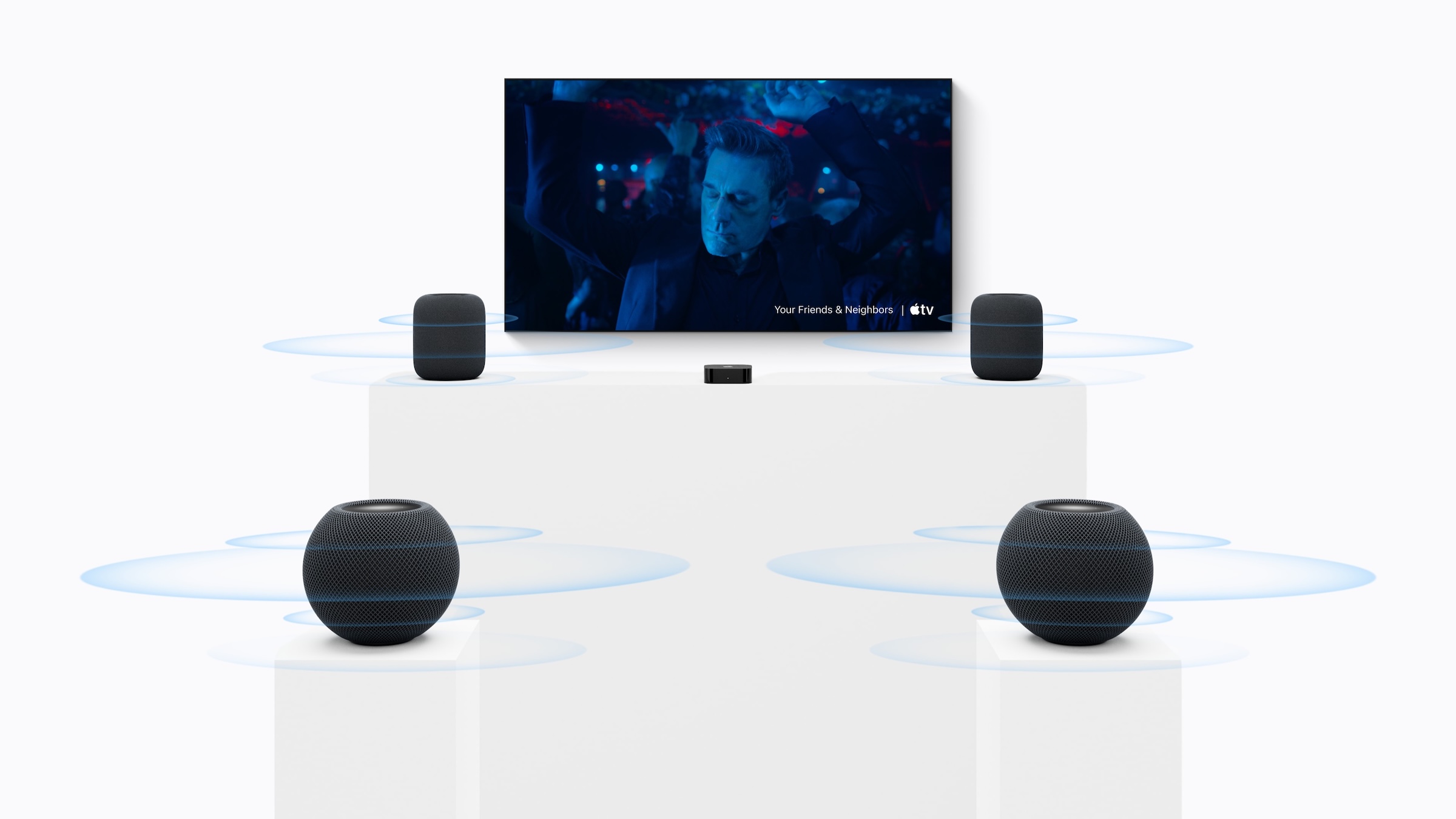
The first-generation HomePod mini and the first-generation HomePod are not included. In the second beta of tvOS 27.2, surround sound was still demonstrated with two pairs of second-generation HomePods connected to the third-generation Apple TV 4K. Apple is only officially referring to the fourth-generation Apple TV.
Speakers for Mac
On a Mac, the HomePod mini 2 serves as the standard speaker for music, movies, games, FaceTime, and video calls, either individually or as a stereo pair. A Mac with Wi-Fi 6E or later is required. According to Apple, the colors are designed to match compatible Macs.
Smart Home Hub
As a control center for Apple Home, the HomePod mini 2 lets you control lights, locks, garage doors, blinds, and thermostats with your voice. Scenes and automations can be created in the Home app, and accessories remain accessible via your iPhone even when you're away from home. It also integrates directly with Thread devices using HomeKit or Matter.
If it detects a smoke or carbon monoxide alarm, it immediately sends a notification to the iPhone, iPad, and Apple Watch. The Home app then allows users to listen in and speak with people nearby. Apple points out that this feature is not suitable for emergencies and requires a separate update to the Home architecture.
Together with doorbells and cameras that use HomeKit Secure Video's facial recognition, it announces who is at the door. Apple explicitly mentions the Apple Home Collection for this purpose, which, however, is only available in the US, Canada, and parts of the UK.
Siri AI: announced, but not for Germany
Apple will bring Siri AI to the HomePod mini 2 via a later, free software update. According to the English announcement, the assistant will be able to hold conversations, answer knowledge-based questions with up-to-date information from the web, find music more easily, and access personal content, such as a song someone has recommended via message or a recipe from an email.
At launch, Siri AI will only run in English in the US, Australia, the UK, India, Canada, New Zealand, Singapore, and South Africa. Users managing their homes with the Home app will need an iPhone or iPad with Apple Intelligence and Siri AI enabled. According to Apple, Siri AI will not initially be available on iPhones and iPads in the EU, meaning it is not available in these regions.
The English announcement also describes how the speaker can recognize up to six people in the household by their voices and connect their devices for messages, timers, and favorite music. The German version omits Siri AI and voice recognition entirely. The same connection to the household's iPhone applies to Siri AI on the Apple TV 4K.
The HomePod mini 2 processes Siri requests either on the device itself or via Private Cloud Compute, where, according to Apple, the data is neither stored nor accessible to Apple or others. Apple does not save audio recordings of Siri requests by default.
Price and Availability
In Germany, the HomePod mini 2 costs €169, and in the US, $149. Pre-orders have been available since October 13th, and it will be in stores starting Friday, October 30th, in the US and more than 23 other countries and regions.
| Period | Price in Germany | Price USA |
|---|---|---|
| HomePod mini until June 24, 2026 | 109 euros | 99 dollars |
| HomePod mini available from June 25, 2026 | 139 euros | $129 |
| HomePod mini 2 | 169 euros | $149 |
During the price update on June 25th, Apple had already increased the price of the previous HomePod mini without making any changes to the hardware. Compared to the price at the beginning of the year, the successor is therefore €60 more expensive.
Accessibility and Environment
Apple lists accessibility features such as adjustments for touch operation, VoiceOver, Siri, control via the Home app and HomeKit, and transcriptions of intercom announcements.
All magnets are made from 100 percent recycled rare earth elements, and the coating on the Apple-designed circuit boards is made from 100 percent recycled copper, gold, and solder. The packaging is made entirely of fiber material.
What was known beforehand and what wasn't true
Bloomberg had reported the October 30th release date for Apple TV 4K and HomePod mini a few days earlier; it was accurate for the HomePod mini 2. Product images in Apple's code at the end of September had revealed a color palette that lacked yellow and orange. According to a code analysis, the system behind Siri AI was already present in the current HomePod software, albeit inactive.
| Feature | Status of the reports | According to Apple |
|---|---|---|
| Chip | S9, S10 or S11 | S10 |
| Design | unchanged | unchanged, 10g lighter |
| Colours | new tones, red tested | Pink, Green, Blue, White, Midnight |
| Radio | N1 chip with WLAN 7 possible, minimum WLAN 6E | WLAN 6E, Bluetooth 6 |
| Ultra-broadband | second generation | Ultra-wideband chip, generation not specified |
| Siri AI | key selling point at launch | via a later update, initially only English. |
| Market launch | Autumn, last updated October 30th | October 30 |
| Price | open | 169 euros |
Who is the HomePod mini 2 intended for?
The HomePod mini 2 is aimed at anyone looking for a compact speaker for Apple Home, and especially at households wanting to set up a home theater with the new Apple TV. Apple only offers four speakers that self-calibrate in this configuration, and this works independently of Siri AI. If you own a first-generation HomePod mini, you'll primarily get the more modern chip, faster Wi-Fi, the lighting effect, and the surround sound capability.
I consider the HomePod mini 2 a solid hardware update for this region, but without Siri AI, it only delivers a fraction of what Apple advertises. Bloomberg recently cited roughly five months after the launch of iOS 27 as the best-case scenario for Siri AI to arrive on EU iPhones. I expect Apple to introduce Siri AI in the EU with German language support at the same time, thus bringing its most important feature to the HomePod mini 2 here.
Are you buying the HomePod mini 2 now for its sound and surround sound, or are you waiting until Siri AI is available in German? Tell us in the comments what you use your HomePod mini for.