This article may contain affiliate links. Learn more on our Partner Program page.
For years, Apple's smart home hub was rumored to be the HomePad, but now it's official: HomeView combines a 7-inch display with a speaker, recognizes up to six people, and controls the home via Siri AI. The device will be released on November 13th, but only in eight countries. Apple will not be selling it in Germany.
Apple unveiled HomeView on October 13 at the "Welcome home" event, together with the HomePod mini 2, a new Apple TV 4K, and its own line of accessories. The details are in the announcement in the Apple Newsroom, and the complete specifications are in the technical data sheet.
Until now, the HomePod, HomePod mini, and Apple TV served as the control center for Apple Home. HomeView is the first device of its kind with its own screen and camera. It is available as a tabletop model and a wall-mounted model, both priced at $299 in the US.
Key Facts at a Glance
- HomeView has a 7-inch display, the A18 chip and a 12-megapixel camera, and comes as a table model in four colors and as a wall model in two colors.
- The device recognizes up to six people and displays their own content to each. Personal content only appears when the paired iPhone or iPad is nearby.
- Both models cost $299 and will be available in eight countries from November 13th, with pre-orders open since October 13th.
- Apple does not sell HomeView in the EU because Siri AI is not available on iOS in the EU. Furthermore, Siri AI on HomeView only speaks English.
- Setup requires an iPhone with iOS 27.2 or an iPad with iPadOS 27.2.
Technical data at a glance
| HomeView | HomeView (Wall Mounted) | |
|---|---|---|
| Display | 7 inches, 1088 × 1088 pixels, 220 ppi | 7 inches, 1088 × 1088 pixels, 220 ppi |
| Brightness | 0.3 to 500 nits, True Tone | 0.3 to 500 nits, True Tone |
| Chip | A18 | A18 |
| Camera | 12 MP, Center Stage, ƒ/2.4 | 12 MP, Center Stage, ƒ/2.4 |
| Microphones | four | four |
| Speakers | two broadband drivers, woofer, two passive radiators | two broadband drivers |
| Radio | Wi-Fi 6E, Bluetooth 6.0, Thread | Wi-Fi 6E, Bluetooth 6.0, Thread |
| Dimensions according to Apple | 14.55cm; 13.67-17.32cm; 9.60-13.02cm | 14.55 × 14.55 × 0.98 cm |
| Weight | 952 g | 286 g |
| Colours | Silver, Polaris, Rose Pink, Space Grey | Silver, Space Grey |
| Price USA | $299 | $299 |
The display is square with rounded corners, measuring 6.98 inches diagonally. It also features an ambient light sensor, an accelerometer, and a temperature and humidity sensor, which Apple says is designed for indoor environments between approximately 15 and 30 degrees Celsius.
Two designs: table and wall
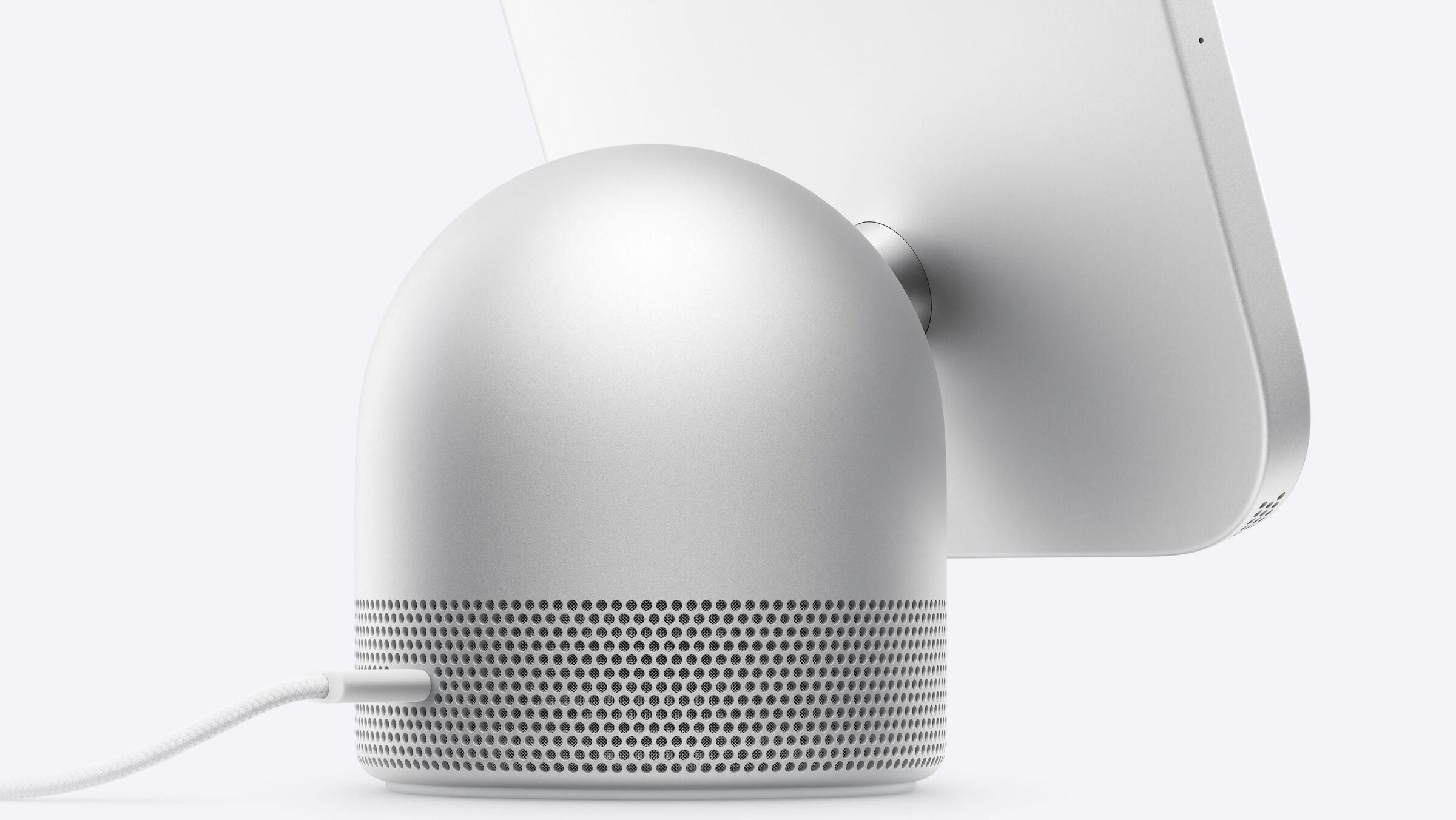
The desktop model features an aluminum display mounted on a stainless steel hinge above a curved speaker stand and can be tilted. It is powered continuously via USB-C; there is no battery. The box contains a color-coordinated 1.5-meter USB-C cable and a 30-watt power adapter.
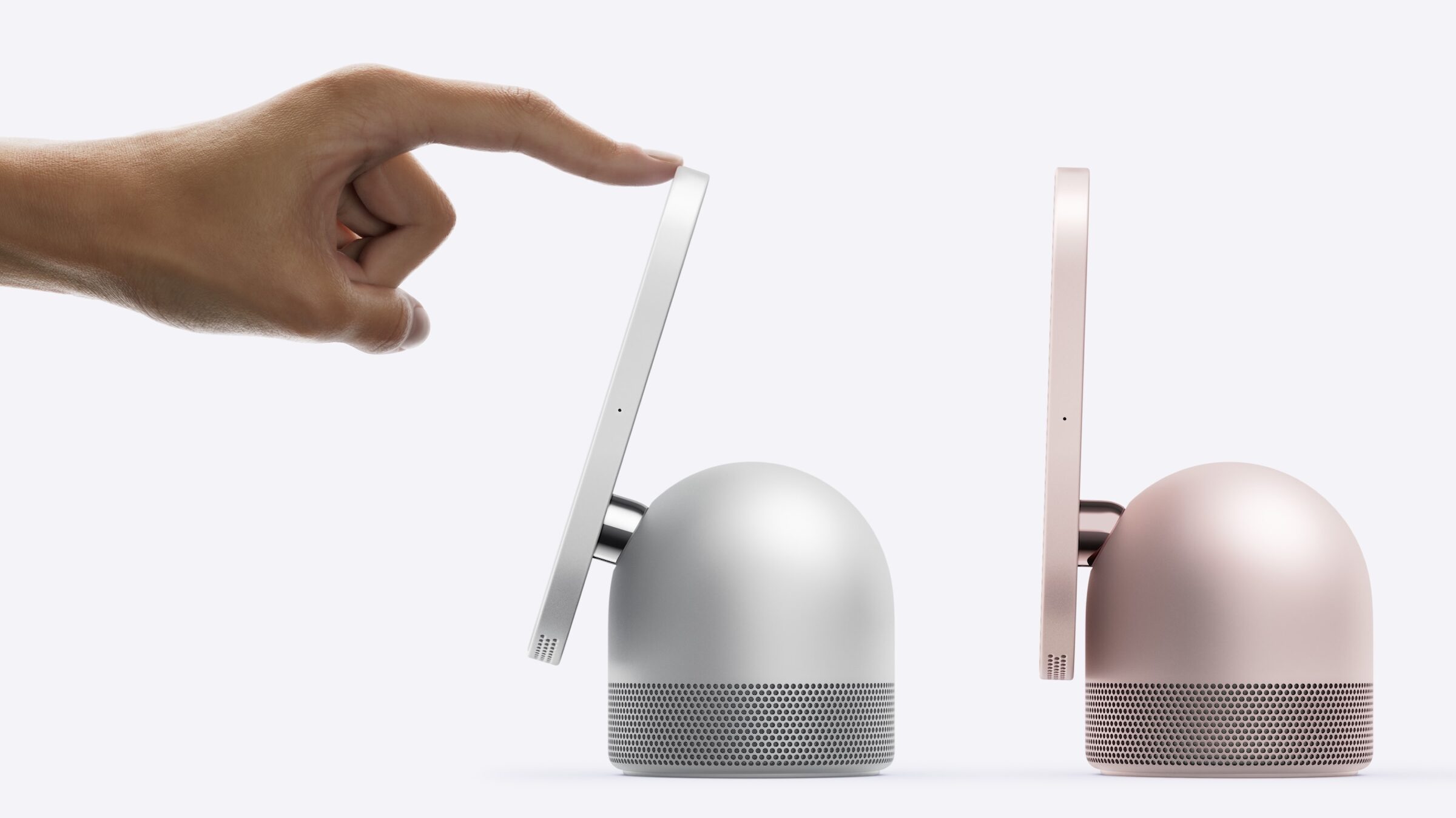
The wall-mounted model is just under one centimeter thick and is installed using one of three mounting brackets from Schneider Home, either by the user or by a professional. The mounting bracket, USB-C cable, and a power adapter with at least 20 watts are not included and must be purchased separately.
| Bracket | Price USA | Availability |
|---|---|---|
| Power Mount USB-C Wall Connector | from $59.95 | Available to order since October 13th |
| Power Mount AC Wired | from $79.95 | Available to order since October 13th |
| Power Mount PoE Wired | $129.95 | Early 2027 |
Display and dials
The brightness adjusts between 500 nits for bright rooms and 0.3 nits for a bedside table. The interface adapts to the distance: From a distance, HomeView displays simplified information; as you get closer, more details are shown.
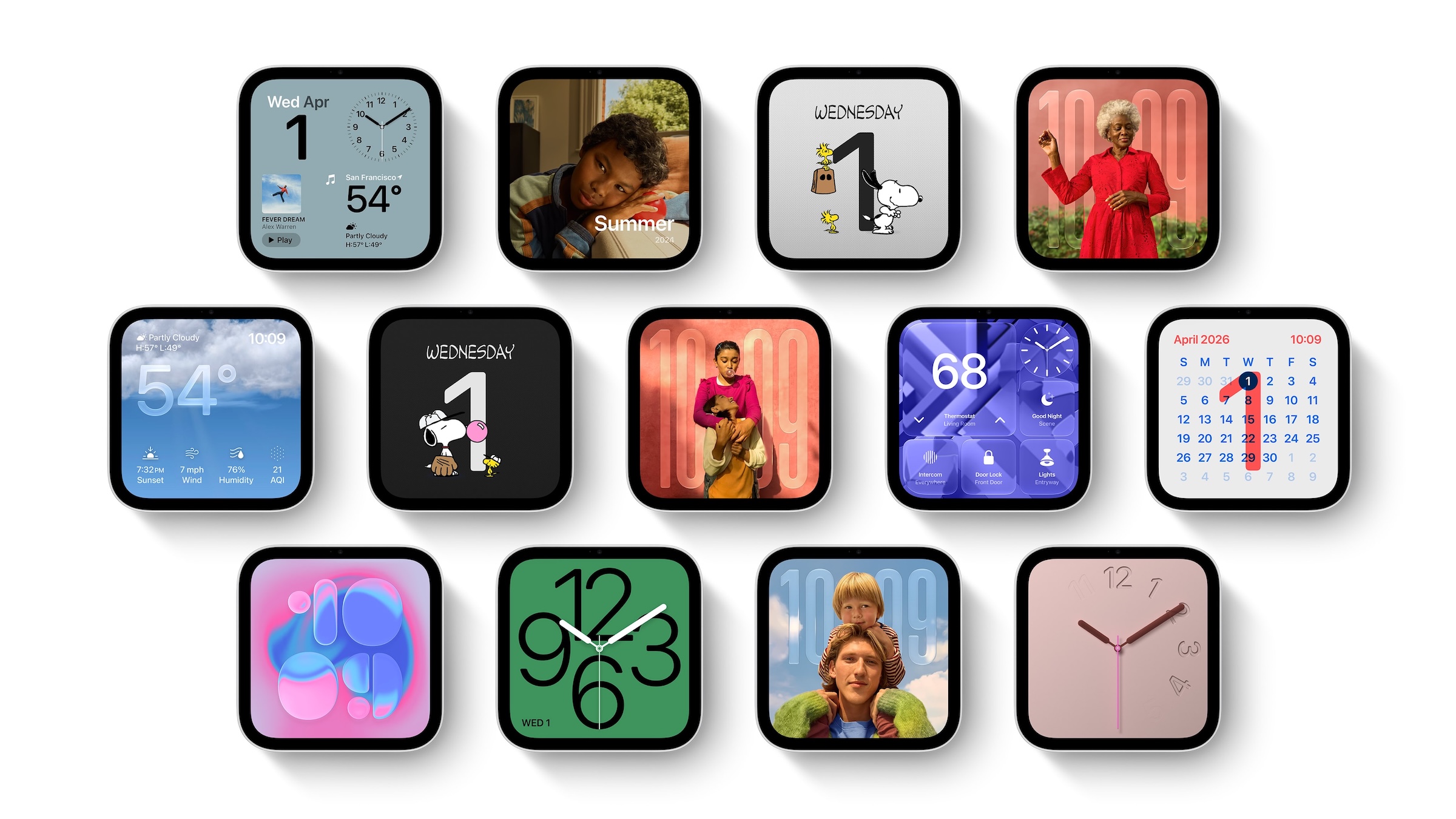
As with the Apple Watch, there are selectable watch faces. Apple lists these views, among others:
- Photos with depth effect in portrait style, optionally with a split album as a digital picture frame
- Flow, a graphic that reacts to presence and movement in the space
- Snoopy with animations showing the time of day, weather, sporting events and holidays
- Calendar and weather
- Home Modular with your preferred devices from the Home app
- Home camera with up to nine camera images simultaneously
The photo view had already appeared in leaked setup screens at the beginning of October, while the selection of watch faces and widgets was revealed in the code in August.
One screen for six people
Home View recognizes up to six people and switches between them. In the press release, Apple refers to facial recognition, while the product page mentions face and voice. The fact that profiles switch automatically via camera and voice was already described in text passages of a macOS update.
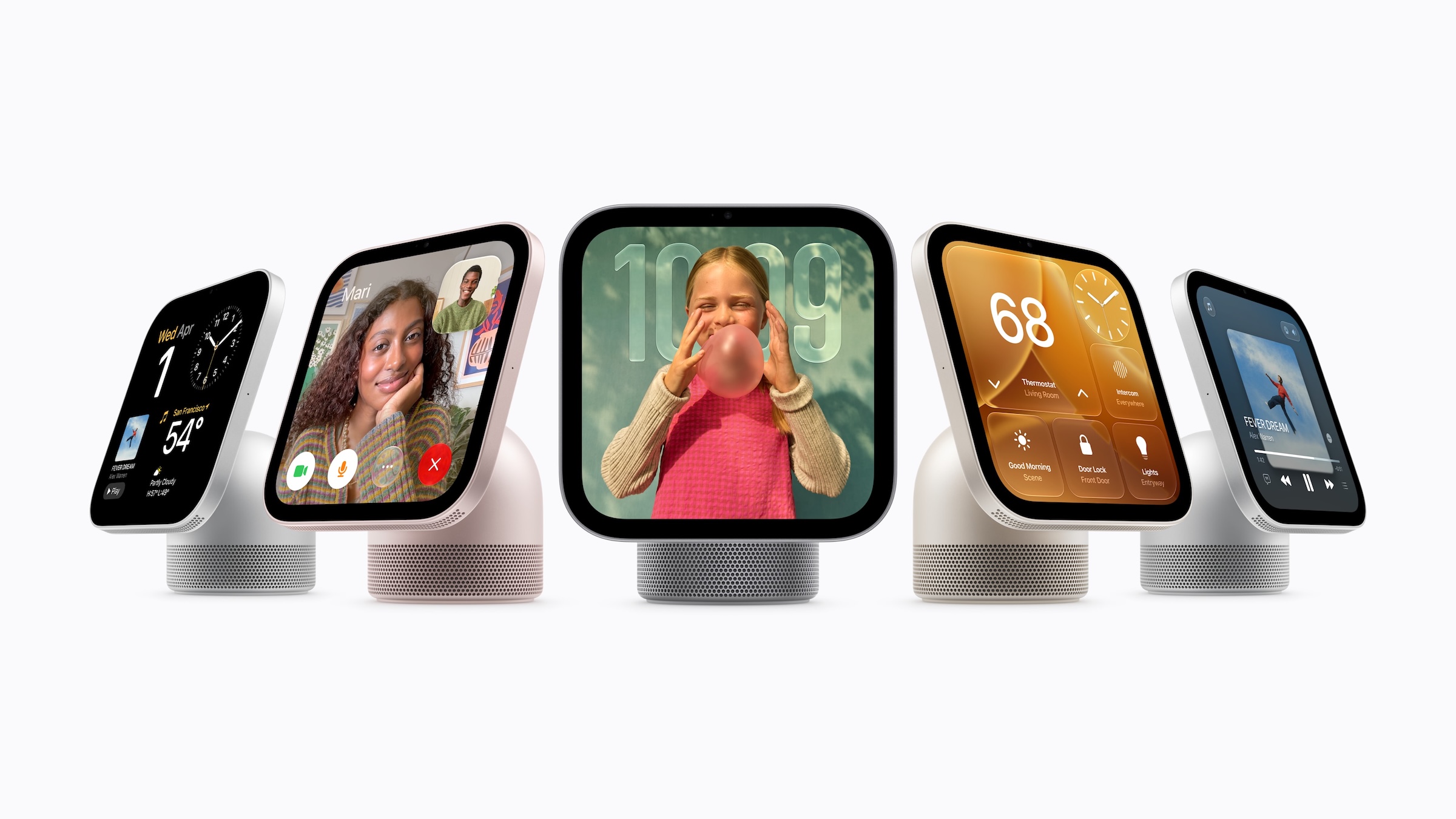
Each person gets their own home screen with apps and widgets. Personal content from messages, FaceTime, calendar, reminders, and "Find My" is not visible to others. Shared photo albums and music, however, are accessible to the entire household. Guests and unrecognized individuals can control accessories, check the weather, set timers, and play music without accessing personal data.
Data privacy: Camera, microphone and the iPhone as a key
Personal content appears only when two conditions are met: the person is recognized, and their paired iPhone or iPad is nearby and has recently been unlocked. Apple makes an exception if the iPhone is not on Wi-Fi. In this case, personal content remains accessible if the device was recently on the same Wi-Fi network, has an active cellular connection, is in the same location, and has recently been unlocked.
The A18 chip processes camera and microphone data in isolated areas that Apple calls Secure Exclaves. According to Apple, neither HomeView software nor apps, the user, nor Apple itself have access to this data. Siri requests are processed either on the device or via Private Cloud Compute, where, according to Apple, the data is neither stored nor accessible to Apple or any other party.
Siri AI as an operating concept
HomeView is primarily controlled via Siri AI. The assistant answers knowledge-based questions, conducts conversations, helps with music searches, and recognizes what is currently displayed on the screen. Four beamforming microphones pick up voices throughout the room and filter out background noise.
With a paired iPhone or iPad equipped with Apple Intelligence, Siri AI accesses personal content from calendars, messages, and playlists and triggers actions in apps. Conversations can be continued in the Siri app on iPhone, iPad, Mac, Apple Watch, or Vision Pro. Even those without a device equipped with Apple Intelligence can still access knowledge-based questions, conversations, and improved music search.
Siri AI runs on HomeView as a beta version in HomeView software 27.2. Apple hasn't given the system a specific name. Daily usage limits apply to certain features that run on Apple's servers; extended access will later require a paid subscription. The customizable, more expressive voices require an iPhone Duo, iPhone 18 Pro, iPhone Air, iPhone 17 Pro, or an iPad with an M4 chip or newer and at least 12 GB of RAM, and currently only work in English.
Music, Apps and Handoff
The display houses two broadband speakers for spatial audio, while the base contains a downward-firing woofer and two passive radiators. Computational audio continuously adjusts volume and bass. The wall-mounted model has two speakers optimized for wall mounting. Together with other HomeView devices, HomePod, HomePod mini, and AirPlay speakers, it can play music in multiple rooms.
Apple services include Apple Music with animated album art and lyrics, Apple Podcasts, audiobooks, Apple News, and content from Apple TV. Apple explicitly mentions Apple News only for Australia, Canada, the UK, and the US. In addition, there are compatible third-party audio and video apps that run on the iPhone. According to Apple, some apps require a paired iPhone nearby.
Handoff allows you to switch a song, podcast, call, video, or recipe from your iPhone to HomeView by holding the iPhone in front of the display.
Daily life: FaceTime, two-way talk and cooking
The 12-megapixel camera keeps people in focus during FaceTime calls using Center Stage, even if they move. Messages can be read and replied to using voice commands or an on-screen keyboard. The two-way audio feature allows announcements to be made to individual rooms or the entire house on Home View, HomePod, iPhone, iPad, and Apple Watch.
HomeView transforms recipes from the web into step-by-step instructions, complete with timers and an overview of ingredients. The "Find My" feature helps locate people sharing their location, as well as iPhones, AirPods charging cases, or items with AirTags. Live Activity displays currently playing songs, timers, or incoming announcements.
The central hub for the smart home
As a control center, HomeView displays camera images and controls thermostats, lights, door locks, and blinds via tap or voice command. It supports HomeKit and Matter accessories, and Thread devices can be integrated directly. If HomeView detects a smoke or carbon monoxide alarm, it sends a notification to your iPhone, iPad, or Apple Watch.
With compatible cameras and a suitable iCloud+ plan, HomeView uses end-to-end encryption to recognize people, familiar faces, pets, packages, and vehicles, and notifies you when someone is at your door. Summaries and natural language searches within recordings require an iPhone or iPad with Apple Intelligence.
The Apple Home Collection, featuring cameras, thermostats, and a lock from LG Electronics and Schneider Electric, is designed to work seamlessly with Home View. It launches in December, with individual devices following in early 2027. It is currently only available in the US, Canada, and parts of the UK. All devices are managed within the same environment as the Home app in iOS 27.
Accessibility and Environment
Apple lists VoiceOver, Zoom, Voice Control, Switch Control, AssistiveTouch, and Live Captions as accessibility features.
The base and housing of the wall-mounted model are made from 100% recycled aluminum, and the magnets are made from 100% recycled rare earth elements. The packaging is made entirely of fiber material.
Price, dates and countries
Both models cost $299 in the US. Pre-orders have been available since October 13th in Australia, the UK, India, Canada, New Zealand, and the US. Pre-orders in Singapore begin on Thursday, October 15th, at 3:00 AM German time. In South Africa, sales are handled through authorized dealers. HomeView will be available in all eight countries starting Friday, November 13th.
The country list exactly matches the countries where Siri AI on HomeView runs in English. French for Canada will follow via a free update. There is no European price because Apple does not offer the device there.
Why HomeView is missing in Germany
Apple explicitly states in its announcement that HomeView will not be sold in the European Union because Siri AI is currently unavailable on iOS in the EU. The company is working with the EU on a solution. The exclusion is therefore not based on the HomeView system itself, but rather on the iPhone to which the device is paired. How the Device Management Authority (DMA) blocks Siri AI on iPhones and iPads has been known since June.
Even without this hurdle, the language issue remains. Siri AI only speaks English on HomeView, and Apple doesn't list German as a planned language. Switzerland isn't subject to the EU exclusion, but it's also not on the list of launch countries.
What was known beforehand and what wasn't true
Long before the unveiling, many key details were circulating. The chip, form factors, and colors were confirmed; a leak from October 1st had already revealed the four color options for the desktop model. A trademark application shortly beforehand had suggested the name HomeView, and a Bloomberg report indicated the mid-November launch date.
| Feature | Status of the reports | According to Apple |
|---|---|---|
| Name | HomePad, most recently HomeView | HomeView |
| Chip | A18 | A18 |
| Display | Seven inches for months, most recently around six inches | 7 inches, 1088 × 1088 pixels |
| Table model | Display on metal arm above round base | Display on stainless steel hinge above curved speaker base |
| Wall model | new magnetic system for assembly | three brackets from Schneider Home |
| Recognition | Camera without depth sensor for Face ID | Face and voice, up to six people |
| Apps | not a fully-fledged app store | Selected Apple apps, third-party apps from the iPhone |
| Power supply | No battery, USB-C | No battery, USB-C |
| iPhone required | for setup and individual functions | iPhone with iOS 27.2 or iPad with iPadOS 27.2 |
| Price | estimated at around 350 dollars | $299 |
| Market launch | Presentation on October 13th, delivery mid-November | Screening on October 13th, available November 13th |
The reports were wrong about the display and price. The earlier figure of seven inches was correct, the more recent correction to six inches was not. Apple's price is $51 below the estimate.
The long road to the start
The smart home hub was originally planned for early 2025. It was pushed back to spring 2026 and then to the second half of the year, each time due to delays surrounding the AI-powered assistant. In early June, it was reported that Apple's AI delays were also impacting the Home Hub, the smart glasses, and the robot.
| Time | Expected start |
|---|---|
| original plan | Early 2025 |
| Interim status | Spring 2026 |
| Summer 2026 | second half of 2026 |
| August 2026 | before the end of 2026 |
| September 20, 2026 | Earliest date: October 2026 |
| September 30, 2026 | Performance on October 13th |
| October 13, 2026 | unveiled, available from November 13th |
Outlook: the robot hub
Besides Home View, Apple is reportedly working on a more sophisticated version: a display on a movable arm that rotates to face the user. Most recently, a nine-inch display was mentioned, and development is said to be in its early stages. A tabletop robot with a display on a robotic arm was already being discussed for 2027 at the beginning of the year; earlier reports also mentioned 2028.
Who is HomeView intended for?
HomeView is aimed at households that already use iPhones and want to control their home via HomeView as a central hub, instead of having to reach for their phone every time. The device cannot even be set up without an iPhone or iPad. Its strength lies in households with multiple residents, who can access their own content via user recognition without having to log in.
I consider this device Apple's most well-thought-out step into the smart home to date, precisely because of its tight integration with the iPhone, which safeguards data privacy. However, this same integration is the reason why it's not available in Germany. Bloomberg recently cited roughly five months after the launch of iOS 27 as the best-case scenario for Siri AI to arrive on EU iPhones. I expect HomeView won't be available in Germany before then. I also anticipate that Apple will launch Siri AI in the EU with German support, meaning HomeView would be usable in German from the outset.
If you want to expand your smart home today, you don't have to wait. The HomePod mini 2, the HomePod, and the new Apple TV 4K all work as control centers in this country as well. Only the screen in the kitchen isn't available yet.
Would you buy HomeView as soon as Apple offers it with Siri AI in German here, or are HomePod and Apple TV sufficient as a control center for you? Let us know your prediction in the comments.