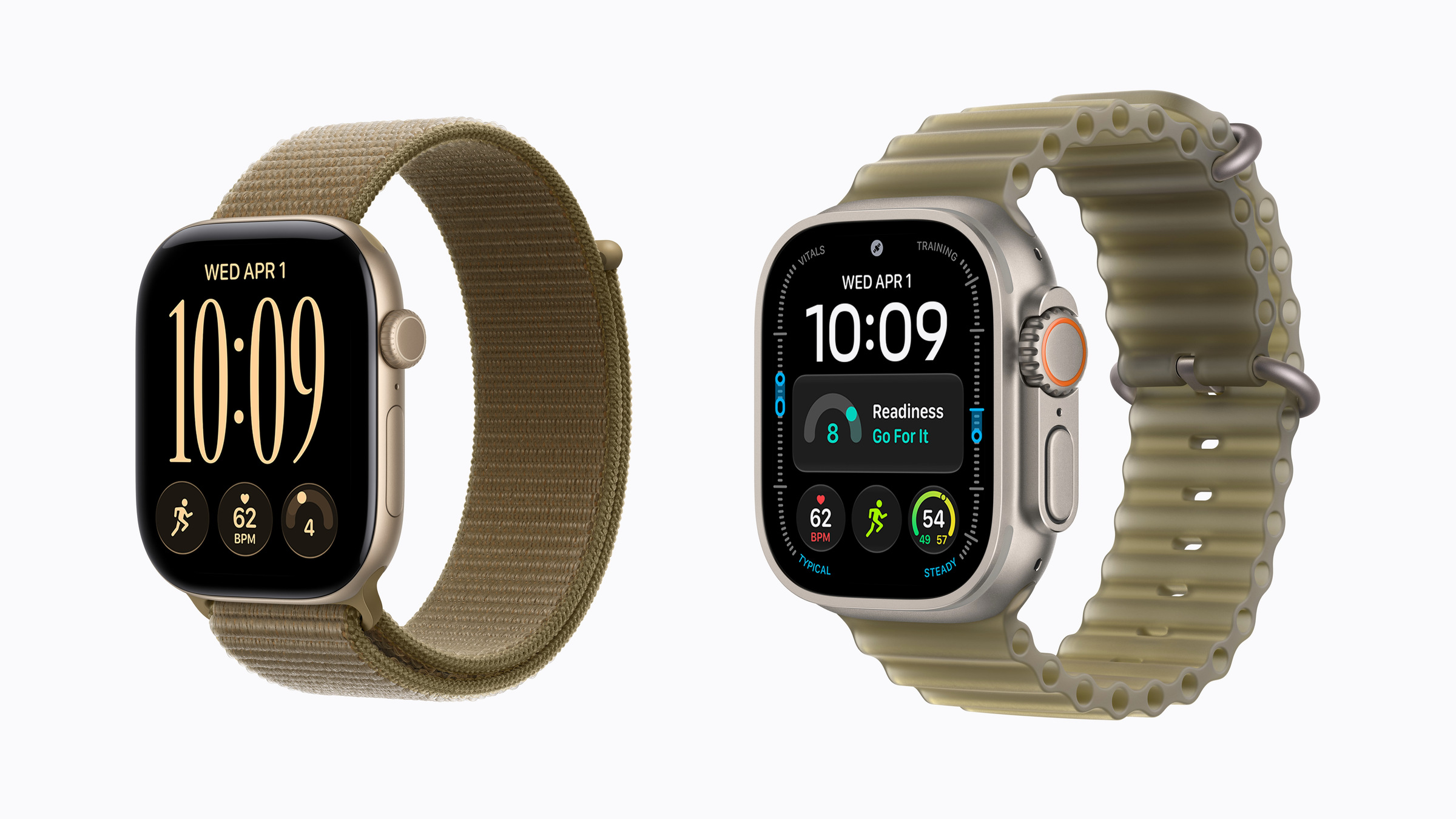
From the outside, hardly anything has changed, but the underside has seen significant changes. The first reviews of the Apple Watch Series 12 and Ultra 4 are in, and they focus almost exclusively on the new sensor system. However, after a week, most testers hadn't seen any improvement in the most important new metric, Readiness.
Apple unveiled both watches on September 9th, and sales begin on Friday, September 18th. The Series 12 starts at €449 in Germany, and the Ultra 4 at €899. The first reviews of the iPhone 18 Pro were published on September 16th.
Among the reviews of the watches available are the joint test of both models by 9to5Mac, the Series 12 test by Engadget, the two individual tests by Tom's Guide for the Series 12 and the Ultra 4, the test by MobileSyrup, which also touches on the Ultra 4, and TechRadar's weekly review of the Ultra 4.
Key Facts at a Glance
- All testers see the new sensor system as the biggest innovation: pulse every five seconds instead of every five minutes at rest, HRV up to 24 times more frequently.
- Readiness needed seven nights of data; only one out of four testers had a value after the test phase.
- Engadget gives it 9.1 out of 10 points, and Tom's Guide awards it the Editor's Choice distinction.
- The Ultra 4 lasted between just under two and more than three days in everyday use by the testers; Apple claims up to 50 hours.
- Live Rewind and Siri Recap were not yet available for testing and will not be released in the EU initially; Siri AI will not launch on watchOS in the EU for the time being.
The new sensor system impressed the testers
The back of the watch has been redesigned, featuring larger green LEDs, ring-shaped photodiodes, and a larger contact area for the electrodes. According to Apple, this allows the watch to measure the heart rate every five seconds, throughout the day. Previously, the interval at rest was five minutes.
The measurements in the test were consistent. Tom's Guide used both watches and a chest strap, most recently the Ultra 4 for a distance of approximately 35 kilometers, and found the values virtually identical. Engadget's everyday heart rate was within two beats per minute of a Fitbit Air. 9to5Mac primarily uses the additional data to see how small things like an afternoon coffee or a stressful situation affect heart rate.
Also new is the heart rate variability (HRV) measurement, now available in two versions. In addition to the existing value for general health, the watch now measures a recovery HRV for stress and recovery, which, according to Engadget, is based on a second calculation method requiring shorter measurement periods. Engadget was able to view HRV values before the seven-night study period had elapsed.
The Vitals app now displays values during the day as well and categorizes them into four levels instead of two. 9to5Mac reports a disappointment: the automatic workout detection was not improved by the more frequent measurements in the test.
Readiness: Only one tester received a score
Readiness summarizes activity, training load, vital signs, and sleep into a score from 0 to 10, with recommendations such as Recover, Pace Yourself, Ready, and Go For It. The watch needs seven nights of data for this. During a test phase of about a week, this slowed most testers down.
| Test | Test duration | Readiness value after the test phase |
|---|---|---|
| 9to5Mac | one week | a value, 8 out of 10 |
| Engadget | seven nights | No value, wrist temperature not recorded |
| Tom's Guide (both models) | one week | No value, a travel night only includes two hours of sleep |
| MobileSyrup | six nights | No value, deadline not yet reached |
According to Tom's Guide, Readiness also requires at least four hours of sleep per night. Engadget criticizes precisely this dependence on uninterrupted sleep: those who don't wear the watch every night won't get any readings the next morning. However, in the tester's experience, this applies to all wearables with comparable functionality that she has tested.
The only direct comparison comes from 9to5Mac. On the same day, the Apple Watch showed 8 out of 10, the Oura Ring 85 out of 100. This isn't conclusive based on a single reading.
Series 12: Ceramic, a new gesture, and faster charging
The most noticeable change is the return of the ceramic casing, available in white and blue. Apple last offered ceramic in 2019 with the Series 5. The aluminum models feature Ceramic Shield 2, which Apple claims is 60 percent more durable than the previous Ion-X glass.
Engadget highlights a seemingly insignificant new feature as a favorite: In addition to double-tapping, the watch now recognizes a single tap with the thumb and forefinger, allowing users to not only scroll through widgets in the Smart Stack but also open them. This isn't exclusive to the Series 12, however. Apple lists the gesture in the footnotes as a feature of watchOS 27 for the Series 9 and later, the SE 3, and the Ultra 2 and later.
The newly developed pedometer, including the step complication, is tied to the S11 chip and is not available on older models. Engadget criticizes the new app grid in watchOS 27, which displays only a selection of apps instead of all of them and doesn't always show the desired app.
Apple still claims a battery life of up to 24 hours, but for outdoor workouts, it now says 10 hours instead of 8. Tom's Guide found Apple's claims to be accurate in their own experience. Engadget went to bed with around 50 percent battery remaining on days with little activity. MobileSyrup, with all health sensors enabled, numerous Siri requests, and using the watch as a remote for Apple TV, got more than two days of battery life. All three confirmed the fast charging capabilities: Engadget's watch charged from 51 to 79 percent in just 12 minutes.
Ultra 4: Longer battery life in everyday use
The Ultra 4 looks like the Ultra 3 and will continue to be available in natural and black. Besides the sensor system, the main new feature is a battery that, according to TechRadar, is 5 percent larger.
| Duration | Ultra 3 | Ultra 4 |
|---|---|---|
| normal use | 42 hours | 50 hours |
| Power saving mode | 72 hours | 84 hours |
| Training (Standard) | 14 hours | 18 hours |
| after 15 minutes of charging | 12 hours | 18 hours |
The figures are from Apple, as reported in tests by 9to5Mac, Tom's Guide and TechRadar.
9to5Mac achieved 48 hours of battery life with a 90-minute workout, three hours without the iPhone, and two nights of sleep tracking. Tom's Guide claims to easily reach two days: On a test day with three and a half hours of training, the battery dropped from 82 to 61 percent between 6 a.m. and 5 p.m.
TechRadar has so far achieved just under two days and plans to monitor the runtime for longer; MobileSyrup achieved more than three days.
Tom's Guide considers the Ultra 4 the best Ultra yet, but still misses a built-in LED flashlight and a smaller case size. According to their test, those with narrow wrists must wear the band tightly, otherwise the sensor won't register a heart rate. TechRadar hasn't yet issued a final verdict and plans to monitor the Readiness feature for a longer period. 9to5Mac found the Ultra 4 to be faster than the Ultra 3 in terms of opening apps and navigating menus.
Audio Intelligence and Siri AI: What's missing in this country
Of the four audio intelligence features, only two were usable in the test: noise recognition and the faster Shazam. Engadget confirms that both react quickly. Live Rewind and Siri Recap, which had generated the most discussion, were not available for testing. The watch processes the necessary audio data in a separate area of the S11 chip and then deletes it.
For users in Germany and Austria, there is an additional restriction that does not apply to the US tests. According to Apple's footnote, Live Rewind and Siri Recap will launch as betas at the end of 2026, initially only in English, not in the EU, and only with an iPhone 16 or newer (excluding the 16e). The footnote refers exclusively to the EU; Switzerland is not affected by this restriction.
The same pattern applies to Siri AI on the watch, which MobileSyrup has used extensively in everyday life. Apple states that Siri AI on watchOS will initially not be available in the EU. Again, Apple only mentions the EU; in Switzerland, however, Siri AI requires English as the system language at launch. German is not among the languages Apple has announced for October. The redesigned Health app with Health Age will also launch later this year, initially in US English; it is already testable in the iOS 27.2 beta.
For whom is the switch worthwhile now?
The limitations primarily affect features that the testers themselves haven't yet been able to try out. Their main praise is for the hardware: the sensor system with its more detailed pulse and HRV data, and, in the case of the Ultra 4, the longer battery life. Live Rewind, Siri Recap, and Siri AI on the watch are currently unavailable in Germany and Austria as selling points.
9to5Mac recommends upgrading from a Series 9 or Ultra 2 or older, and MobileSyrup comes to the same conclusion for those upgrading from a Series 9. Tom's Guide is undecided about the upgrade from the Ultra 3, as its heart rate monitoring is decent, but recommends it to owners of older Ultra models and anyone who prioritizes battery life. Compared to the Series 11, the main advantage is the new health metrics of the Series 12, while the Ultra 4 offers eight hours more battery life compared to the Ultra 3.
In practical terms, this means that if you haven't yet decided between the models, in this country it's less about AI features and more about battery life, case design, and price. With the SE 3 starting at €269, the Series 12 at €449, and the Ultra 4 at €899, there's a €630 difference between the cheapest and most expensive current Apple Watch model.
Would you upgrade from your current Apple Watch for more detailed heart rate and HRV data and a readiness score, even though Live Rewind and Siri AI are currently missing? Let us know in the comments which model you're currently wearing.