
This article may contain affiliate links. Learn more on our Partner Program page.
Less capacity, yet more endurance in the lab: The EU product data sheet for the new iPad mini reveals the battery size, which Apple doesn't specify in milliampere-hours on its product pages. More interesting than the raw number is what else the sheet shows – from drop tests to repairability.
Since June 2025, smartphones and tablets in the EU must carry an energy label, supplemented by a detailed product information sheet. With the labels on the iPhone and iPad pages, figures such as drop tests and the repairability index have since also been available from Apple. For the iPad mini with A20 Pro, OLED display, and IP67, the information sheet is now available, both from Apple as a German product information sheet for the Wi-Fi model and in the EU Commission's EPREL product database, where the entry is dated October 28.
For the predecessor, the comparative values are also available in EPREL, Apple's own specifications in the technical data of the iPad mini (A17 Pro).
Key Facts at a Glance
- The battery of the new iPad mini has a capacity of 4,900 mAh, compared to 5,034 mAh in its predecessor – about 2.7 percent less.
- Apple lists 18.9 watt-hours instead of 19.3 watt-hours on the technical specifications page, and still up to 10 hours of battery life.
- In the EU test cycle, the new model lasts 78 hours instead of 67, and the energy efficiency class increases from E to D.
- In the drop test, the Wi-Fi model survived 104 drops, the Wi-Fi + Cellular model 57 – the predecessor managed 52 in both variants.
- The repairability class remains C, the index rises slightly from 2.73 to 2.89.
Fewer milliampere-hours, same runtime
The battery capacity drops from 5,034 to 4,900 mAh. The energy consumption, as specified by Apple in the technical data, is 18.9 watt-hours instead of 19.3, a decrease of approximately 2 percent. This does not affect the battery life claims: Apple promises up to 10 hours of web browsing or video playback with Wi-Fi for the new model, just as with its predecessor, and up to 9 hours on a cellular network for the Wi-Fi + Cellular models.
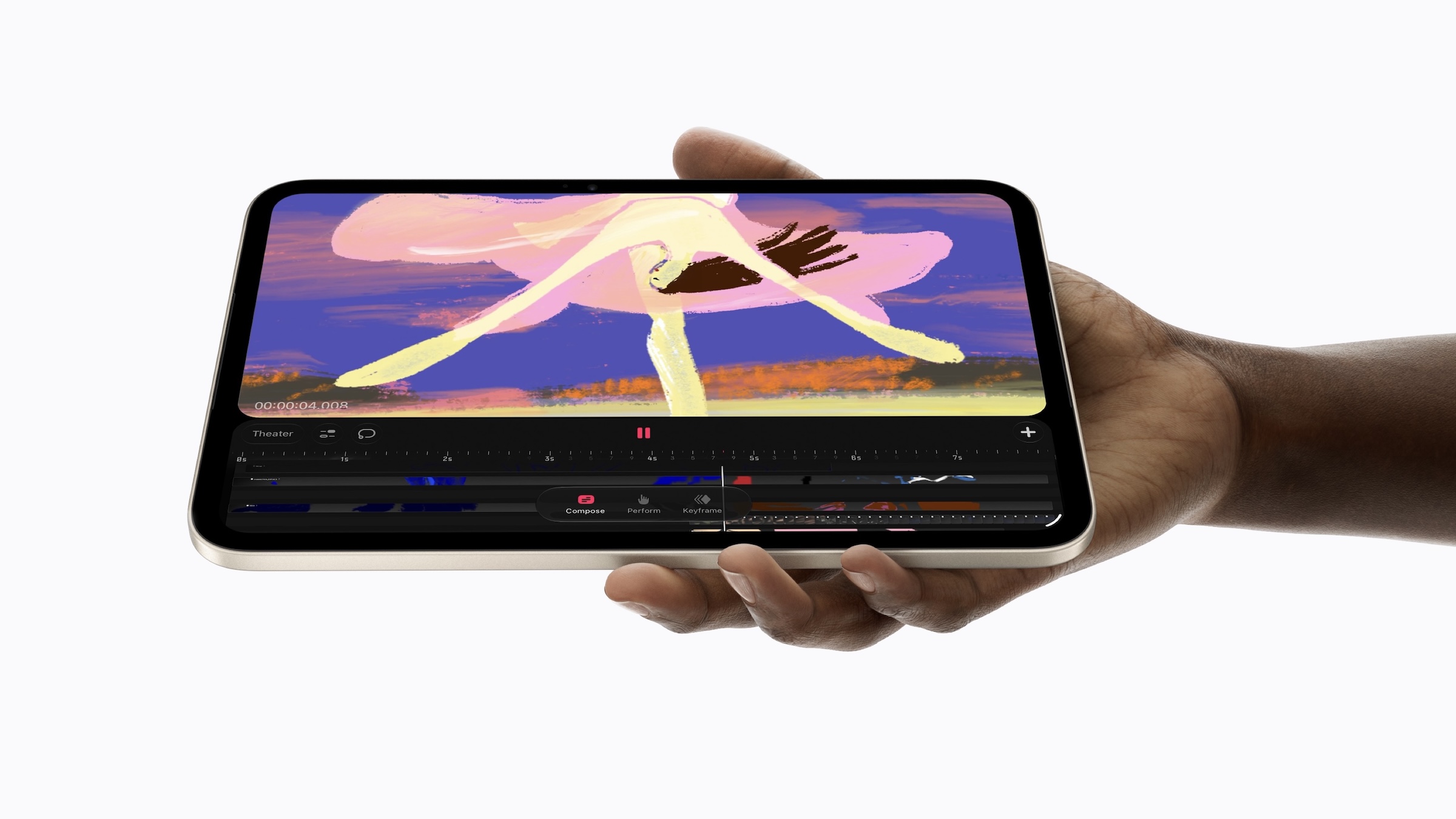
The smaller battery is housed in a significantly slimmer casing. The new iPad mini is 5.4 mm thick instead of 6.3 mm and weighs 255 g as a Wi-Fi model instead of 293 g, and 263 g as a Wi-Fi + Cellular model instead of 297 g. Considering the approximately 14 percent reduction in thickness, the reduction in battery size is minimal.
What else the EU data sheet reveals
The product data sheet doesn't measure battery life according to Apple's standards, but rather according to the EU regulation's test cycle. There, the new iPad mini achieves 78 hours per charge, compared to 67 hours for its predecessor – an increase of just over 16 percent. These figures can only be compared to each other, not to Apple's stated battery life of up to 10 hours.
| Info | iPad mini (A20 Pro) | iPad mini (A17 Pro) |
|---|---|---|
| Nominal capacity | 4,900 mAh | 5,034 mAh |
| Energy (Apple) | 18.9 Wh | 19.3 Wh |
| Battery life according to Apple (surfing with Wi-Fi) | up to 10 hours. | up to 10 hours. |
| Battery lifespan per cycle (EU test) | 78 hours. | 67 hours. |
| Energy efficiency class | D | E |
| Battery life in cycles (up to 80 % remaining capacity) | at least 1,000 | at least 1,000 |
| Drops without damage (Wi-Fi / Cellular) | 104 / 57 | 52 / 52 |
| Reliability class after drop test | D | D |
| Penetration resistance rating | IP67 | IP42 |
| Charger: required output power | 20 W | 15 W |
| Repairability class | C | C |
| Repairability Index | 2.89 out of 5 | 2.73 out of 5 |
A difference between the two versions is noticeable in the drop test. The Wi-Fi model survives 104 drops without damage, while the Wi-Fi + Cellular model only survives 57. Both still end up in the same Class D as their predecessor, which managed 52 drops in both versions.
The increase in water resistance from IP42 to IP67 matches Apple's own specifications. According to the technical data, the new iPad mini can withstand water up to one meter deep for up to 30 minutes.
Repairability hardly moves
The repairability rating remains at C. The index rises from 2.73 to 2.89 out of 5 points, primarily because the "spare parts" score doubles from 1 to 2 points. The EU database now lists the battery in this category for the new model, in addition to the display. According to the data sheet, the battery is still not considered user-replaceable.
The commitment to software updates remains unchanged: at least five years from the end of the marketing period, i.e., from the point at which Apple no longer markets the model in the EU.
The chip compensates for the smaller battery
I interpret the data sheet as good news. A battery that's roughly 2.7 percent smaller is a manageable price to pay for a case that's 0.9 mm thinner and almost 40 g lighter in the Wi-Fi model – and the EU testing cycle shows the opposite of a step backward. It's likely that the A20 Pro and the OLED display contribute to this.
Anyone upgrading from the iPad mini with the A17 Pro to the new model shouldn't consider the battery capacity a deterrent. The more robust IP67-rated casing adds weight, but this makes a greater difference in everyday use than 134 milliampere-hours. All other specifications and release dates can be found in the overview for the iPad mini (A20 Pro), and further news about the device is available on the iPad mini topic page.
Does the slightly smaller battery even matter to you if both Apple and the EU test certify at least the same battery life – or do you only trust your own real-world measurements? Let us know in the comments how long your iPad mini has lasted on a single charge so far.