At its "One more thing" event, Apple officially announced the first processor designed specifically for the Mac, called the M1. Everything you need to know about Apple's new Mac processor can be found below.
The Apple M1 chip features an eight-core design combined with a powerful Neural Engine and graphics processor. This groundbreaking combination offers dramatic efficiency and performance improvements for the Mac. The company announced the switch from Intel to Apple Silicon chips at WWDC 2020. The entire Mac range is to be converted over the next two years. The whole thing started with the current MacBook Air, MacBook Pro and Mac mini. If Apple controls the processor in a Mac, the company can offer much better software optimization.
Apple Silicon Mac devices can now run iOS and iPadOS applications
In the case of the Mac, this means that macOS 11 Big Sur has been specifically tuned for the M1 processor. By manufacturing the silicon in-house, Apple has much more control over how well macOS and Mac work together. Aside from the technical specifications of the new M1 chip, the optimization in macOS should lead to dramatic improvements in performance and reliability. Using Apple Silicon in the Mac also means that the Mac can now run iPhone and iPad applications. However, developers can opt out and lock their apps to the Mac App Store. Apple advertises the whole thing as follows:
- Download iPhone and iPad applications on Mac via the Mac App Store
- Rosetta 2 translation allows users to run applications developed for Intel Macs on Apple Silicon (Note: Sometimes applications perform better in Rosetta with M1 than natively with Intel - according to Apple)
- Universal Apps are applications designed for Apple Silicon and Intel processors and can be downloaded from the Mac App Store or the web
Apple Silicon: “amazing machine learning performance”
During the online event in November, Johny Srouji, Apple’s senior vice president of Hardware Technologies, said:
There's never been a chip like M1, our breakthrough SoC for Mac. It builds on more than a decade of developing industry-leading chips for iPhone, iPad, and Apple Watch, and ushers in a whole new era for Mac. When it comes to low-power silicon, M1 has the world's fastest CPU core, the world's fastest integrated graphics in a personal computer, and the amazing machine learning power of the Apple Neural Engine. With its unique combination of remarkable performance, powerful features, and incredible efficiency, M1 is by far the best chip we've ever designed.
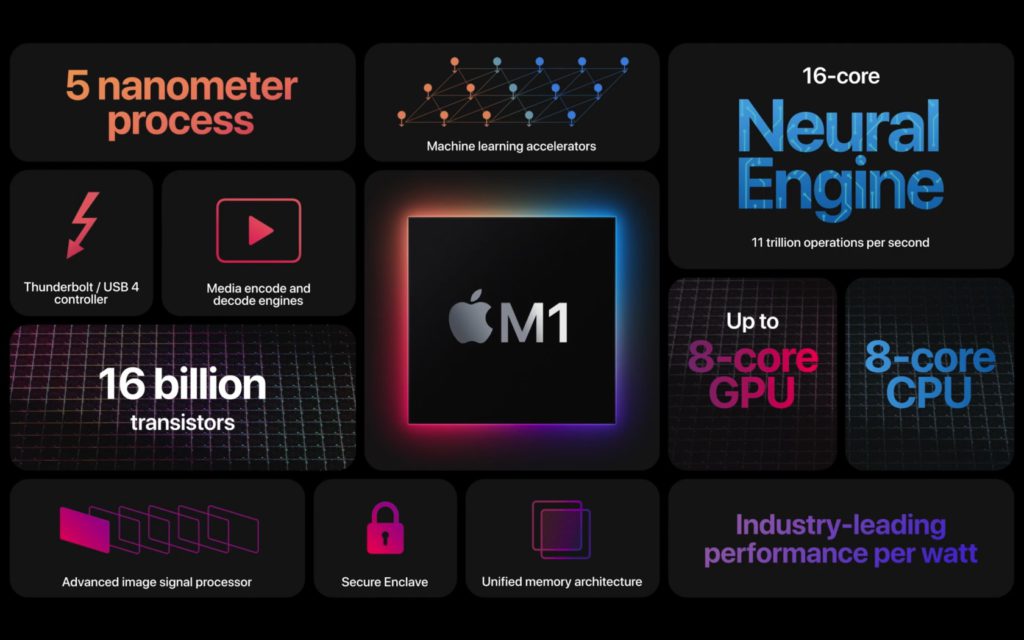
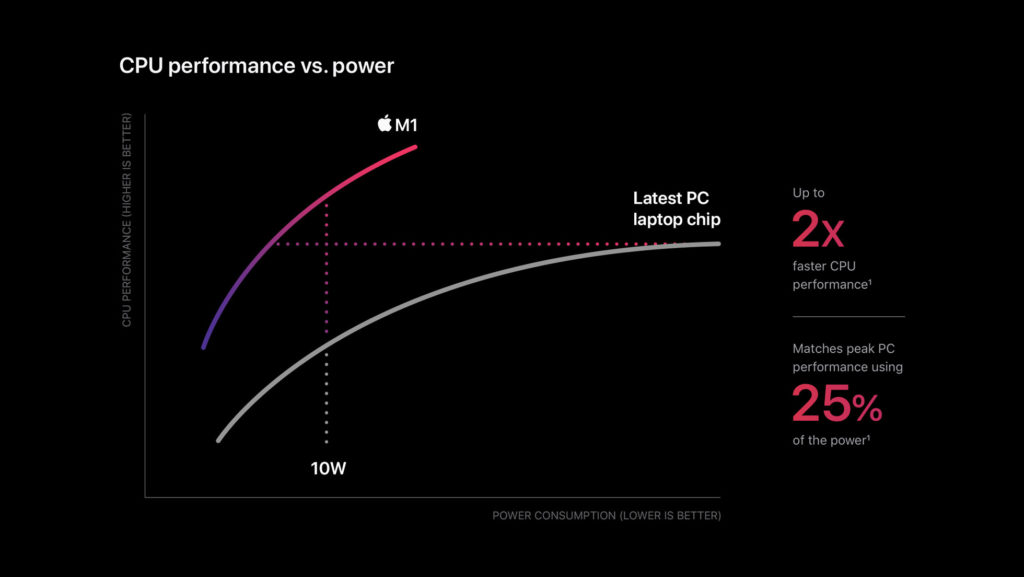
It is built on the 5-nanometer manufacturing process with 16 billion transistors and was specifically designed "for Mac systems where small size and power efficiency are critical," according to Apple. As such, the M1 delivers industry-leading performance per watt. This is why the first Apple Silicon MacBook Air and MacBook Pro models compared to their Intel predecessors can provide such remarkable improvements in battery life.
Apple M1: The CPU
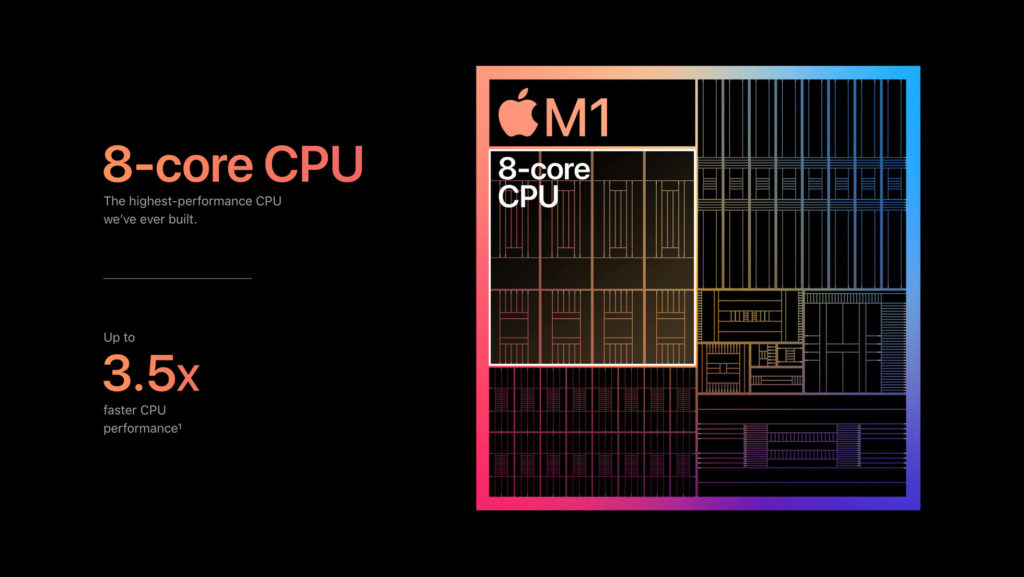
At the heart of the M1 chip is an 8-core CPU with four high-performance cores and four high-efficiency cores. Each of these high-performance cores delivers industry-leading performance for single-threaded tasks. According to Apple, they are "the world's fastest CPU cores made with low-power silicon." Interestingly, the company stated that the four high-efficiency cores deliver "outstanding performance at one-tenth the power." In fact, the high-efficiency cores themselves are so powerful that they deliver similar performance to the two-core Intel MacBook Air while being much more efficient. Overall, Apple says the eight cores work together to deliver "incredible processing power for the most demanding tasks, achieving the world's best CPU performance per watt." Early evidence from experts suggests that the M1 chip will live up to the hype.
Apple Silicon: The graphics processor
Was that it? No. The M1 offers much more. It also features a GPU with up to 8 cores, capable of executing 25,000 threads simultaneously. According to Apple, this means the M1 can handle "extremely demanding tasks with ease." According to the company, the chip boasts "the world's fastest integrated graphics in a personal computer" with 2.6 teraflops of throughput. But what does all this mean for real-world use? Essentially, it handles activities like Apple Arcade, video editing, graphic design, powering an external 6K display, and much more with ease.
Apple Silicon: The Neural Engine
The M1 chip also brings Apple's industry-leading Neural Engine to the Mac for the first time. The M1 Neural Engine features a 16-core design that can perform 11 trillion operations per second. The Cupertino-based company has been using the Neural Engine in the iPhone and iPad since the launch of the A11 processor in 2017. But what kind of improvements can we expect with the Neural Engine? The Neural Engine is specifically designed for machine learning tasks. This includes things like video analytics, speech recognition, artificial intelligence, and more. Many modern applications increasingly rely on machine learning for everyday tasks, so the Neural Engine in the M1 chip will play a very important role. It works in conjunction with the CPU and graphics processor and will improve the user experience tremendously.
Apple M1 chip: consistent memory and SSD performance
But that's not all. The brand new Apple M1 chip also includes a new unified memory architecture. Apple says:
M1 also features a unified memory architecture that consolidates high-bandwidth, low-latency memory into a single pool within a custom chip. This allows all technologies in the SoC to access the same data without having to copy it between multiple memory pools, further improving performance and efficiency.
Specifically for SSD storage, Apple has integrated a new high-performance storage controller with AES encryption hardware for improved security and faster performance. According to the company, the new M1-powered MacBook Air offers up to 2x faster SSD performance.
M1 Macs with Secure Enclave and ISP
It was already expected that Apple would equip the M1 chip with the Secure Enclave. This handles tasks like Touch ID authentication and other security-related tasks. In previous models, the Secure Enclave was housed in the T1 and T2 chips. But integrating it into the M1 processor brings further advantages. The brand-new M1 chip also features the latest image signal processor, which offers higher video quality with better noise reduction, as well as improved white balance and a wider dynamic range. This should allow the webcam on the MacBook Air and Pro to deliver better quality, despite using the same "dusty" 720p camera.
Apple M1 chip: But there are also limitations
The new Apple M1 chip may have many advantages. But there are also limitations. The first Macs to be equipped with the M1 chip are the MacBook Air, the MacBook Pro 13″ and the Mac mini. They all have only two USB-C ports that support USB 4 and Thunderbolt. It is believed that there is a limitation of the M1 controller, which is why the devices only support two ports. Another limitation is in the area of RAM. The current Mac range can only be purchased with 8 or 16 GB of RAM. Intel Macs, on the other hand, are available with more RAM. The same applies to SSD storage. Here, too, it is believed that the M1 chip is reaching its limits. It should also not go unmentioned that Apple Silicon Macs do not support external graphics processing units. Whether this will change in the future remains to be seen. AirPods Pro on special offer at Amazon – available now. (Image: Apple)