
This article may contain affiliate links. Learn more on our Partner Program page.
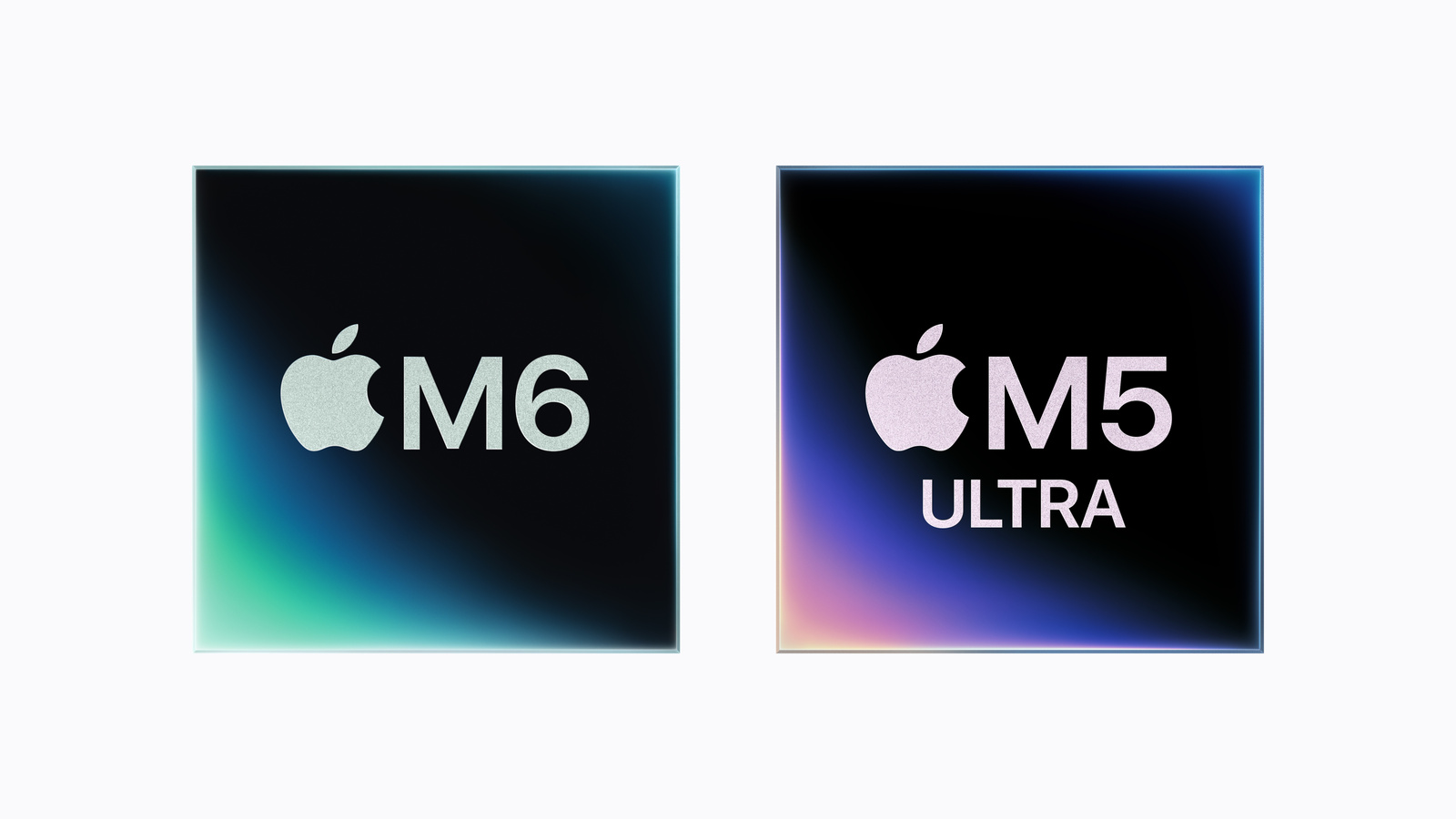
Behind the two new desktop Macs are two chips that each push a technological boundary. The M6 is Apple's first processor manufactured using a 2-nanometer process, while the M5 Ultra is the first M-series chip ever, consisting of four interconnected dies. Both change more than just the number of cores.
Alongside the new desktops, Apple unveiled the chips themselves: the M6 in the Mac mini and the M5 Ultra in the Mac Studio. While the product announcements focus on performance comparisons, the chip announcement lays out the foundation: a manufacturing process shift to 2 nanometers and a design that allows four processing units to operate as a single unit. The quote comes from Sri Santhanam, Apple's head of chip development.
Key Facts at a Glance
- The M6 is Apple's first chip manufactured using a 2-nanometer process.
- Its CPU complex consists of two super cores, four performance cores, and six efficiency cores.
- A dual 16-core Neural Engine doubles the peak performance compared to the previous generation.
- The M5 Ultra combines four dies into a single chip for the first time, with a bandwidth between them exceeding 4.4 TB/s.
- Both chips feature Neural Accelerators in each GPU core.
Why 2 nanometers is more than a smaller number
The change in manufacturing process is the real crux of the announcement. A finer feature size means more transistors in a smaller area – and thus either more performance with the same power consumption or the same performance with less power consumption. Apple utilizes both: two additional CPU cores, two additional GPU cores, and still claims leading performance per watt.
For desktop computers with a power supply, energy efficiency may initially seem unimportant. However, it isn't: less heat output means quieter operation, and that's precisely what matters for a device that sits on the desk as a constantly running computing hub.
A CPU complex consisting of three core types
The M6 features twelve CPU cores, two more than the M5. Its unusual configuration consists of two super cores, four performance cores, and six efficiency cores. The super cores handle tasks that would otherwise run on a single core, the performance cores join in when multi-core workloads occur, and the efficiency cores perform background tasks.
This results in 1.2 times the multithreaded performance compared to the M5 and 2.4 times that of the M1. For single-threaded performance, Apple claims the world's fastest CPU core. The measurements are from Apple's own tests from August 2026 and were conducted on pre-production hardware.
Neural Engine and GPU share the AI workload
New is a dual 16-core neural engine, meaning two processing units instead of one, which together achieve up to twice the peak performance of the previous generation. Both can address system frames simultaneously.
In parallel, each of the twelve GPU cores contains a Neural Accelerator. Apple claims a nearly 30 percent increase in the pure AI computing power of the graphics unit compared to the M5 and more than eight times that of the M1. Memory bandwidth increases to up to 170 GB/s, ten percent more than the M5. RAM can be expanded to 32 GB.
The graphics feature a revised shader architecture, dynamic caching and hardware-accelerated ray tracing, along with 50 percent higher geometry rates.
Four Dies that behave like one
The M5 Ultra takes a different approach. Previously, Apple's UltraFusion technology combined two dies into a single chip. With the M5 Ultra, there are four for the first time: two M5 Max units, each consisting of two dies, are coupled together.
For this to work, the connection between the dies had to increase significantly. Apple cites a bandwidth of over 4.4 TB/s and a connection density more than six times greater. As a result, the four components behave externally as a single processor – software doesn't need to be aware of this.
The result is up to 36 CPU cores, consisting of twelve Super cores and 24 Performance cores, as well as up to 80 GPU cores. Compared to the M3 Ultra, Apple claims 1.25 times the single-threaded performance and 1.3 times the multi-threaded performance, a 40 percent increase in graphics performance, and up to 4.5 times the GPU's AI computing power. It also features a 32-core Neural Engine, four ProRes units for video editing, and up to 512 GB of RAM at 1.2 TB/s.
| Feature | M6 | M5 Ultra |
|---|---|---|
| Production | 2 nm | not specified |
| CPU cores | 12 | up to 36 |
| GPU cores | 12 | up to 80 |
| Neural Engine | Dual 16 cores | 32 cores |
| RAM | up to 32 GB | up to 512 GB |
| Memory bandwidth | up to 170 GB/s | 1.2 TB/s |
A generation without a middle class
What's remarkable about this announcement is the absence of an M6 Pro and an M6 Max. Neither will be released – Apple has discontinued development in favor of the M7 series. For now, the M6 generation consists of just one chip.
This explains the unusual pairings in the new devices: The Mac mini features an M5 Pro above the M6, while the Mac Studio has an M5 Max alongside the M5 Ultra. It also explains why Apple stuck with the Ultra chip in the M5 series instead of switching to the M6. A top-of-the-line M7 Ultra with significantly more memory is rumored, but not in the immediate future.
How performance will be measured in the future
The performance figures for the two chips cannot be directly compared because Apple uses different reference points: the M6 is measured against the M5, and the M5 Ultra against the M3 Ultra. Therefore, comparing the specifications side-by-side reveals rates of improvement, not absolute values.
In practical terms, this means that when buying RAM, the number of cores, the amount of memory, and the bandwidth are more important than the generation number. An M6 is manufactured using more modern technology than an M5 Ultra, but it's not faster in any aspect. Our RAM recommendations for Apple Silicon tell you which amount of memory is suitable for which workload.
The manufacturing advantage as the real news
The move to 2 nanometers is the part that points beyond this generation of devices. It lays the foundation for everything that will be created at this manufacturing level in the coming years – from the chip in future MacBooks to the processors in the iPhone. The quad-die design of the M5 Ultra also demonstrates how Apple scales performance without making a single chip ever larger: not more surface area, but more components that communicate quickly enough with each other.
Would the more modern manufacturing process of the M6 be a deciding factor for you – or does it ultimately only matter how many cores and how much memory you get? Let us know in the comments what you look for in a chip.
- Mac Studio: M5 Ultra reclaims 512 GB of RAM
- Mac mini with M6 and M5 Pro: Apple focuses on AI performance
- Apple HomePad: Camera should automatically switch profiles