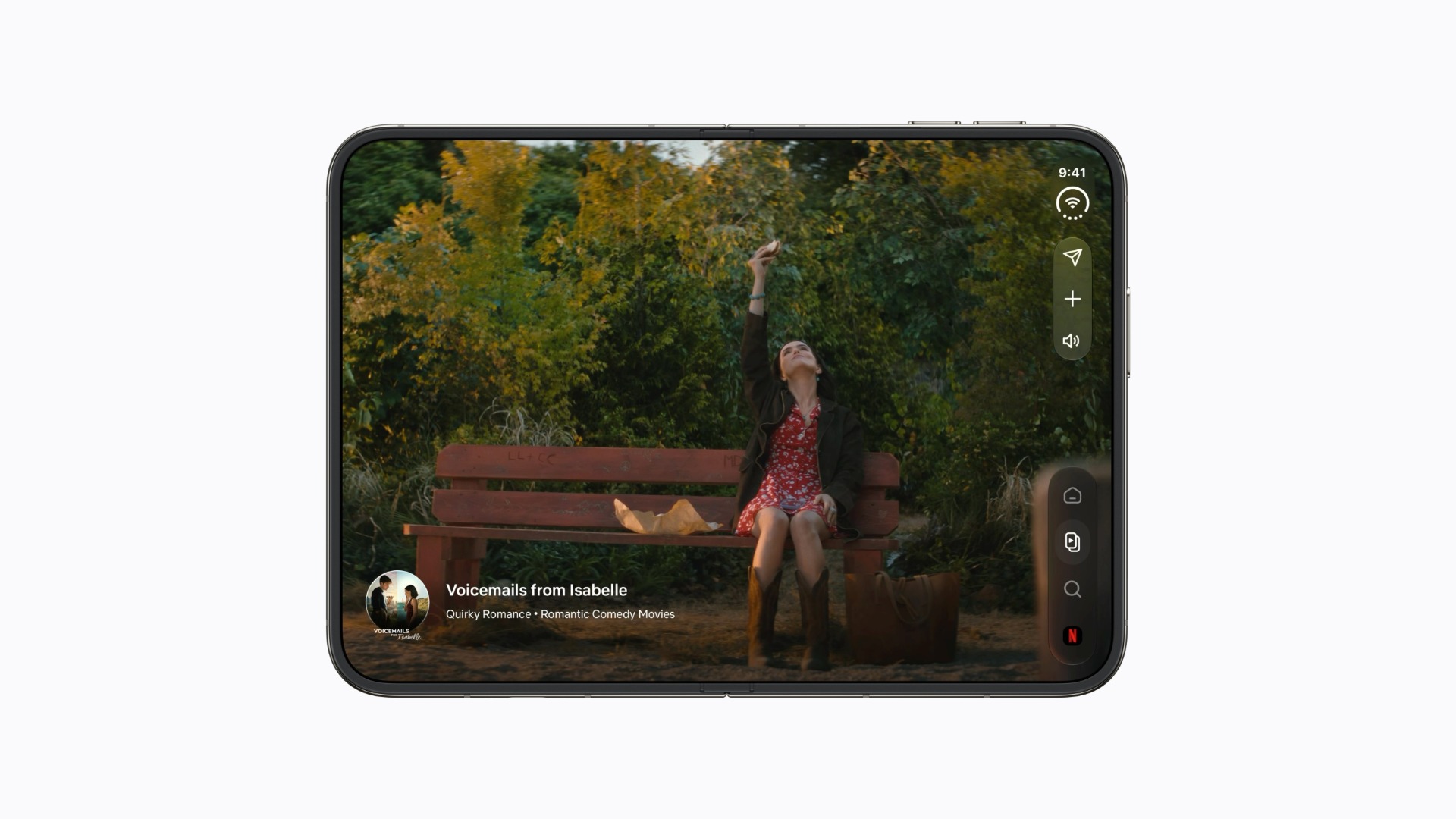
With foldable smartphones, the crease in the middle of the display usually becomes more noticeable over time. Apple's new hardware chief predicts the opposite for the iPhone Duo – and explicitly urges buyers to judge the company by this. In the same interview, he explains why he dislikes screen protectors on the iPhone.
Tom Marieb recently became Apple's Vice President of Hardware Engineering, a position previously held by current CEO John Ternus. In a discussion at Apple's London office, he spoke with TechRadar about the durability of the iPhone Duo and the iPhone 18 Pro.
The focus is on three key aspects that will determine the quality of a foldable phone over the years: the crease in the inner display, the hinge, and the cover glass. The device's specifications are listed in the overview of all data, prices, and release dates for the iPhone Duo.
Key Facts at a Glance
- The matte nanotexture of the inner display is designed to keep the crease inconspicuous even after prolonged use. Marieb explicitly requests that Apple be judged on this.
- The hinge was designed so that when closing it feels like the door of a high-quality car and does not give way when half-open.
- According to Marieb, Ceramic Shield 2 is a compromise between scratch and abrasion resistance. In accelerated tests, Apple simulates five years of use in just a few weeks.
- Marieb considers screen protectors unnecessary. This applies to the outer display of the Duo and the front of the iPhone 18 Pro, but not to the foldable inner display.
Matte surface to prevent visible creases
Another journalist in the group pointed out that the crease in foldables is barely noticeable at first, but becomes more apparent after a few months of intensive use. Marieb responded with an unusually direct promise: "Please take us at our word."
The reason lies in the surface. Glossy displays reflect so much light that even small imperfections are immediately noticeable. According to Marieb, the matte surface is more forgiving of changes to the hinge over time, and that's precisely why Apple opted for it, in addition to the anti-glare feature.
The role of nanotexture in reducing wrinkles isn't new: CEO John Ternus was ultimately convinced by the matte surface of a prototype when developing the device. Marieb goes a step further by making a statement about how the wrinkle develops over time.
A hinge like a car door
Marieb says he's particularly proud of the hinge because it took a long time to get it right. The team's concern is that people who see how thin the device is might think it's fragile. He has the same concern with the iPhone Air, which he says is one of the most reliable iPhones Apple has ever made.
Apple therefore worked on the torque curve. The hinge should feel as solid as the door of a high-quality car when closing, and the same when opening. In addition, there are the positions in which the Duo is partially opened, such as when used as a bedside clock in standby mode. In these positions, it must neither flex nor be difficult to open.
According to Apple's announcement regarding the iPhone Duo, the hinge consists of more than 100 components that control the opening and closing mechanism and support the center of the display. The device is IP68-rated for dust and water resistance.
Why Apple considers screen protectors unnecessary
Marieb was quite clear about the cover glass. He said that whenever he saw someone applying a screen protector to an iPhone, he got goosebumps – the team worked hard to create beautiful displays.
He describes Ceramic Shield 2 as a trade-off. Many materials are either exceptionally scratch-resistant or exceptionally resistant to abrasion; achieving both simultaneously is difficult. Apple could have made the glass even more scratch-resistant, but then it would have become less abrasion-resistant. According to Apple, Ceramic Shield 2 is three times more scratch-resistant than the previous generation.
According to Marieb, testing is not based on outdated military or industrial standards, but on actual usage patterns. Accelerated tests are designed to simulate five years or more of use in just a few weeks.
Not every display surface is equally protected
Marieb's statement about screen protectors doesn't apply to the entire Duo. Ceramic Shield 2 is only applied to the outer display of the Duo. According to Apple's product page, the foldable inner display consists of ten ultra-thin layers with a scratch-resistant coating and nanotexture.
| Area | Protection according to Apple |
|---|---|
| iPhone Duo, external display | Ceramic Shield 2 |
| iPhone Duo, inner display | Scratch-resistant coating, nanotexture |
| iPhone Duo, back | Ceramic Shield |
| iPhone 18 Pro, front | Ceramic Shield 2 |
Furthermore, a film on the inner display would lie over precisely the matte surface that is intended to keep the crease inconspicuous.
A promise that can only be verified after months
Marieb's statement is remarkable because it can be verified. It doesn't refer to the device when unpacked, but to its condition after months of use.
No one can confirm this at launch. The duo won't be available until October, and long-term experience won't be available until next year at the earliest. What can be said in the meantime is that Apple isn't relying solely on mechanics for the crease, but also on the surface's appearance – a crease that remains should simply be less noticeable.
Those wishing to pre-order the duo can do so from 2 pm on October 16th. It costs from €2,299 in Germany and from CHF 1,999 in Switzerland; delivery begins on October 23rd.
Would you trust Marieb's promises for a foldable phone costing over €2,000 – or wait until after a year of other buyers' experiences before buying? Tell us in the comments what you would use to determine its durability.