
This article may contain affiliate links. Learn more on our Partner Program page.
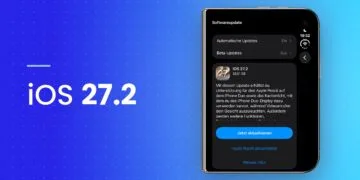
With iOS 27, one phone number can be used on two iPhones – but only with a single German provider. Telekom is integrating the feature into its MultiSIM offering, which costs €6.95 per month depending on the plan or is already included. Austria and Switzerland are not included at launch.
In early September, Apple introduced the feature that allows two iPhones to share the same mobile phone number. At the time, it remained unclear which carriers would participate. Two days before the release of iOS 27, the answer for German-speaking countries is now clear: Apple's support document for setting up the feature lists exactly two network operators worldwide – T-Mobile in the US and Telekom in Germany.
Key Facts at a Glance
- iPhone Handoff starts with iOS 27 on September 14th, exclusively at Telekom in Germany.
- The function works via the existing MultiSIM offer; a second contract or a second phone number is not required.
- An additional MultiSIM costs €6.95 per month; one is included in MagentaMobil L, and two in XL.
- Apple does not list any supported providers for Austria and Switzerland.
- Unlike with classic MultiSIM, only one of the two iPhones is active at any given time.
How the switch works
After setup, there is a primary and a secondary iPhone. Switching between them involves unlocking the desired device – the phone number then switches to that device, and the confirmation message "Switched to this iPhone" appears at the top of the screen. Calls, voicemail, iMessage, RCS, and SMS messages, as well as location shared via "Find My," follow the active device.
This is set up either when configuring a new iPhone or later under "Settings" → "Cellular" → "Set Up Cellular" or "Add eSIM," using the option "Use Number on This iPhone and the Other iPhone." Both devices must be running iOS 27, connected to Wi-Fi, using the same Apple ID, have iCloud Messages enabled, and be signed in to FaceTime and iMessage with the same account. The phone number must be configured as an eSIM.
What Telekom charges for this
Deutsche Telekom treats iPhone Handoff as part of its MultiSIM offering, which can be added to all MagentaMobil plans. According to the company, an added MultiSIM costs €6.95 per month, totaling €83.40 per year. One MultiSIM is included at no extra cost in the MagentaMobil L plan, while the MagentaMobil XL plan includes two.
There is no separate price for iPhone Handoff: Those who already have MultiSIM included in their plan pay nothing extra. Those who book it specifically for the second iPhone pay the standard MultiSIM price.
| Classic MultiSIM | With iPhone Handoff | |
|---|---|---|
| Devices active simultaneously | Yes, several | No, only one iPhone at a time. |
| Switch | Service short codes or settings | Unlock device |
| Incoming calls | can ring on multiple devices | only on the active iPhone |
| SMS | permanently assigned to a device | follow the active iPhone |
| Price | 6.95 euros per month, included in sizes L and XL | the same |
Less parallelism for the same money
The comparison highlights a point that both companies mention only in passing: With classic MultiSIM, multiple devices are simultaneously connected to the network, and incoming calls can ring on several of them. With iPhone Handoff, however, only one iPhone is active at a time.
The added value lies in the convenience. Previously, switching between functions required service shortcuts or settings; in the future, simply unlocking the device will suffice. And SMS messages will move with the device instead of remaining permanently assigned to it – this is the most noticeable change in everyday use.
Where the feature reaches its limits
Apple explicitly states three limitations. The Apple Watch doesn't move with you: it remains connected to the iPhone it was paired with. Apple therefore recommends pairing it with your most frequently used device. Certain Wallet items, such as specific tickets, ID cards, or company badges, only work on one of the two devices; however, payment cards and car keys can be used on both.
The third limitation concerns administration: call forwarding, caller ID, and mobile account management are handled exclusively via the primary iPhone. And anyone wanting to cancel the service must contact their provider – simply deleting the eSIM doesn't necessarily stop billing, according to Apple.
At least it works with dual SIM. If both eSIMs are registered with providers that support iPhone Handoff, they switch together when unlocking.
For whom does this pay off?
The feature targets a small group: people who already own and regularly use a second iPhone – the compact device for cycling, the older one for the beach, and a separate work device. Those who currently switch their eSIM back and forth will save themselves real effort in the future.
Anyone who would have to add a MultiSIM should do the math. €83.40 per year is a hefty price for a convenience feature, especially since the second iPhone is mostly inactive on the network. The bill changes completely with the L and XL plans, as the necessary SIM card is already included.
The blind spot south of the German border remains: Apple doesn't list any supported providers for Austria and Switzerland. More network operators are expected to follow, but there's no timeline for this in the documentation. For the time being, those living there will still need to use the eSIM transfer method.
Do you even use a second iPhone – and would the automatic switching be worth €6.95 a month to you if only one of the two devices is reachable at any given time? Let us know in the comments how you handle your second device.