This article may contain affiliate links. Learn more on our Partner Program page.
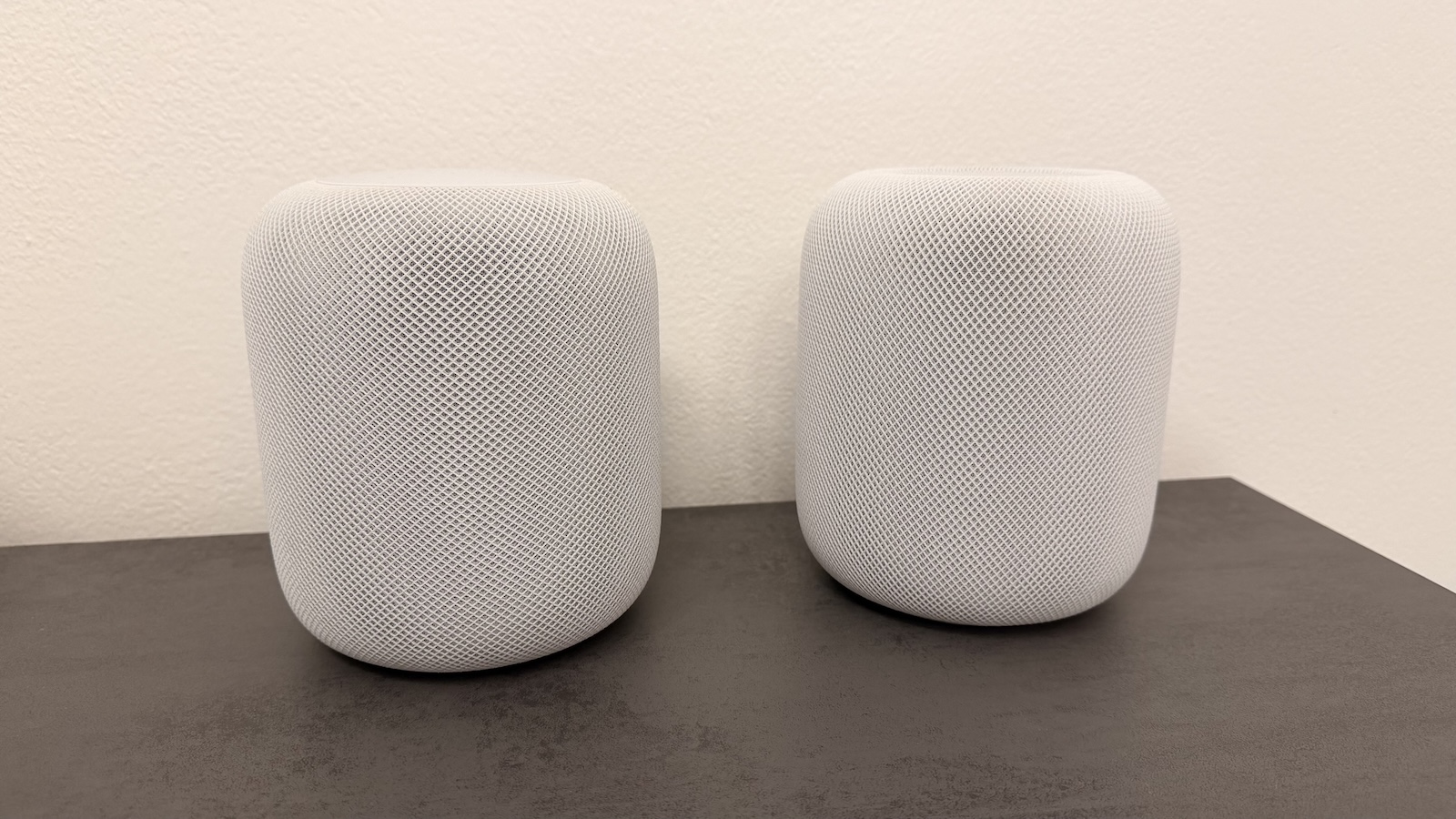
The included code for audioOS 27 contains configuration files for a surround sound system consisting of four HomePods – front left and right, rear left and right. A second data set describes the same configuration with two speakers, which isn't even available in the product line. None of this configuration can be set up yet.
Currently, Apple TV supports a maximum of two speakers: a single HomePod or a stereo pair. The eighth beta of audioOS 27 goes further. It contains tuning files for four HomePods operating simultaneously, along with enhanced room calibration and references to a device Apple has never shown. This discovery comes at a time when new speakers are already expected – rumors about the HomePod 3 and HomePod mini 2 range from a small model to a home hub with a display.
The pre-release version was analyzed in a post on the MacRumors forum, which identifies each instance with its full file path. This makes the analysis verifiable, unlike an unsubstantiated claim. What the files contain is thus documented; what Apple does with that information is not.
Key Facts at a Glance
- audioOS 27 recognizes four speaker roles: front left, front right, rear left, rear right
- The voting option is only available for the HomePod (2nd generation).
- A second variant combines two current HomePods with two speakers that do not correspond to any sold model.
- The Home app, HomeKit, and Apple TV do not recognize the four-unit configuration – it cannot currently be set up.
- For stereo pairs, an additional "Party Mode" with a deliberately wide image appears.
Four reels instead of two channels
In the new arrangement, each speaker has its own specific task and sound processing. The two front speakers are tuned separately for the left and right channels, taking into account the possibility of them being placed close to a wall or in a corner. The two rear speakers receive omnidirectional processing designed to fill the space behind and to the sides of the listening position.
Behind this lies a processing chain that controls the woofers and tweeters of each individual device and manages bass, sound curve, synchronization, and calibration data. A separate tuning file is available for each of the four positions – so the placement in the room determines how a HomePod sounds.
The room measurement grows with
The HomePod already uses its microphones to measure the room and adjust playback accordingly – for single use and for stereo pairs. audioOS 27 extends this technology to a four-speaker setup.
New features include a dedicated measurement path for surround sound, an estimation of the time differences between the devices, and an assignment of all four speaker positions to each other. Without this time correction, four speakers freely distributed in the room would not function properly together.
A separate vote for each item of content
The playback changes depending on what's playing. The code distinguishes five cases:
| Contents | What the system does |
|---|---|
| Film and multi-channel sound | Dialogue editing, bass management, dynamic range limiting, sound curve and a spatial mixer |
| Latency-critical playback | dedicated surround mode with low latency |
| Music | custom values for bass, dynamics and sound curve |
| Stereo with spatialization | All four devices receive a spatially processed mix. |
| Stereo without spatialization | The front speakers play normal stereo, the rear speakers receive an empty mix. |
Whether Spatial Audio is enabled determines, in stereo mode, whether the rear speakers output any sound at all. audioOS provides separate mixes for Siri and system sounds on the rear channels.
A loudspeaker that is not part of the standard product range
The files contain two setups. The first requires four HomePods (2nd generation), meaning four identical devices. The second mixes them: two current HomePods at the front, and two speakers from a different tuning family at the back that doesn't belong to any currently sold model.
Neither the first HomePod, nor the HomePod mini, nor the second generation belong to this family. The identifier appears for the first time in Apple's software, and it's there only as a name – without any information about components, size, or features. It's impossible to tell from this whether it's a successor to the HomePod mini or a third-generation HomePod.
There are no four-way voting results for the original HomePod or the current HomePod mini. In August, the code for macOS Tahoe 26.7 already contained a new chip codename for the HomePod mini alongside two variants of the smart home hub.
Party Mode: broad rather than pinpoint accuracy
Regardless of the four-speaker configuration, the system includes another setting for stereo pairs of the HomePod (2nd generation). This setting becomes active as soon as "Party Mode" is enabled.
The goal is clearly different than usual: Instead of creating the most precise soundstage possible in front of the speakers, this mode distributes the sound more evenly throughout the room. The optimal listening position in front of the speakers is therefore no longer relevant, but the sound is similar everywhere. Siri and system sounds are also reproduced with a wider soundstage.
What can be built from this today
Nothing. Neither HomeKit, nor the Home app, nor Apple TV are designed to manage four HomePods as a cohesive system. The necessary configuration is in the system, but the user interface is missing.
The current situation is as known: According to Apple's guide to home theater audio, a HomePod, a HomePod mini, or a stereo pair can be set as the output for the Apple TV 4K; only the larger HomePod supports Dolby Atmos as well as Dolby Digital 5.1 and 7.1, while the mini reproduces these formats in mono or stereo.
Why the finding points more to hardware than an update
Three points are clearly stated side by side: The four-way voting option is only available for a single sold model. The second option requires a device that no one can yet buy. And the user interface is completely missing. We therefore expect that this feature won't arrive with the fall update, but will be tied to new speakers – and that it will only appear once Apple introduces the corresponding hardware.
More interesting than the release date is the potential division of tasks. Should the unknown speaker actually be the successor to the HomePod mini, it would break with the established logic: The smaller model has so far been excluded from multi-channel audio and would likely function as the return channel in such a setup. For you, this primarily means that a second purchase based on the four-speaker configuration currently lacks a solid foundation.
Would you set up four HomePods for home theater sound in your living room – or is a soundbar with its own rear speakers the more sensible option for you? Let us know your setup in the comments.