

This article may contain affiliate links. Learn more on our Partner Program page.
Apple is forecasting its best-ever quarter for the holiday season. However, the profit outlook is less rosy: the margin is expected to fall to between 45 and 46 percent, while operating expenses are rising. Despite record sales, the bottom line is projected to be barely higher than a year ago.
In the conference call regarding the quarterly results, CFO Kevan Parekh provided the outlook for the December quarter, the first quarter of fiscal year 2027, as the conference transcript shows. This is the first outlook under CEO John Ternus and also the point that analysts considered crucial.
As usual, the forecast is contingent on tariffs remaining at the level of the conference day and the global economy not deteriorating. It was poorly received on the stock market: the share price temporarily fell by around 3.4 percent in after-hours trading.
Key Facts at a Glance
- Apple expects revenue growth of 7 to 10 percent in the December quarter, making it the best quarter in its history.
- According to Parekh, the forecast reflects a limited supply.
- The gross margin is expected to be between 45 and 46 percent; a year ago it was 48.2 percent.
- Operating expenses will rise to between $20.4 and $20.8 billion.
- In purely mathematical terms, the operating profit would remain roughly at the previous year's level despite record sales.
- The stock fell by around 3.4 percent in after-hours trading.
The outlook in figures
The December quarter is traditionally Apple's strongest. A year ago, the company generated $143.76 billion in revenue; growth of 7 to 10 percent translates to roughly $153.8 to $158.1 billion. The average analyst estimate at the end of October was $153.55 billion, with individual estimates ranging from $131.5 billion to $170.4 billion.
| Key figure | Outlook December 2026 | December 2025 |
|---|---|---|
| Sales volume | +7 to +10 %, calculated 153.8–158.1 billion $ | 143.76 billion $ |
| Services | +8 to +9 % | 30.01 billion $ |
| Gross margin | 45–46 % | 48,2 % |
| Operating expenses | 20.4–20.8 billion $ | 18.38 billion $ |
| Tax rate | approximately 17 % | 17,5 % |
Parekh puts it this way:
We expect this to be the best sales quarter in the company's history.
He did not specify a target for the iPhone in his prepared remarks. He expects 8 to 9 percent for services.
The supply sets the limit
The revenue growth reflects Apple's best assessment of limited supply, Parekh said. Shortages of iPhones, Macs, and iPads already hampered sales in the September quarter. Ternus cannot predict when the iPhone Duo shortage will end; the German Apple Store currently lists January 25th online.
Anyone who orders the iPhone Duo online in Germany today will only be counted by Apple in the following quarter. Furthermore, there's a strong point of comparison: a year ago, December was already the best quarter in the company's history.
Without customs refunds, the margin has been falling since spring
The most important metric is the gross margin. Parekh cites higher storage costs as the main reason, along with some costs associated with ramping up Siri AI. According to him, the customs refunds that had recently helped have now largely disappeared.
| Quarter | Gross margin | No customs refunds |
|---|---|---|
| December 2025 | 48,2 % | 48,2 % |
| March 2026 | 49,3 % | 49,3 % |
| June 2026 | 50,1 % | approximately 48.1 % |
| September 2026 | 47,9 % | approximately 46.9 % |
| December 2026 (Outlook) | 45–46 % | not quantified |
In an interview with Reuters, Ternus described what helped in the past quarter. He was referring to the price reductions for the iPhone and Mac:
We had higher storage costs than in the June quarter, which were partially offset by the benefit of our existing inventories and lower costs for certain other components. These price increases provided some compensation.
The market situation remains tense; SK Hynix sees itself as practically sold out until 2029.
Record sales, but hardly any profit
The operating profit can be estimated from the ranges. A year ago, it was $50.85 billion in the December quarter. Using the midpoints of the forecast, it would be around $50.4 billion; the entire range extends from approximately $48.4 billion to $52.3 billion.
In the middle of the range, roughly 8.5 percent more revenue would be completely offset by the lower margin and higher operating expenses. Research plays the largest role in operating expenses, accounting for around 60 percent in the fiscal year.
The stock fluctuates significantly in after-hours trading
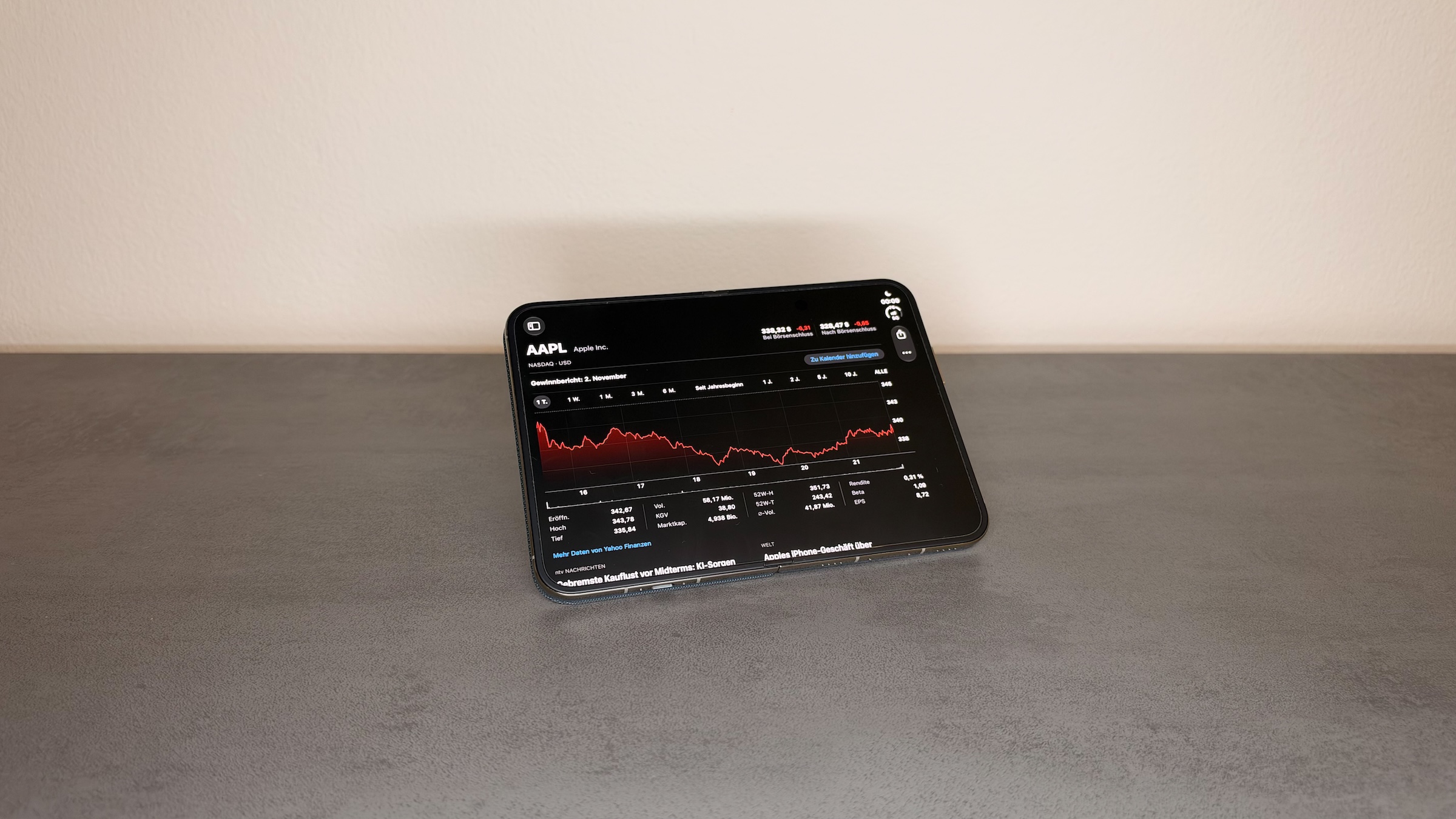
The stock closed regular trading on Monday at $338.32. Following the outlook, it fell briefly to $326.77 in after-hours trading, a decline of approximately 3.4 percent. Shortly after midnight German time, it was trading again at around $330, down about 2.3 percent from its closing price.
The 52-week high is $351.73. The average price target before the earnings release was already below the price at that time, which was around $344. However, after-hours prices are only a preliminary indication; regular trading begins on Tuesday at 3:30 p.m. German time.
What the outlook means for prices
I consider the profit margin to be the most important figure of the evening, especially for buyers. Apple has already adjusted prices twice this year, most recently in September with the iPhone, and yet the margin is expected to fall further. Therefore, I don't expect Apple to refrain from further adjustments next year.
Anyone planning to buy one anyway should currently focus less on discounts and more on availability. This is especially true for models where Apple itself reports shortages.
Do you think Apple will pass on the higher costs to customers again next year, or will the company prefer to keep prices stable? Let us know your prediction in the comments.