This article may contain affiliate links. Learn more on our Partner Program page.
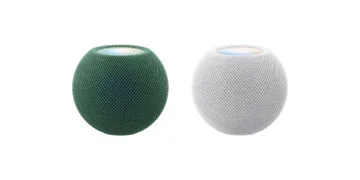
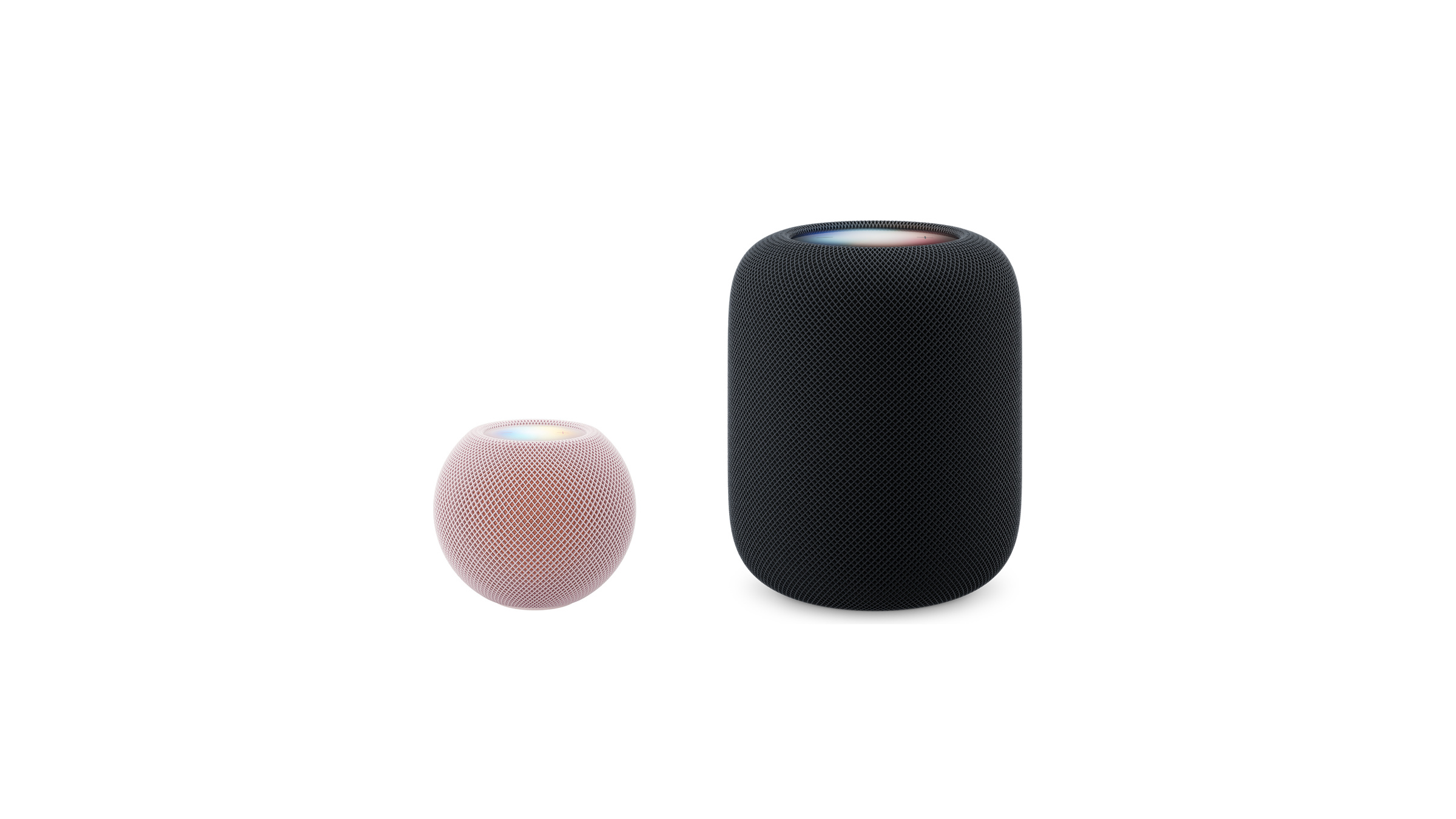
The smaller HomePod now has the newer chip, faster Wi-Fi, and the only Siri AI integration. The larger one delivers the sound quality that people buy a HomePod for in the first place. There's a €230 price difference between the two, and which speaker is right for you depends less on the specs and more on the room where it will be placed.
With the HomePod mini 2, which Apple unveiled at the "Welcome home" event on October 13, there are once again two current HomePod models in the lineup. The larger HomePod 2 has been on the market since February 2023 and has cost 399 euros since the price adjustment in June, while the HomePod mini 2 arrives on October 30 for 169 euros.
Apple lists the technical specifications in the German data sheets for the HomePod mini 2 and the HomePod (2nd generation), and the chips in the announcements for the HomePod mini 2 and the 2023 HomePod. Compared to the first-generation HomePod mini, the successor has grown mainly through the jump from the S5 to the S10 and in Wi-Fi, but hardly at all in the speaker itself.
Key Facts at a Glance
- The HomePod 2 has a 4-inch woofer, five tweeters, room sensing, and 3D audio with Dolby Atmos. The HomePod mini 2 has none of these features.
- The HomePod mini 2 is technically newer: S10 instead of S7, WLAN 6E instead of 802.11n, Bluetooth 6 instead of 5.0.
- Apple has officially announced Siri AI only for the HomePod mini 2, via a later update and initially only in English. Siri AI is not available on either model in German-speaking regions.
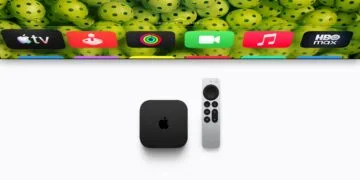
- For surround sound on the new Apple TV 4K, both models can be combined: one pair at the front, one pair at the back.
- A stereo pair consists only of two speakers of the same model and generation.
Technical specifications compared
| HomePod mini 2 | HomePod 2 | |
|---|---|---|
| Price in Germany | 169 euros | 399 euros |
| Market launch | October 30, 2026 | February 3, 2023 |
| Chip | S10 | S7 |
| Speakers | Broadband driver, two passive membranes | 4-inch woofer, five tweeters with their own neodymium magnet |
| Calibration microphone for the bass | not specified | Yes |
| Room recognition | – | Yes |
| 3D Audio with Dolby Atmos | – | Yes |
| Microphones for Siri | three | four |
| Wi-Fi | WLAN 6E (802.11ax) | 802.11n |
| Bluetooth | 6 | 5.0 |
| Thread and ultra-wideband | Yes | Yes |
| Temperature and humidity sensor | Yes | Yes |
| Accelerometer | – | Yes |
| Sound Glow | Yes | not specified |
| Height | 84.3 mm | 168 mm |
| Width | 97.9 mm | 142 mm |
| Weight | 335 g | 2.3 kg |
| Colours | Pink, Green, Blue, White, Midnight | White, midnight |
| Power supply | 20-watt power supply included | Power cable |
The larger HomePod is twice as tall and almost seven times heavier.
Sound: This is where the real difference lies
The HomePod mini 2 uses a single full-range driver and two passive radiators to enhance the bass. A waveguide distributes the sound in all directions, and the S10 continuously adjusts dynamics and volume.
The HomePod 2 separates bass and treble into dedicated drivers and measures the bass response using an internal microphone. According to Apple, its woofer diaphragm moves 20 millimeters. It also features room sensing: it detects sound reflections to determine whether it's positioned against a wall or in an open space and adjusts the sound accordingly. The HomePod mini 2 lacks this capability; Apple explicitly states that this feature is not applicable to it.
3D audio with Dolby Atmos is also only available on the larger model, for both music and video. Apple lists this feature as not applicable to the HomePod mini 2.
Technology: The smaller one is more modern
The situation has reversed with regard to chips and wireless technology. The HomePod mini 2 uses the S10 chip, which Apple introduced in 2024 with the Apple Watch Series 10. The HomePod 2 has been using the S7 chip from the Apple Watch Series 7 of 2021 since 2023.
The difference is more pronounced when it comes to wireless technology. The HomePod mini 2 uses Wi-Fi 6E and Bluetooth 6, while the HomePod 2 still uses 802.11n, the standard now known as Wi-Fi 4, and Bluetooth 5.0.
New to the HomePod mini 2 is Sound Glow: The top light up and pulses to the music, with the colors changing according to the album artwork. Apple doesn't mention this feature for the HomePod 2.
Siri AI: Not a selling point for buyers in this country
Apple has officially announced Siri AI only for the HomePod mini 2. The update will be released later and free of charge, initially only in English, according to the announcement, in the US, Australia, the UK, India, Canada, New Zealand, Singapore, and South Africa. Germany, Austria, and Switzerland are not included, and according to Apple, Siri AI will not be available on iPhones and iPads in the EU at first. Therefore, Siri AI will not be available on the HomePod mini 2 in these countries for the time being.
For the larger HomePod, only a caption on Apple's order page currently describes a Siri AI lighting effect; the product page itself does not mention Siri AI. Therefore, Siri AI plays no role in the purchasing decision for either model in German-speaking countries.
Stereo pair and surround sound on Apple TV
According to Apple, a stereo pair can only be formed by two speakers of the same model and generation. Therefore, a HomePod mini 2 cannot be paired with another HomePod 2, nor with a first-generation HomePod mini. The Home app automatically sets up the HomePod stereo pair as soon as two compatible speakers are in the same room.
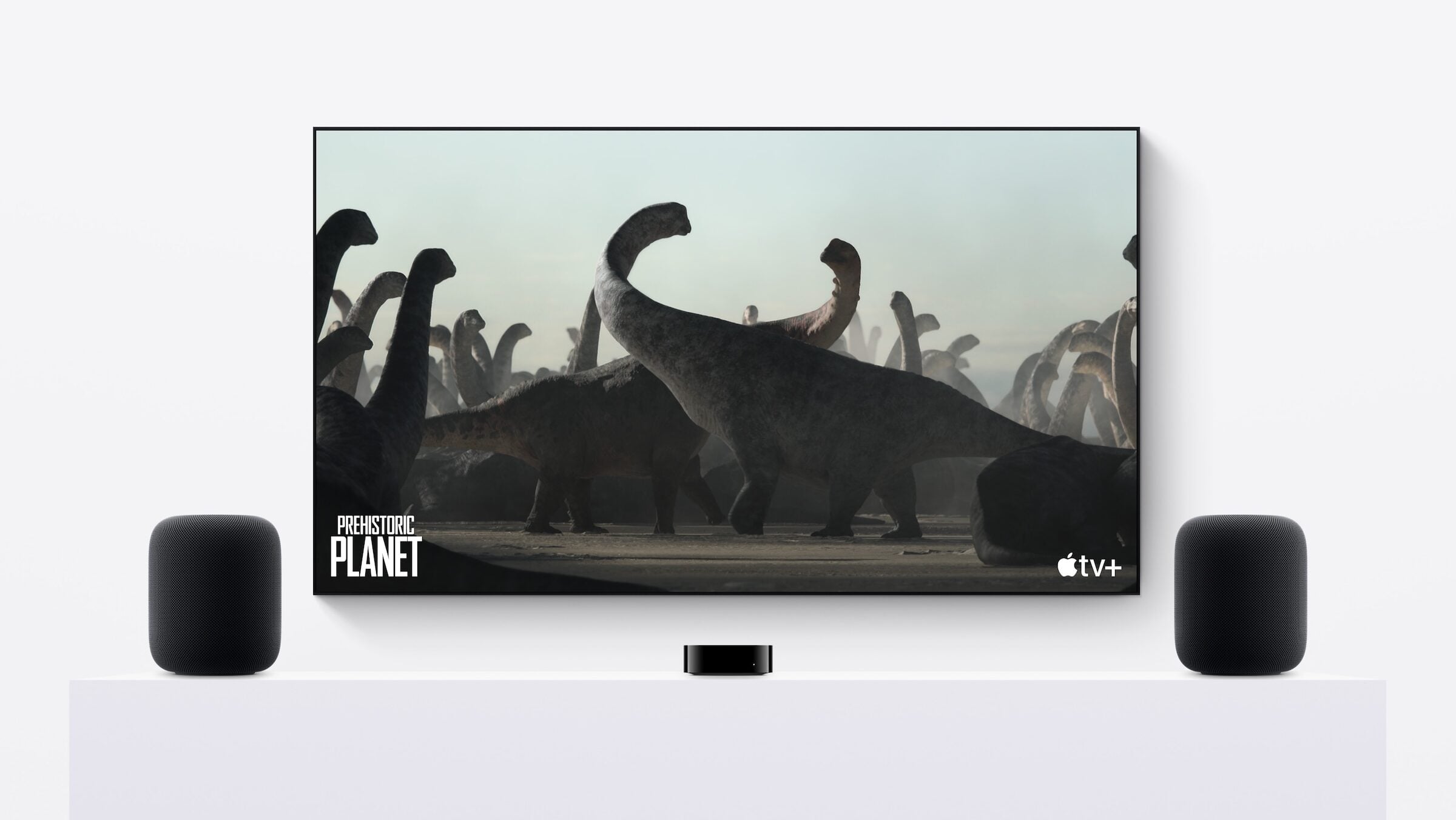
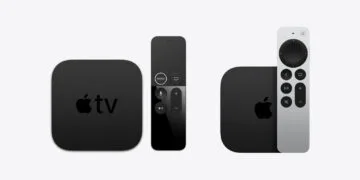
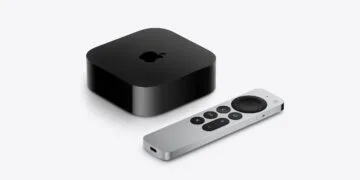
Apple is more generous with its four-speaker surround sound setup. It requires the fourth-generation Apple TV 4K and two matching pairs, one at the front and one at the back. The two pairs can be different: Apple itself demonstrates a setup with two HomePod 2 speakers next to the TV and two HomePod mini 2 speakers behind it.
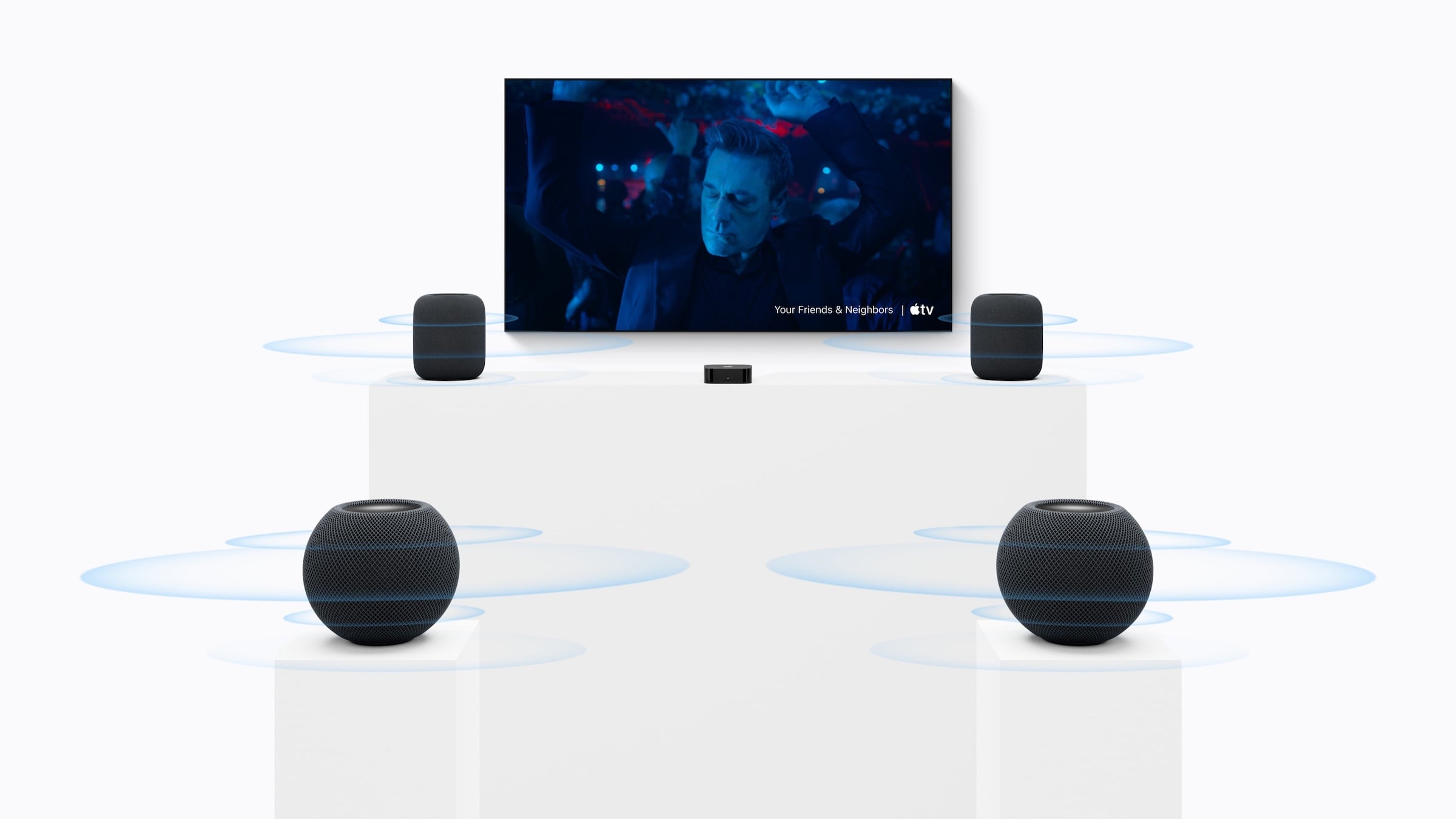
Adding up the prices results in three tiers:
| Surround sound with four speakers | Speakers | With Apple TV 4K (349 euros) |
|---|---|---|
| Four HomePod mini 2s | 676 euros | 1,025 euros |
| Two HomePod 2s in the front, two HomePod mini 2s in the back | 1,136 euros | 1,485 euros |
| Four HomePod 2s | 1,596 euros | 1,945 euros |
The first-generation HomePod mini and the first-generation HomePod are not designed for surround sound.
Commonalities in the Smart Home
As a control center for the smart home, both models are equally capable. Both are home hubs for Apple Home, integrate Thread accessories with HomeKit or Matter, and measure room temperature and humidity. Both detect the alarm tone of smoke and carbon monoxide detectors and then send a notification to the iPhone.
According to Apple, both models can also be used as speakers with a Mac, individually or as a stereo pair. A Mac with Wi-Fi 6E or later is required.
When the large HomePod is worth it
I would base the decision on room size and listening habits, not on the technology. The HomePod mini 2 is sufficient for the kitchen, bathroom, bedroom, or office, and as a control center for a smart home, it's on par with the larger model, even superior in terms of Wi-Fi. Anyone who listens to music consciously, wants to fill a large living room with sound, or values Dolby Atmos will find the HomePod 2 indispensable.
For home theater, I think the mixed setup is the most sensible approach: two HomePod 2s at the front handle dialogue and bass, while two HomePod mini 2s at the rear provide the rear channels. This costs €460 less than four larger speakers. It remains frustrating that the larger HomePod, with Wi-Fi 4 and a 2021 chip, is technically behind the smaller model almost four years after its launch, yet still costs €230 more.
HomePod mini 2 vs. HomePod 2 – the most important points at a glance
The HomePod mini 2 is the more modern device and the more affordable entry point, while the HomePod 2 is the significantly better speaker. Siri AI currently doesn't support either model in this region. However, combining both allows you to create surround sound on the new Apple TV 4K without limitations, using both large and small speakers.
Would you choose the larger HomePod for the living room, or would two HomePod mini 2s as a stereo pair for €338 suffice? Let us know in the comments which speaker you'd put in which room.
Frequently Asked Questions: HomePod mini 2 vs. HomePod 2
What is the biggest difference between HomePod mini 2 and HomePod 2?
The sound. The HomePod 2 has a 4-inch woofer, five tweeters, room sensing, and 3D audio with Dolby Atmos. The HomePod mini 2 uses a full-range driver and two passive radiators. Technically, however, the smaller speaker is newer, with an S10 chip, Wi-Fi 6E, and Bluetooth 6.
No. According to Apple, a stereo pair can only be formed by two speakers of the same model and generation. A first-generation HomePod mini cannot be paired with a HomePod mini 2.
Yes. The fourth-generation Apple TV 4K can connect four speakers for surround sound, one pair at the front and one pair at the back. The two pairs can be different models, for example, two HomePod 2s at the front and two HomePod mini 2s at the back.
No. Apple lists 3D audio with Dolby Atmos as not applicable to the HomePod mini 2, nor is room recognition. Both are only available on the HomePod 2.
Not for now. Apple has only announced Siri AI for the HomePod mini 2, via a later update and initially only in English in eight countries. Germany, Austria, and Switzerland are not among them. There has been no official announcement for the HomePod 2.
The HomePod mini 2 costs €169 in Germany and will be available from October 30th. The HomePod 2 costs €399.
Yes, both models work, individually or as a stereo pair. According to Apple, a Mac with Wi-Fi 6E or newer is required.