Headphones that can "see" their surroundings long sounded like science fiction. Apple has been working on them for about four years – at times on two versions simultaneously. Since August 2026, information from Apple's own code has been available for the first time, and it contradicts previous rumors at a key point.
The AirPods Pro 3 were released in September 2025 with improved sound, stronger ANC, and, for the first time, heart rate monitoring. However, they still use the H2 chip from 2022 and are part of a product line that ranges from the AirPods 4 to the AirPods Max 2. The differences between the three series are explained in the buying guide for the Pro 3, AirPods 4, and Max 2.
A premium model with cameras and the new H3 chip, rumored to be called AirPods Ultra, is expected to follow. Consistent reports from Ming-Chi Kuo, Mark Gurman, and several Weibo leakers have been painting this picture for years. In August 2026, a new source emerged that doesn't replace any of the previous ones but puts them all into perspective: Apple included information about the device in a released version of macOS.
Key Facts at a Glance
| Detail | Expectation |
|---|---|
| Product | Higher-priced AirPods Pro with cameras, possibly “AirPods Ultra” |
| Variants | Two versions developed in parallel: B798 and B790 |
| Release | B798 by the end of 2027; B790 reportedly no longer in the planning stages |
| Chip | H3 (new generation) |
| Cameras | One per earbud; the system code describes color images, analyst reports referred to infrared |
| Resolution | Output resolution up to approximately 1 megapixel, no video |
| Price | Estimated price: €299–349 (AirPods Pro 3 cost €249) |
| Replaces | Nothing – the AirPods Pro 3 will remain in the product range alongside the new models. |
Two code names, one remaining schedule
For years, all reports revolved around a single device with the internal designation B798. This project was originally scheduled for the second half of 2026 and was subsequently pushed back to the end of 2027.
Alongside this, a second version called B790 existed – essentially a camera variant of the existing AirPods Pro 3. Internally, it was considered more advanced and was still slated for release this year until recently. Developing competing versions of the same product in parallel is common practice at Apple.
This duplication has now been resolved. According to a report by Mark Gurman, the B790 will no longer be released; Apple is focusing on the new generation. This means the market launch remains at 2027, even though video footage that surfaced around the same time suggested otherwise.
| Feature | B790 | B798 |
|---|---|---|
| Expected start | last scheduled for 2026, reportedly cancelled | End of 2027 |
| first known | July 2026 via beta code | February 2024 |
| Current status | no longer in the planning | remaining variant |
| Presumed role | Restructuring of the existing model | A completely new generation |
This confirms the obvious assumption that of two competing implementations, only one survived. This has implications for the evaluation of all code findings: they originate from the environment of the scrapped variant.
What Apple's own code reveals about the cameras
The release candidate for macOS Tahoe 26.7 initially included a fully narrated demo video in which a user holds a book cover in front of their earbuds. The demo video, written in Apple's own code, demonstrates image recognition in everyday use but does not reveal the cameras themselves.
A framework in the same system version that controls image capture is significantly more productive. Analyzing this code provides concrete values for the first time:
| Mode | Recording | Output |
|---|---|---|
| Active | 640 × 640 pixels | 1024 × 1024 pixels |
| Passive | 320 × 320 pixels | 320 × 320 or 512 × 512 pixels |
The active mode thus corresponds roughly to one megapixel in the output image. Video recording is not supported – the framework only recognizes still images, either a single shot or repeated at a fixed interval. Both earbuds trigger as a pair: if the image identifiers of both sides do not match, the system interprets the recording as an error.
Color or infrared? Two sources, two answers
At this point, the sources are at odds, and this cannot currently be resolved.
Analyst reports over the past two years consistently mentioned infrared sensors, which would align with the announced gesture control and its compatibility with the Vision Pro. However, the system code explicitly describes color images in a format with three separate color layers and explicitly identifies grayscale levels.
These two possibilities are not mutually exclusive. The analysis notes that additional sensors outside this image area cannot be ruled out – a device could therefore have color cameras for image recognition and further sensors for gestures. This has not been proven.
From reported development halt to orderly schedule
In early July 2026, the timeline was thrown into disarray twice, in opposite directions. First, prototype collector Kosutami reported on X that Apple had temporarily suspended development, thus correcting an earlier statement from June that the project was complete.
He provided no evidence, and his track record is mixed: He was correct about the metal-encapsulated battery of the iPhone 16 Pro, but wrong about the supposedly imminent launch of the AirPods Pro 3 in August 2024.
Just hours later, a counter-signal emerged from Apple's own code. In the second iOS 27 beta, a developer stumbled upon an entry for a device with cameras designed to process two images from both sides of the head – precisely the setup of a camera-equipped earbud. The code cites landmarks like the Eiffel Tower and everyday objects like a coffee cup as examples.
In retrospect, the two things fit together: The stop announcement likely concerned the variant that has since been dropped from the plans. However, the chronology of the past few months primarily shows how often the plans were revised.
| Time | Status |
|---|---|
| February 2026 | Cameras in the AirPods Pro for 2026 |
| May 2026 | Development reaches crucial testing phase |
| June 2026 | Postponed to 2027, coinciding with the anniversary iPhone release. |
| July 2026 | A leaker reports a development halt. |
| August 2026 | The second version is expected to be released this year. |
| August 2026 | Demo video and framework in Mac code; market launch remains at 2027. |
Name: AirPods Ultra or AirPods Pro with cameras?
Apple has not yet made a decision. Two scenarios are being discussed.
In the first case, there would be two versions of the AirPods Pro – with and without cameras, similar to the AirPods 4, which are available with and without ANC.
In the second scenario, a standalone product called AirPods Ultra would be created. Apple already uses the Ultra label for the Apple Watch Ultra, for chips, and for CarPlay Ultra. A price above that of the AirPods Pro 3 would create a new premium tier – between the Pro 3 at €249 and the AirPods Max 2 at €579.
Development status: Prototypes with near-final design
According to a Bloomberg report, the prototypes are currently undergoing Design Validation Testing – an advanced phase in which internal testers put devices with a near-final design through their paces in everyday use. Only Production Validation Testing remains before early mass production can begin.
The launch wasn't delayed because of the hardware, but because of the software: The next major Siri generation serves as the basis for the AI functions and takes longer to develop. Additionally, Apple had to create visual models that can reliably recognize objects in the environment.
The hardware is therefore considered to be very advanced, but the market launch remains tied to the maturity of the software.
Cameras: What they can – and can't – do
The cameras are not photo or video cameras. They capture the environment in low resolution and send the data to Siri and Apple Intelligence.
A typical use case: a glance into the refrigerator, a question about what can be cooked with the available ingredients – the answer comes directly to your ear, without having to take your iPhone out of your pocket. The concept is similar to the image recognition that already works on the iPhone; how this works is explained in the guide to Visual Intelligence with Camera and Screen.
The cameras are located in both earbuds. This allows the environment to be captured from two perspectives, making spatial perception more precise than with a single camera.
Expected features at a glance:
- Visual Intelligence: Object recognition, text recognition, and context-related information directly through the earbuds.
- Gesture control in the air: hand movements instead of pressure on the stem – some reports suggest that Apple could completely replace the pressure-sensitive stems.
- Spatial Audio with Vision Pro: improved head tracking through the combination of sensors and the H3 chip
- Context-dependent memories that arise from what has been seen
- More precise navigation, where specific landmarks are named as turning points.
Passive mode and the question of triggers
What's new is the realization that the earbuds aren't just meant to work on voice commands. The low-resolution mode is designed to perceive the surroundings and uses five conditions in its code: speech in the vicinity, a change in the acoustic environment, a change in body posture, a head turn, and leaving a defined radius.
Whether each of these conditions actually triggers a recording is not clear from the code. What is clear is that a recording in this mode does not require any conscious action from the user.
Because earbuds fit differently in the ear and move constantly while walking, the system invests considerable effort in calibration: field of view, position of the cameras relative to each other, correction of lens distortion, and comparison with the motion sensor. It automatically filters out blurry or obscured images.
Design: Longer stem and indicator light
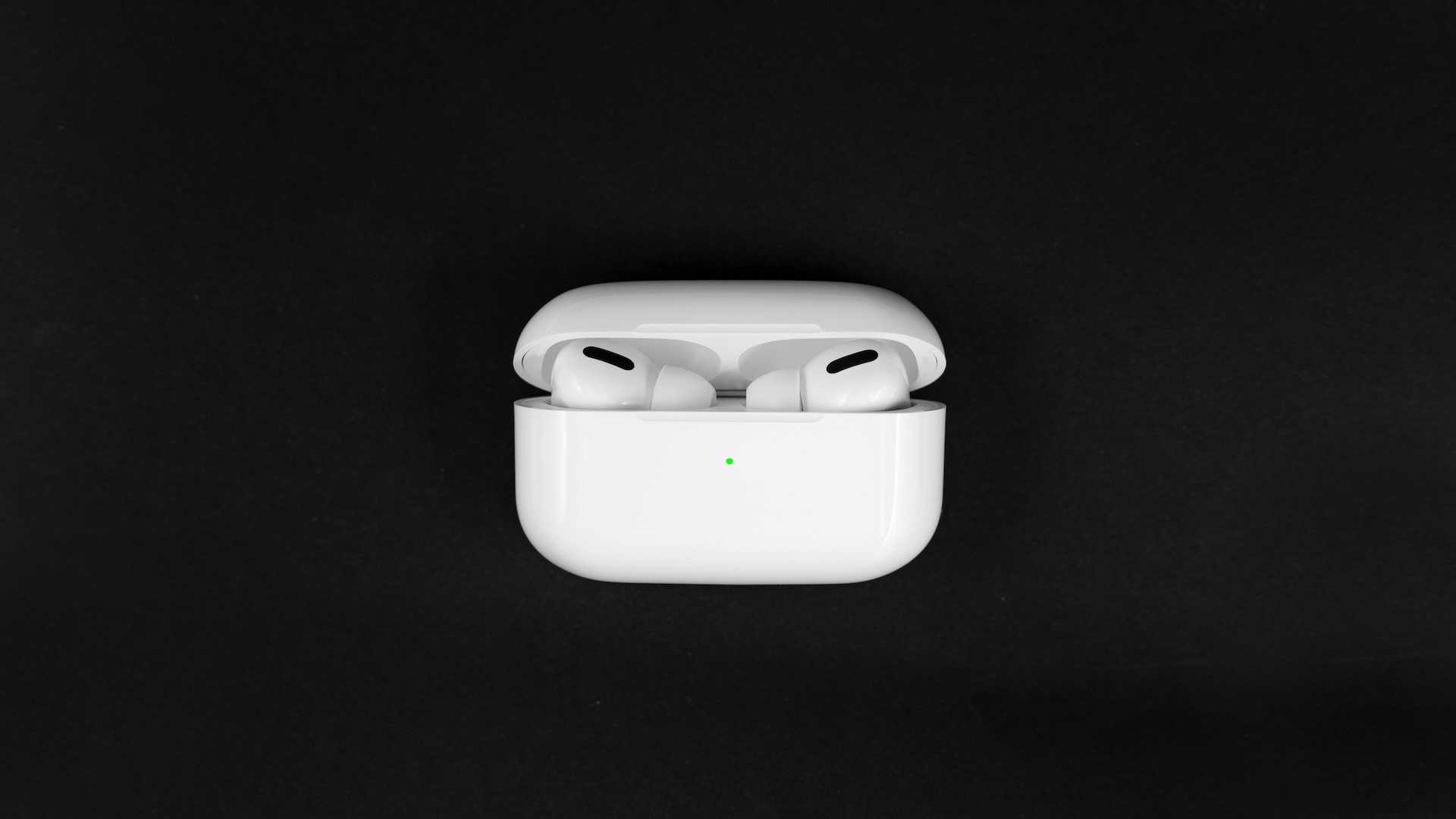
Visually, the AirPods Ultra are expected to closely resemble the current AirPods Pro. The key change lies in the stem: it's longer to accommodate the cameras. In the demo video that surfaced, the stem appears correspondingly thicker than on the current model.
A small display on the casing will make the recording visible – the system code can control the state and brightness of such a hardware display. Apple is thus adopting a principle familiar from the camera on the Mac.
However, two limitations are also included in the code. There is no indication that an unobstructed view of the display is a prerequisite for recording – a light obscured by hair would therefore not prevent the recording. And the existing person recognition feature is not used to withhold recordings of strangers: the code includes a setting that flags an unrecognized person and still forwards the image.
Chip: H3 for gestures and sensors
Despite new features, the AirPods Pro 3 still use the H2 chip from 2022. The new H3 chip, which is reportedly already in development, is intended for the AirPods Ultra.
Expected improvements:
- Better sound quality and lower latency
- Computing power for real-time gesture processing and image analysis
- Higher energy efficiency to support the additional sensors
- Closer integration with iPhone and Vision Pro
Part of the analysis is supposed to run directly on the earbuds. The system code mentions a detection feature on the accessory itself that determines whether a person is in the field of view.
Health functions
The AirPods Pro 3 already measure heart rate and offer hearing tests. With the H3 chip and additional sensors, further features could be added, such as enhanced fitness data or improved ambient sound analysis.
No source has yet provided specific details. This expectation is based on the direction of development, not on a report of confirmed features.
Price and positioning
The AirPods Ultra would fill a gap in the product range. The AirPods Pro 3 will remain on sale alongside the AirPods – just as the AirPods 4 with and without ANC will coexist.
| Model | Price (DE) |
|---|---|
| AirPods 4 | from €149 |
| AirPods 4 with ANC | from €199 |
| AirPods Pro 3 | 249 € |
| AirPods Ultra (expected) | €299–349 |
| AirPods Max 2 | 579 € |
Release: When will the AirPods Ultra be released?
For a long time, autumn 2026 was considered the most likely timeframe – along with the iPhone 18 Pro, the iPhone Ultra and the Apple Watch Series 12. Ming-Chi Kuo had previously assumed a production start in 2026.
A Bloomberg report subsequently postponed the market launch to the end of 2027, coinciding with the expected release window for Apple Glasses. With the earlier launch date now off the table, this remains the only possible timeframe.
We expect the launch date to change at least once more before the presentation. The documented reason for this is the project's history: within six months, the product was slated for 2026, then 2027, was temporarily halted, then brought forward, and finally back to being a 2027 product. A project whose plans change so frequently rarely reaches its final form.
What the market launch means for buyers in Germany and Austria
Cameras worn on the ear only make sense if a paired device can actually do something with the image data. This is precisely where the divide lies for Germany and Austria: Apple stated in a separate announcement in June that Siri AI will not launch in the EU with iOS 27 and iPadOS 27 – the enhanced visual intelligence experience is explicitly included in the list of missing features. The background information can be found in the overview of the DMA dispute surrounding Siri AI.
The crucial point is the second part of the same announcement: Users in the EU will indeed receive Siri AI on macOS 27 and visionOS 27. The Apple Watch is excluded, and Apple gives a specific reason for this – Siri AI on watchOS 27 requires a paired iPhone with Siri AI.
This dependency doesn't exist with AirPods. They aren't tied to an iPhone, but to an Apple account: Apple lists iPhone, iPad, Mac, Apple Watch, and Apple Vision Pro equally in its instructions for switching AirPods devices. Anyone using the earbuds with a Mac or Vision Pro is working with a system where Siri AI is available in this region.
The code doesn't answer whether the image data analysis technically requires an iPhone. It only proves that the blanket statement "EU block, therefore useless here" doesn't hold water. The [organization/group] is collecting information on which other functions are missing in this country. Overview of Apple features missing in the EU.
For Switzerland, the question is moot anyway: Apple lists all 27 affected member states in its announcement, including Germany and Austria; Switzerland is not among them. The restriction does not apply there – the determining factor is residence, not the place of purchase.
Who are the AirPods Ultra intended for?
The AirPods Ultra are not a replacement for the AirPods Pro 3. Anyone simply looking for good headphones with ANC is perfectly happy with the Pro 3 and doesn't need to wait for anything.
This model will be interesting for anyone who actively uses Apple Intelligence, owns a Vision Pro, or is interested in gesture control and spatial applications. If you're planning to buy new AirPods right now, you can confidently go for the Pro 3 – they'll remain in the product line, continue to receive software updates, and the variant that could have been released this year is no longer planned.
Those waiting for the next big Apple headphone innovation should realistically expect it by the end of 2027. Information regarding the development status, codenames, and timelines is primarily based on reports from Mark Gurman, whose track record of accurately predicting Apple's product planning has been proven over many years; information from individual leakers is marked as such above and is significantly less reliable. Apple has not confirmed either the product or a release date.
Would ear-mounted cameras be worth the extra cost to you if the recording is only visible via a small light – or is that precisely the point at which you'd stop buying this product? Let us know in the comments where you draw the line.
- iPhone Ultra (iPhone Fold): All rumors and facts at a glance
- Apfelpatient Weekly #19: Who sets the prices at Apple
- Apple's leadership team is undergoing a transformation: Who's leaving and who's taking their place?