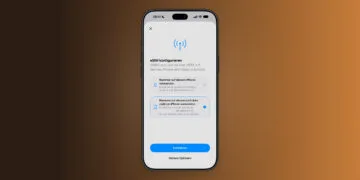
There's a somewhat forgotten feature in iOS 14. It's called "Precise Location" and can be found in the Location Services section. This feature gives users more control over which apps can access their current location and at what granularity.
Before iOS 14, you could grant an app access to your location and choose whether it would apply all the time or only when you were using the app. However, if location access was allowed, the app would always receive your exact coordinates. Many apps don't actually need such precise location information, and iOS 14 offers that flexibility, including the ability to ask the user up front in the permissions dialog.
iOS 14 Location: Users decide individually
While navigation apps require a precise location to function, many application classes don't require GPS-level positioning. For example, a weather app only needs to know the current city to display the weather at that location. Apple provided a great example during WWDC 2020 with its own TV app. Streaming services have different content rights for each region, so the app needs to know the user's location to display content that the user is legally permitted to view. However, it doesn't need exact coordinates to do so. Therefore, under iOS 14, the TV app only requests high-level regional location data. iOS 14 includes APIs that allow apps to declare that they only need "reduced-precision" location, allowing diligent app developers to collect only the minimum amount of information and nothing more. Users can also individually decide which app should have full or partial access.
iOS 14: How to enable or disable the “Precise Location” feature
If you want to control this feature later, you can do so at any time via the iOS settings. To do so, open the "Privacy" section in the iOS settings. Then navigate to "Location Services" and select any app. You can now restrict location tracking. Important: Apps that were granted location permission before iOS 14 automatically receive full access to precise location data. Therefore, this must be changed manually.
iOS 14: How can iOS roughly determine location?
Reduced precision location information is designed to be useful and privacy-preserving. Location services see circular regions a few kilometers in diameter. Region data is only recalculated a few times per hour, so exact tracking is not possible. The user's actual location will be somewhere inside the circular region, but it cannot be determined precisely. The system is intelligent enough to provide location results that make sense to humans. For example, if you are driving near the border of two countries, the approximate location region will be entirely within the current country you are in. This means that a weather app will always be able to show relevant local forecasts without ever knowing exactly where you are.
Likewise, the radius of approximate location regions varies depending on the context. If the user is driving through a dense area with multiple cities, the radius shrinks to a few kilometers to ensure the app can provide relevant results. On the other hand, if iOS knows you're driving through a wide, open area, the approximate location can be much larger. The reduced accuracy setting also applies to background location updates. Apps running in the background with approximate location permissions are only notified of location alerts about four times per hour, and each update has the same imprecise granularity; a region typically spanning a few kilometers.
What about apps that actually need the exact location?
Of course, there are also apps that need the exact location. But it's the developers' job to convince users to grant them access - right? This would apply to navigation apps, for example. If the location were restricted here, the app would not be able to inform the user in time when to turn. Apps can also request temporary full access. The ideal behavior is best shown by the way the Apple Maps app works on iOS 14. When the user grants a restricted location, the maps app shows the user's current location marker as best as possible. A notice is displayed at the top of the screen. However, if a user tries to navigate to another location, the maps app reports that it needs an exact location to perform the routing. Now you could grant temporary full access for this purpose.
iOS 14 Location: Balancing privacy and convenience
This function is actually well thought out. It offers customers useful improvements Privacy without unnecessarily penalizing any class of apps. Precise location permissions remain the default, causing limited disruption to the app ecosystem. "Well-behaved" apps can voluntarily grant only reduced location permissions, knowing they don't need anything more precise. If the user disables them, the app has the opportunity to explain why it needs full location and can direct the user directly to the relevant page in Settings. In summary, there are now two axes of location permissions in iOS 14—a balance between privacy and convenience. (Photo by Denys Prykhodov / Bigstockphoto)