
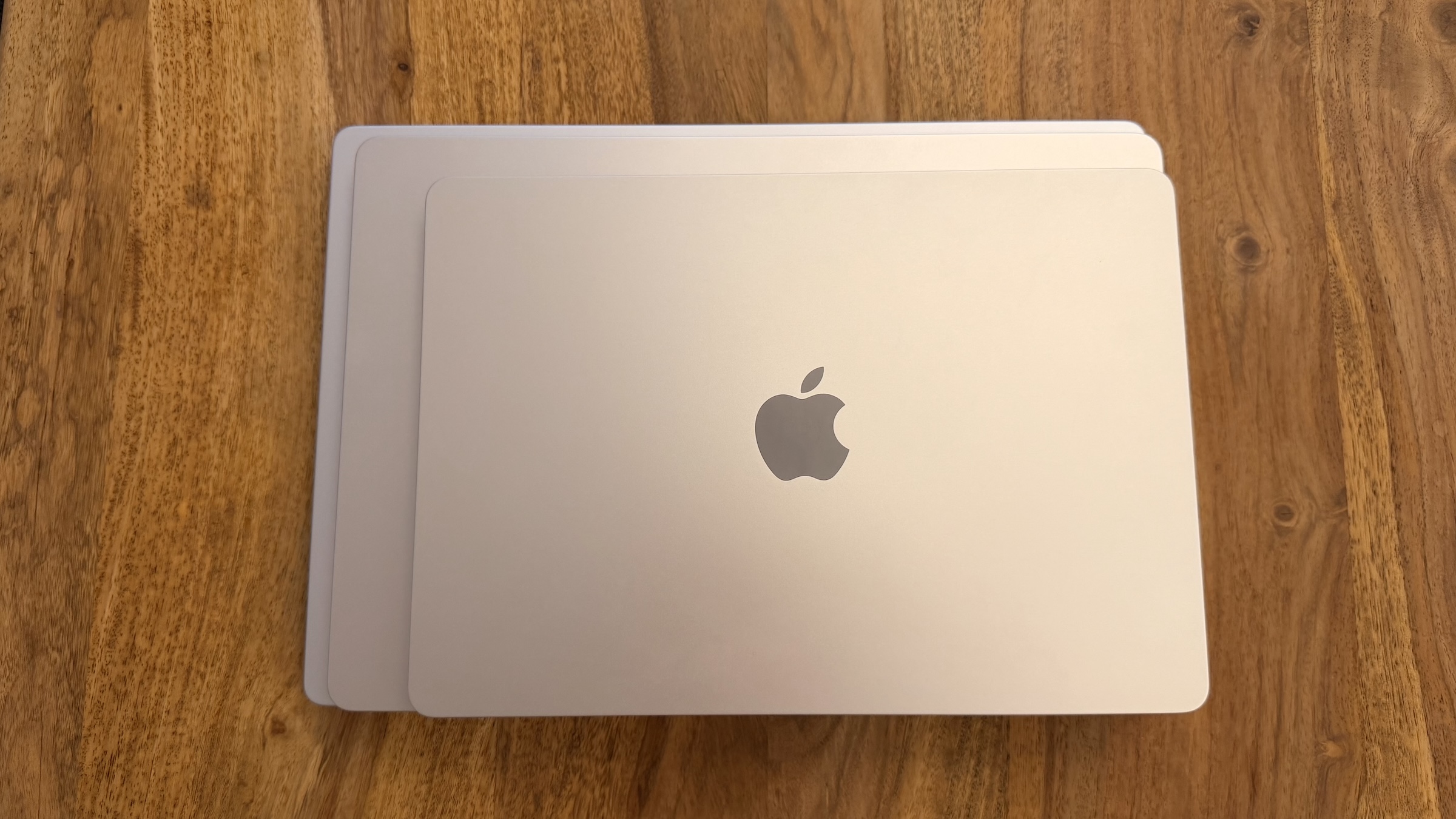
Touchscreen, OLED, and Dynamic Island have been the buzzwords for the new top-of-the-line MacBook. Now, another feature has been added that may be more important in everyday use than all three: The device is expected to weigh noticeably less than the current MacBook Pro.
Mark Gurman reports in the latest edition of his Power On newsletter at Bloomberg that Apple has redesigned the internal components, miniaturized parts, and rearranged them to make the computer significantly lighter. The report does not specify a concrete weight.
The timeline remains unchanged. Gurman confirms that the device is still slated for release by November, after previously expecting an October or November launch. Whether Apple will market it as the MacBook Pro or the MacBook Ultra remains to be seen. The overall design of the MacBook Ultra thus gains a feature that would be immediately noticeable when carrying it.
Key Facts at a Glance
- According to Bloomberg, the new top-of-the-line MacBook with OLED display and touchscreen will be significantly lighter than the current MacBook Pro.
- This will be achieved through smaller components and a new internal arrangement.
- There is no weight information provided.
- According to Apple, today's 16″ MacBook Pro weighs between 2.14 and 2.15 kg, while the 15″ MacBook Air weighs 1.51 kg.
- The launch is still expected sometime in November.
What the report says about weight
Gurman describes the weight reduction as significant, not a minor detail. This is based on design changes: smaller components and a reorganized internal layout. He cites the gap between the 16-inch MacBook Pro and the 15-inch MacBook Air as a benchmark, a gap that is currently large enough that any significant reduction would be immediately noticeable. 14-inch and 16-inch versions are expected.
How heavy the current models are
Apple's data sheets for the 16″ MacBook Pro, the 14″ MacBook Pro, and the 15″ MacBook Air show how large the gap is today:
| Model | Weight according to Apple |
|---|---|
| 16″ MacBook Pro with M5 Max | 2.15 kg |
| 16″ MacBook Pro with M5 Pro | 2.14 kg |
| 14″ MacBook Pro with M5 Max | 1.62 kg |
| 14″ MacBook Pro with M5 Pro | 1.60 kg |
| 15″ MacBook Air with M5 | 1.51 kg |
The difference in weight between the large MacBook Pro and the 15-inch MacBook Air is therefore around 630 grams. The 14-inch model with the M5 Pro, on the other hand, weighs only 90 grams more than the larger Air. This weight gap is particularly noticeable in the 16-inch class.
The new device is expected to use the same chip as the current M5 Pro and M5 Max models. Therefore, any weight reduction would not come from a more energy-efficient chip, but solely from improvements to the casing, cooling system, and components.
Gurman's Report and its Limitations
Gurman is one of the most reliable sources regarding Apple's product plans; he has frequently provided early and accurate information on timelines and specifications in the past. However, the current information is purely qualitative: no weight, no percentage, no breakdown by display size.
Why weight matters with the 16-inch model
I believe weight is the most underrated aspect of this generation. OLED and touchscreens are visible innovations, but anyone who carries a 16-inch notebook daily notices every gram, and this is precisely where the current MacBook Pro falls significantly short of anything else Apple sells in terms of notebook weight. A lighter 16-inch model would ease the trade-off between a large display and portability, a decision that currently often favors the 14-inch model or the Air.
Anyone who is about to buy a 16″ MacBook Pro and frequently takes it with them has a concrete reason to wait for the launch, which is expected in November.
How much lighter would the new 16-inch model have to be for you to choose the larger display over the 14-inch model or the Air? Tell us in the comments which MacBook you're currently lugging around every day.