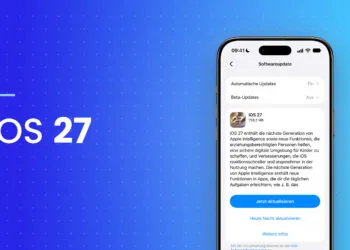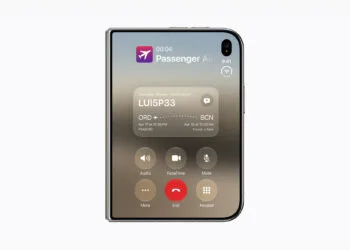

The non-public program libraries of iOS 27 and macOS 27 Golden Gate contain an architecture that makes Siri AI interchangeable with third-party models. Two separate paths are implemented in the code – one of which completely replaces Apple's own server model.
The developers discovered the structures and published two demonstration videos on X. These videos show a Mac on which a third-party language model takes over tasks that were previously the sole domain of Apple's Assistant – to the point that personal data from email and contacts flows to this model. How Apple handles this data has always been a separate issue in Apple Intelligence, and that's precisely where things get interesting.
Key Facts at a Glance
- The finding comes from private frameworks of iOS 27 and macOS 27 Golden Gate, evidenced by two videos.
- A process called Model Delegation allows a foreign model to appear as a Siri extension, just as the built-in ChatGPT connection already does.
- A second approach goes further: It completely replaces Apple's server-side Siri model with a third-party one.
- The foreign model receives Apple's own control instructions including a tool list, can trigger system actions, and receives the results back.
- None of this has been enabled for users yet: In the macOS 27 Release Candidate, only the ChatGPT extension can be selected.
What the first variant can do
In the first video, the user accesses the search and question bar and selects a different model, in this case Claude, via a context menu. A reminder can then be created by voice command: the other model understands the phrasing, and the Reminders app is subsequently populated by Siri.
The division of labor is thus clearly defined. If a request requires access to a system function, the external model passes the task back to Siri. A second example shows the opposite direction: The model generates a CSV file, something Apple's assistant itself cannot do.
The second option goes deeper
The real finding is in the second video. There, instead of simply adding an extension, the part that does the work is replaced: Apple's server-side model is replaced by a different one, in this example GPT-5.6 Terra from OpenAI's current model series.
The external model receives Apple's planning instructions and a description of the available tools. It can then request system actions, receives the associated personal data, and formulates a response that Siri subsequently outputs in its own interface and voice. In the demonstration, the model searches for emails on a specific topic, summarizes them along with their tasks, and sends a message to a contact.
| Expansion next to it | Server model replacement | |
|---|---|---|
| What is being replaced | nothing, the model is added | Apple's own Siri model |
| Who executes system actions? | Siri, after return | the foreign model via Apple's tool list |
| Access to personal data | mediated via Siri | directly as a result of the tool calls |
| Status in Release Candidate | Only ChatGPT is selectable. | Not released to third parties |
Why the European legal framework plays a role here
The Digital Markets Act obliges Apple to grant third parties effective access to the functions available through its services. The European Commission has explicitly stated that this principle also applies to Siri. The App Store, iOS, Safari, and iPadOS are named as the central platform services – although the demonstrated procedure ran on a Mac, the obligation itself is tied to the iPhone operating system.
This suggests that the architecture did not arise solely from technical curiosity. We expect that a choice menu for language models will become visible in Europe sooner than elsewhere – so far, only the existence of the underlying infrastructure has been proven.
From sole provider to intermediary
For years, Apple operated its assistant as a closed system. The code now describes the opposite: a layer that receives requests, forwards them to an arbitrary model, and feeds the result back into Apple's interface. Who provides the model thus becomes a matter of configuration.
In practical terms, this means little for now, because third-party access has not been granted and none of this appears in the finished system. Strategically, however, it is the more far-reaching aspect of the announcement: An assistant whose model is interchangeable no longer competes on the quality of its response, but rather on its integration into the system.
Would you prefer a third-party model behind Siri if it could see your emails and contacts – or is that precisely where you draw the line? Let us know in the comments where you would draw it.