
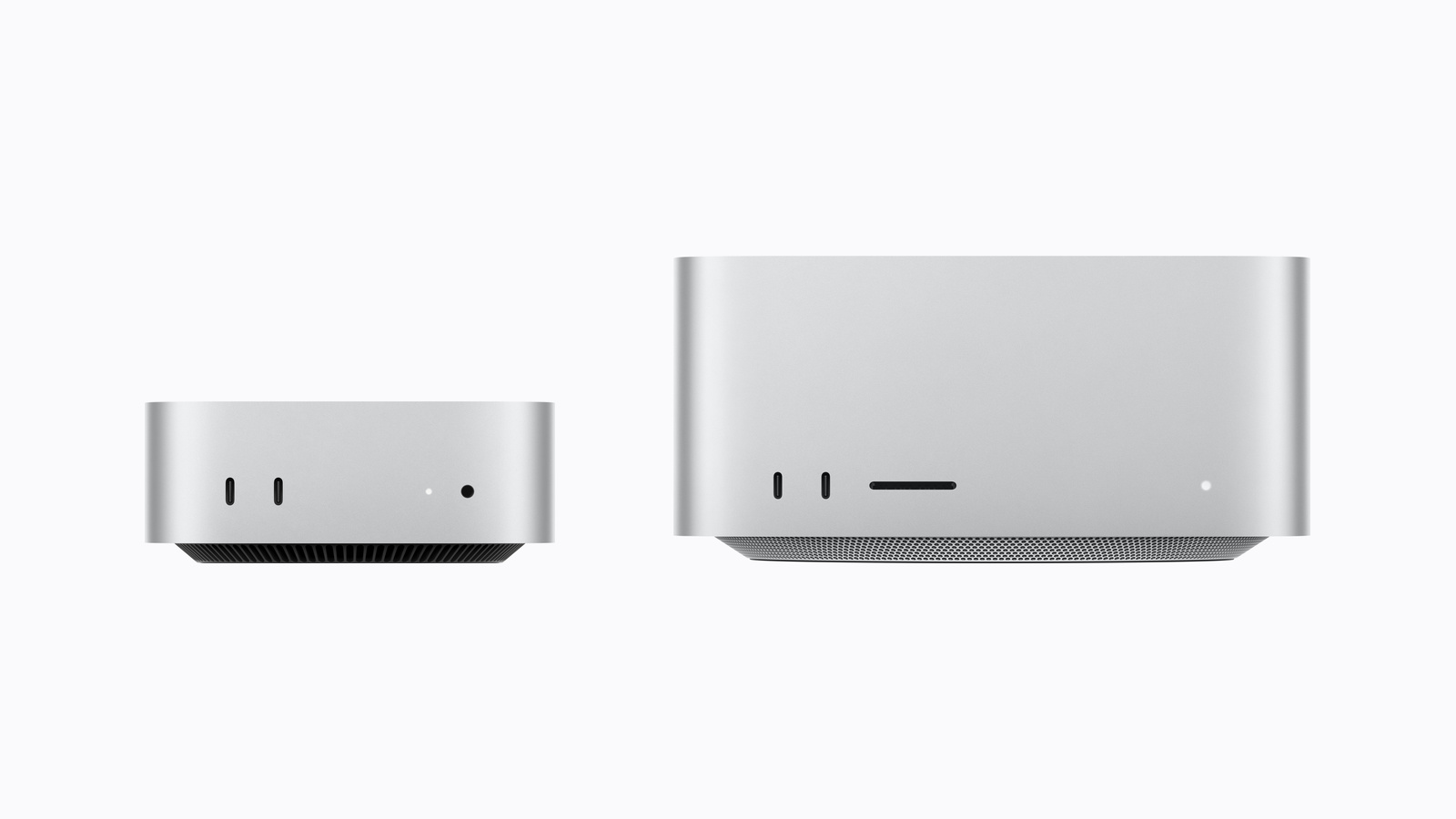
One day before their release, the first tests of the Mac mini with M6 and the Mac Studio with M5 Ultra are available. Both devices impress with their performance, but both suffer from the same drawback: the price. The test results also confirm what had leaked before the market launch.
Apple unveiled both desktop Macs together on August 25th, and they will be available in stores starting Tuesday, September 22nd. The Mac mini comes with the new M6 or the M5 Pro, while the Mac Studio features the M5 Max or the newly introduced M5 Ultra. A comparison of the Mac mini and Mac Studio will show which of the two devices is best suited for which application.
Full reviews of the Mac mini are available from Engadget, 9to5Mac, and Tom's Guide, while reviews of the Mac Studio are available from Engadget and Tom's Guide. All reviewers used the M6 or M5 Ultra versions; the M5 Pro and M5 Max versions were not tested.
Key Facts at a Glance
- The Mac mini with M6 beats the M4 Pro in the single-core test and writes and reads with a 512 GB SSD roughly twice as fast as its predecessor.
- According to Engadget, the Mac Studio with M5 Ultra is around 20 to 30 percent faster than the M3 Ultra, and almost twice as fast with the SSD.
- The main criticism of both devices is the price; in the case of the Mac mini, the additional criticism is the basic storage capacity of 256 GB.
- The Geekbench scores that were made public before the market launch largely correspond to the measurements on the test devices.
Mac mini with M6: The processor is ahead of the M4 Pro
All three testers had a Mac mini with an M6 processor and 24 GB of RAM. In Geekbench 7, the device achieved 4,074 points in the single-core test and 22,632 in the multi-core test, and 92,542 in the Metal graphics test, according to 9to5Mac. Compared to the M4, these figures represent increases of 24, 48, and 71 percent, respectively, according to 9to5Mac's calculations. The M6 even surpasses the 12-core M4 Pro in terms of processor performance, while the M4 Pro remains ahead in graphics.
Tom's Guide measured a single-core score of 4,708 for the M6 in Geekbench 6, compared to 3,838 for the M4. Engadget sees the M6 as 16.5 percent ahead of the M4 Pro in the single-core test, and just behind in the multi-core test. Tom's Guide also found that the M6 downscaled a 4K file to 1080p in 2 minutes and 45 seconds, while the M4 took 4 minutes and 42 seconds.
The SSD doubles the speed. 9to5Mac measured around 6,000 to 6,400 MB/s for both read and write speeds with 512 GB, while the M4 with 512 GB achieved approximately 3,000 to 3,400 MB/s. Tom's Guide explicitly attributes the jump to the 512 GB configuration of its test device – none of the tests mention the entry-level 256 GB version.
Games also run smoothly: Cyberpunk 2077 achieves around 55 to 57 frames per second in 1080p according to both Engadget and Tom's Guide. None of the three testers noticed any bothersome fan noise.
Mac Studio with M5 Ultra: Performance for a small audience
Engadget tested the fully equipped version with a 36-core CPU and 256 GB of RAM, while Tom's Guide tested the entry-level variant with a 30-core CPU and 64-core GPU. In the Geekbench 7 multi-core test, the M5 Ultra achieved 52,185 points in Engadget's tests, compared to 39,145 for the M3 Ultra. Engadget sees an improvement of approximately 20 to 30 percent across the processor, graphics, and Neural Engine compared to its predecessor.
The difference is even more pronounced with the SSD. Engadget measured around 14 GB/s write and 11 GB/s read speeds, while Tom's Guide recorded 14,283 and 13,902 MB/s respectively – more than double the speed of the Mac Studio with the M4 Max. Engadget's device transcribed a 70-minute podcast episode in 18 seconds, less than a quarter of the time taken by its predecessor with the M4 Max.
Apple's claim of simultaneous playback of eight 8K ProRes tracks is confirmed by Engadget on a 4K timeline, but not on an 8K timeline. In games, Tom's Guide reported that the Mac Studio achieved 77 frames per second in Cyberpunk 2077 at 4K, while Engadget recorded Baldur's Gate 3 at an average of over 80 frames per second in 4K. Both testers described the device as quiet under load.
According to Engadget, the price premium compared to the M5 Max is only justified for a few users: In the AI benchmark Geekbench AI, the M5 Ultra was only about 10 percent ahead of the M5 Max, but costs about twice as much in most configurations.
What the testers criticize together
The price is the main point of criticism for both devices. With the Mac mini, all three reviewers are bothered by Apple raising the entry price without including more than 256 GB of storage, and by the fact that any upgrades remain expensive. Engadget and Tom's Guide also criticize the power button on the bottom.
Both reviewers criticize the Mac Studio with M5 Ultra primarily for its starting price, which has increased from $3,999 to $5,499 in the US. Engadget therefore recommends the Mac Studio with M5 Max to creative professionals, while Tom's Guide advises users without professional requirements to consider the Mac mini.
The values remain the same before the market launch
Before the sales launch, initial Geekbench scores for the M6 and graphics scores for the M5 Ultra and M6 surfaced, each from individual, unconfirmed entries. The measurements on the test devices were only slightly off.
| Value (Geekbench 7) | Entry before market launch | Test device |
|---|---|---|
| M6, single core | 4.071 | 4,074 (9to5Mac) |
| M6, multi-core | 22.783 | 22,632 (9to5Mac) |
| M6, Metal | 93.217 | 92,542 (9to5Mac) |
| M5 Ultra, multi-core | 52.516 | 52,185 (Engadget) |
The deviations remain below one percent. The entries thus reliably reflect the performance of the trading devices.
The Mac mini remains the sensible purchase
In Germany, the Mac mini with the M6 starts at €1,049, the Mac Studio with the M5 Max at €2,999, and with the M5 Ultra at €6,599. According to tests, the Mac mini is the right choice for most buyers: its processor now outperforms the M4 Pro, it remains quiet, and it costs a fraction of the price.
The M5 Ultra, on the other hand, is only worthwhile where a lot of RAM is needed – for example, for large local AI models. However, Apple states that the 512 GB version, which it is advertising for this purpose, will not be available until the end of October. Those undecided between the two devices can find a comparison based on use cases in the Mac buying guide.
Is a Mac mini with an M6 processor sufficient for your needs, or do you actually require the performance of a Mac Studio for your work? Let us know in the comments where you draw the line between the two.