
Apple's planned switch to in-house modems across the entire iPhone 18 lineup is mostly discussed in terms of speed and efficiency. However, one little-noticed aspect could prove more important for many users: only with the move away from Qualcomm modems will the entire iPhone lineup gain a privacy feature that provides cellular carriers with less precise location data.
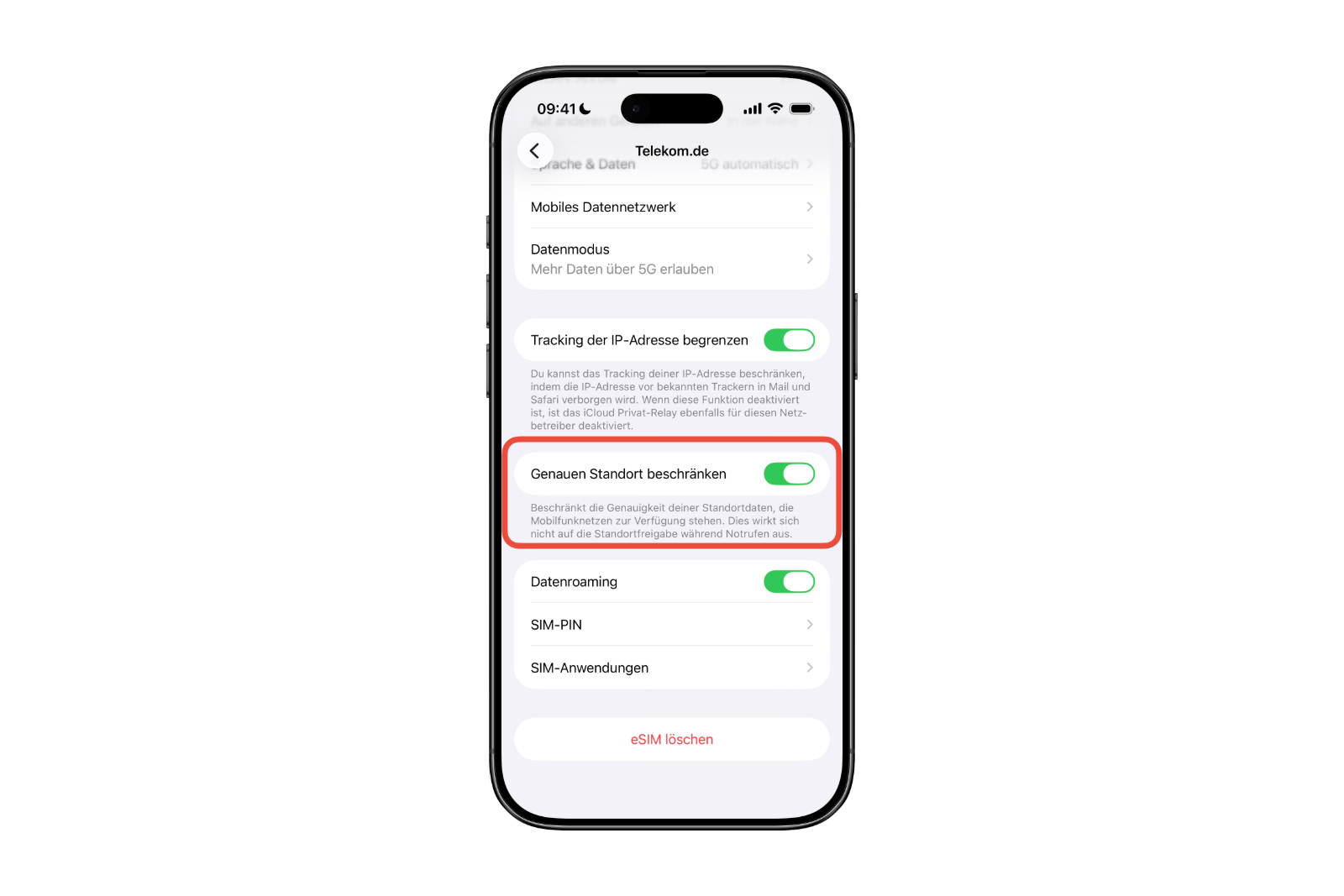
With iOS 26.3, Apple introduced a new setting at the beginning of the year called “"Limit exact position" introduced – but only for a very small group of devices. The reason for this is hardware-related: the function only works on iPhones and iPads with Apple's own C1 or C1X modems. With the iPhone 18 Pro and iPhone Ultra Apple's foldable phone, expected in fall 2026 and which, according to two independent leakers, Apple might market under the Ultra label instead of "Fold," is expected to fully transition to Apple's own modems. This should also make the privacy feature available for the entire iPhone generation.
What the Setting Actually Does
“Restrict exact position” limits the level of detail in the location data that mobile network operators receive via the connection to the mobile network. Instead of near-address-accurate localization via the connected cell towers, carriers only receive a rough region or neighborhood.
This form of location tracking works independently of apps and GPS. Cellular carriers can determine a device's whereabouts whenever it connects to a given cell. iOS 26.3 inserts a technical filter at this point that deliberately makes this network-side location coarser.
Important: Emergency Calls and Signal Quality Remain Unaffected
Apple makes clear that the feature deliberately leaves several critical aspects untouched. Signal strength does not change, voice and data quality remain identical, and above all: in emergency calls, the full precise location is still transmitted to emergency services. Location permissions in apps – for example, for maps or navigation – are also unaffected by the setting, because they run through the separate Location Services.
The restriction therefore applies exclusively to the data stream that already runs in the background between the cellular carrier and the device – and that has been invisible to most users until now.
Why the Feature Has Remained Largely Unknown
The setting is currently only available on four devices: the iPhone Air, iPhone 16e, iPhone 17e, and the M5 iPad Pro – precisely the current Apple devices that already use a C1 or C1X chip. Devices with Qualcomm modems, including the iPhone 17 Pro models, simply do not have the option in their Settings menu.
On top of that, cellular carriers also have to actively implement support. In the US, only Boost Mobile is on board so far. Internationally, the picture looks somewhat better: in the UK, EE, BT, and Sky support the feature, and carriers in Austria, Germany, Denmark, Ireland, and Thailand are also Apple partners. Apple maintains a complete list of supporting providers on a dedicated support page.
Why the iPhone 18 Transition Brings the Feature to the Mainstream
The next generation is the point at which the privacy feature could step out of its current niche existence. Rumors point to Apple's C2 modem in the iPhone 18 Pro as well as the iPhone Ultra – both replacing the last Qualcomm modems in Apple's high-end segment. According to previous reports, the C2 is not only faster and more efficient, but will also support mmWave 5G for the first time, which the current C1 and C1X modems do not. With this improvement, the last technical reservation against Apple's in-house modems in the premium iPhone falls away.
The consequence of "Restrict exact location": As soon as Apple equips all new iPhones with its own modems as standard, theoretically all customers will have access to this setting. Provided, of course, that the mobile network operator cooperates. With a significantly broader device share, the pressure on carriers to retrofit support is also likely to increase – a classic economies of scale within the Apple ecosystem.
How This Strategy Fits Apple's Privacy Profile
Privacy has been a central marketing argument for Apple for years. Unlike many other data protection features, however, cellular location tracking is one area where Apple could do little in the past – simply because the modem was delivered by Qualcomm as a black box. Only with its own modem architecture can Apple intervene in this otherwise hidden data stream and deliberately reduce the granularity of the location information being passed on.
This reveals a recurring pattern: the more hardware components Apple controls itself, the more privacy functions the company can anchor deep within the system. From the A-Series chip to the N-Series networking chips and the upcoming C2 modem – each of these building blocks reduces Apple's dependence on external suppliers and opens up new ways to control data flows.
Apple's Privacy Profile Grows with Every Chip Step
At first glance, the iPhone 18 generation change appears to be a purely technical update – faster modem, mmWave 5G support, improved efficiency. However, the iPhone's privacy architecture is also shifting with this transition. The hidden "Restrict Precise Location" feature is a prime example of how Apple derives a tangible user benefit from a purely technical diversification of its supply chain. How quickly this benefit actually materializes now depends primarily on mobile network operators – and on how actively Apple will promote the feature in the future. The best products for you: Our Amazon Storefront Offers a wide selection of accessories, including those compatible with HomeKit. (Image: Shutterstock / Anannapa Kuenun)
- Intel manufactures chips for iPhone, iPad and Mac for the first time – Apple production is underway
- OpenAI is preparing legal action against Apple over its Siri partnership
- Anthropic's Mythos Uncovers New macOS Vulnerabilities – Apple Reviews Report
- Shrinking Season 4: Filming starts next week – premiere possible in early 2027
- iPhone 17 Pro charges faster than 32 other smartphones in the test
- Unlocked iPhones bring thieves up to $800 more
- Apple's F1 plans in Europe: Sky secures key markets early
- Evercore raises Apple price target to $365 – Confidence in Apple Intelligence
- Tim Cook in Beijing: Trump Delegation with Musk and Wall Street Leaders
- Margo's Got Money Troubles: Apple TV orders second season
- Safari 26.5: Security update closes 20 WebKit vulnerabilities
- WhatsApp introduces Incognito Chats with Meta AI
- Apple sides with Google in the EU DMA dispute
- "Fútbol is life" becomes reality: Ted Lasso star Cristo Fernández signs professional contract
- Survey: Foldable smartphones and AI offer little incentive to switch
- Foxconn confirms ransomware attack on North American plants
- The iPhone 17 further increases Apple's market share in the US
- Quick Share meets AirDrop: Google opens file sharing to more Android devices
- Apple is using AI-generated presenters in its own app for the first time