
Apfelpatient
  • Home
  • News
  • Rumors
  • Tips & Tricks
  • Reviews
  • Insights
No result
View All Results
  • iPhone 18
  • iPhone 18 Pro
  • iPhone Duo
  • Apple Home
  • Siri AI
  • HomePod
  • HomePod mini
  • HomePod mini 2
  • MacBook Pro
  • Apple TV 4K
  • Apple Watch Series 12
  • Apple Watch Ultra 4
  • AirPods 5
  • iOS 27
  • iPadOS 27
  • macOS
  • MacBook Neo
  • iPhone 17e
  • AirTags
  • iOS 26
  • iPhone 17
  • iPadOS
  • iMac
  • Mac mini
  • Apple TV
  • iPad Pro
  • iPhone Air
  • Apple Vision Pro
  • iPhone 16
  • AirPods 4
  • Apple Watch Ultra
  • MacBook Air
  • iPad
  • AirPods Max
  • AirPods Pro 3
  • Mac Studio
  • Studio Display
  • iPad Air
  • iPad mini
  • watchOS 27
  • Apple CarPlay
  • Apple Pay
  • watchOS 26
  • Home
  • News
  • Rumors
  • Tips & Tricks
  • Reviews
  • Insights
No result
View All Results
Apfelpatient
No result
View All Results
  • iPhone 18
  • iPhone 18 Pro
  • iPhone Duo
  • Apple Home
  • Siri AI
  • HomePod
  • HomePod mini
  • HomePod mini 2
  • MacBook Pro
  • Apple TV 4K
  • Apple Watch Series 12
  • Apple Watch Ultra 4
  • AirPods 5
  • iOS 27
  • iPadOS 27
  • macOS
  • MacBook Neo
  • iPhone 17e
  • AirTags
  • iOS 26
  • iPhone 17
  • iPadOS
  • iMac
  • Mac mini
  • Apple TV
  • iPad Pro
  • iPhone Air
  • Apple Vision Pro
  • iPhone 16
  • AirPods 4
  • Apple Watch Ultra
  • MacBook Air
  • iPad
  • AirPods Max
  • AirPods Pro 3
  • Mac Studio
  • Studio Display
  • iPad Air
  • iPad mini
  • watchOS 27
  • Apple CarPlay
  • Apple Pay
  • watchOS 26

HomeView teardown: Adhesive makes repair risky

Milan Jovicic by Milan Jovicic
November 18, 2026 - 00:51 CET
in Apple News
0
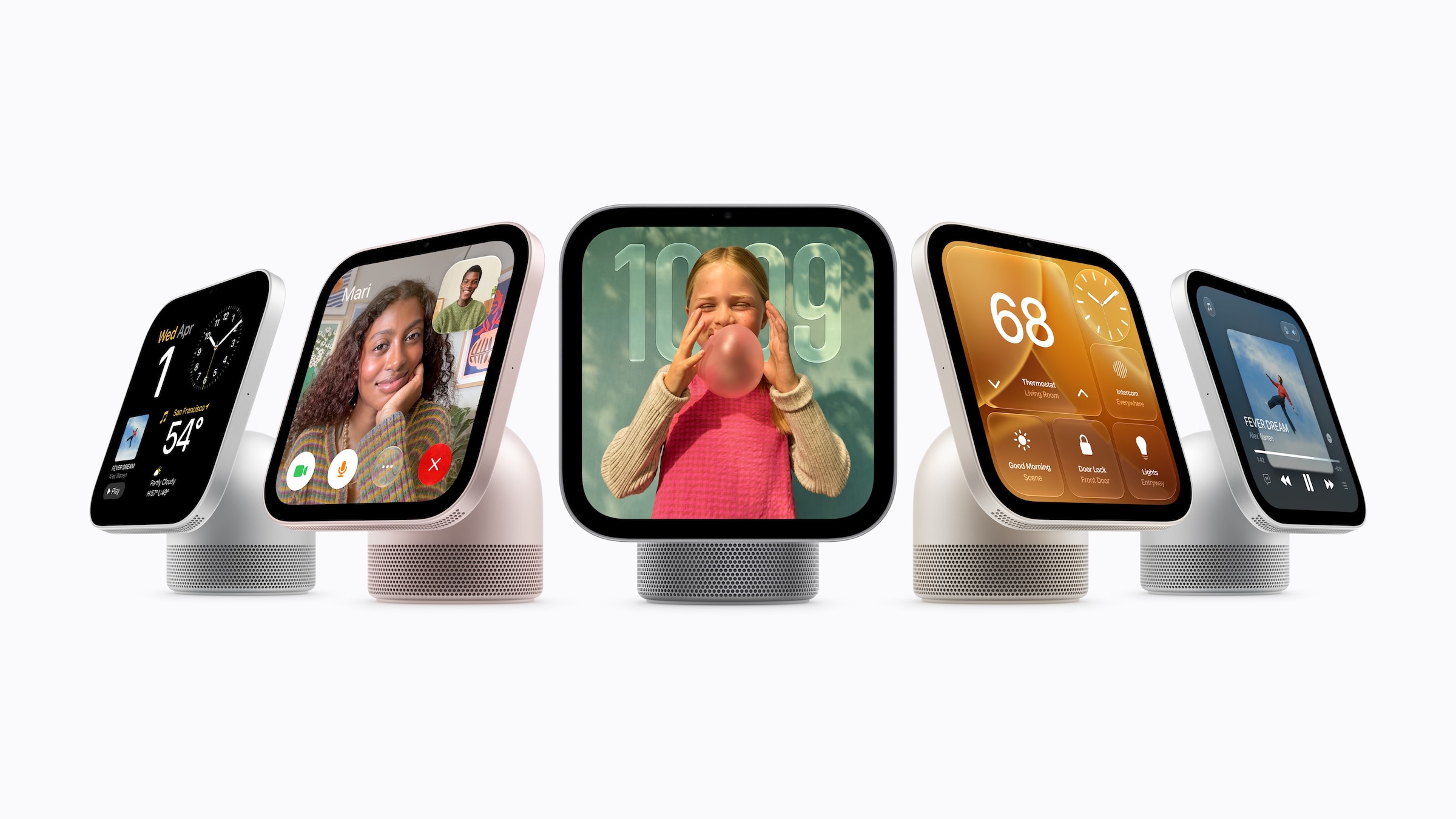
HomeView teardown: five tabletop Apple HomeView units side by side showing a clock, a FaceTime call, a photo view, smart home controls and music playback

Image: Apple

WhatsAppFacebookEmail
Threads

This article may contain affiliate links. Learn more on our Partner Program page.

Make Apfelpatient a preferred source One click – and you'll see us more often on Google

From the outside, HomeView looks like an iPad on top of a HomePod, but internally it has little in common with either. The initial teardown reveals strong adhesive on the display, speakers, and logic board, and one speaker breaks in two during removal. The base is the only place where components can be easily replaced.

Since November 13th, Apple has been shipping its smart home hub in seven countries, including the US and the UK. A few days later, iFixit disassembled both versions, the desktop and wall-mounted models, and published the results in a teardown video on YouTube.

The verdict is clear. Compared to iPads and HomePods, where Apple has made progress in recent years, repair experts see HomeView as a clear step backward. Apple's repair costs were already set before the product launch: In the US, every repair without AppleCare+ costs almost as much as a new device.

Key Takeaways

  • The display is more strongly glued than on any Apple device the technician has opened recently.
  • The two large speakers behind the display sit on thick adhesive pads; one broke during removal.
  • The logic board with A18 chip and 8 GB of RAM is connected to the aluminum housing via an adhesive heat spreader.
  • The display and stand can only be separated with great effort, but the USB-C port in the stand is modular.
  • iFixit does not assign a repair rating because there is no rating scale for this class of device.

The display is more securely mounted than on the iPad

Even opening it becomes a struggle. The aluminum casing conducts the heat from the heating mat away from the adhesive, making it nearly impossible to loosen. Only with a heavy suction cup can the display be freed.

Behind this lies the first surprise: the majority of the display housing consists of two large speakers. Before getting to the components, you also need two tools for a single bracket, because Apple uses a Phillips head screw on one side and a Torx screw on the other.

You are currently viewing a placeholder content from YouTube. To access the actual content, click the button below. Please note that doing so will share data with third-party providers.

More information
Unblock content Accept required service and unblock content

Connectors that won't release

The real problems begin with the speaker connectors. With the first connector, the cables rip out of the housing when lifted. With the second, the technician scrapes away all visible adhesive residue and cuts the seams open with a knife, but the connector still cannot be removed without damage. There is also adhesive between the housing and the connector.

Next comes the component that absolutely must not be damaged. Beneath the logic board lies not only thermal paste, but also a shield on the back, which is attached to the frame with thermally conductive adhesive. This conducts the heat from the A18 through the housing, but makes removing the board risky.

Great for keeping the chip cool. Terrible for keeping the device repairable.

The board houses the A18 chip, 8 GB of LPDDR5X RAM from SK Hynix, and a NAND flash memory chip from Kioxia. According to iFixit, based on its identifier, it is very likely 64 GB of memory.

Speakers break during removal

Especially with the speakers, a simple replacement would have been the obvious solution, since mechanical components wear out. Instead, they're glued to thick pads that don't budge even after liberal amounts of isopropyl alcohol have been used. The metal pry tool bends, and in the end, one speaker breaks in two.

iFixit suggests using screws with rubber grommets, like those used by many notebook manufacturers, or the lighter adhesive from Apple's own MacBooks. For a device that sits on a countertop or wall, industrial-grade adhesive isn't necessary.

The display and stand are permanently attached

In the CT scan, the display and stand appeared as two separate assemblies. In reality, Apple threaded the connecting cables through the hinge at the factory before screwing everything together. The screws on the hinge are secured with threadlocker and are positioned at such an awkward angle that a special ratchet is required. Anyone wanting to replace only a faulty speaker stand may have to disassemble the entire display.

The stand itself is the most user-friendly part of the device. Four Torx screws under a pad reveal the base plate, the USB-C port is modular, and the two passive radiators are also easily replaceable. However, the cable to the woofer is so short that reassembling the parts is nearly impossible. There's certainly room for a longer cable.

The wall-mounted model has smaller speakers

iFixit found a slightly wider logic board with larger capacitor bank connectors on both sides in the wall-mounted model. The desktop model hides these capacitors in its base. Because they need space behind the display in the wall-mounted model, the internal speakers are smaller there.

Both models cost $299 in the US, but the wall-mounted model also requires a matching mount, which Apple sells separately.

Why the repair prices now make sense

I interpret the teardown as an explanation for Apple's pricing. Apple only recognizes a single damage category for the Home View and charges $279 in the US, regardless of whether the display or the speaker is defective. With a device whose speaker breaks during removal and whose circuit board is stuck to the casing, replacing individual parts is hardly economical. I expect that in practice, Apple usually replaces defective devices completely.

This doesn't directly affect anyone in this country for now. Apple doesn't currently sell HomeView in Germany, Austria, or Switzerland; the launch outside the EU still stands.

Would repairability be important to you for a device that's going to be on the wall or kitchen counter for years, or do you buy such things with AppleCare+ anyway? Tell us in the comments how you deal with defects in smart home devices.

Was this article helpful?
YesNo
Tags: Apple HomeHomeViewteardown
SendShareSend
Share

Our Amazon Storefront

A handpicked selection of products for iPhone, Mac and more – sorted by topic and updated regularly.

Shop Now

This post contains affiliate links (including Amazon). We earn a small commission on qualifying purchases – at no extra cost to you. Learn more on our Partner Program page.

Previous Post

iPhone: Market share expected to rise to 26 percent by 2027

Next Post

iPhone 18 and Air 2: Display production begins at the turn of the year

Milan Jovicic

Milan Jovicic

Milan founded Apfelpatient in 2016 and has been responsible for all editorial content since 2018 – news, rumors, how-to guides and product reviews. Here, Apple devices aren't review units kept for two weeks, they're everyday tools: from iPhone to MacBook Pro, MacBook Air and iMac all the way to Apple Vision Pro, at least one device from every product category is in daily use, many of them replaced every year. Every menu path in a guide is checked on the device before it goes live.

Related posts

App Store Awards 2026: These are the 45 finalists

by Milan Jovicic
November 18, 2026 - 3:50 PM CET
App Store Awards 2026: App Store icon hovers above a blue podium

Apple has announced the 45 finalists for the 2026 App Store Awards. Three titles from Germany are among them: Things 3, Ulysses, and Tiny Bookshop.

Read moreDetails

iPhone: Market share expected to rise to 26 percent by 2027

by Milan Jovicic
November 18, 2026 - 00:37 CET
iPhone market share: boxes of the iPhone Duo and two iPhone 18 Pro series models in red and black side by side on a gray surface

Morgan Stanley expects around 270 million iPhones to be sold by 2027, representing a 26 percent market share. Germany lags far behind in the iPhone Duo market.

Read moreDetails

Apple vs. Epic: Epic demands fine over documents

by Milan Jovicic
November 18, 2026 - 00:23 CET
Symbolic image for Apple vs. Epic: illustrated file folder showing the case number of the commission proceedings on a dark blue background

Epic Games is demanding a daily penalty: Apple is withholding over 122,000 documents regarding the planned US commission; only 632 are available.

Read moreDetails

iPhone Duo: Apple now sells replacement parts for self-repair

by Milan Jovicic
November 17, 2026 - 17:09 CET
Folded iPhone Duo in a dark blue case, for which Apple now sells self service repair parts

Repair your iPhone Duo yourself: Apple now sells original parts, also in Germany. The inner display is available separately for €578.99.

Read moreDetails

iPhone attack via Optimizely also affected German websites

by Milan Jovicic
November 17, 2026 - 4:34 PM CET
Older gold iPhone seen from the back, the kind of device targeted by the iPhone attack via Optimizely

iPhone attack via Optimizely: Malicious code found on the websites of 178 companies, including German ones. Which iPhones were at risk and what to do.

Read moreDetails
Load More

Leave a Reply Cancel reply

Required fields are marked with * marked.

By submitting, you consent to the storage of your comment along with your name, email address and IP address. Details are available in our privacy policy.

Categories

  • Apple Insights
  • Apple Rumors
  • Apple News
  • Apple Tips & Tricks
  • iPhone news, rumors and tips
  • Mac and MacBook News
  • Reviews
Make Apfelpatient a preferred source One click – and you'll see us more often on Google

About APFELPATIENT

APFELPATIENT brings you the latest Apple news, product updates, guides, reviews and tips across the entire Apple ecosystem — from the iPhone to the Mac to the Apple Vision Pro. From the first rumors to confirmed news: researched responsibly.

Follow Apfelpatient

Facebook Instagram YouTube Threads Threads

Company

  • About Apfelpatient
  • Contact
  • Author Profiles

Community

  • Netiquette
  • Push notifications
  • RSS feed

Legal

  • Legal Notice
  • Privacy Policy
  • Terms of Use
  • Cookie settings
  • Affiliate Program

Resources

  • Sitemap

© 2026 Apfelpatient. All rights reserved.

No result
View All Results
  • Home
  • News
  • Rumors
  • Tips & Tricks
  • Reviews
  • Insights

© 2026 Apfelpatient. All rights reserved. Site map

Change language to Deutsch