When Apple integrated ChatGPT into Siri in 2024, OpenAI saw it as a gateway to hundreds of millions of iPhones. Two years later, OpenAI admitted in court that the integration had fallen far short of its expectations. This admission is unusually candid, and not without reason.
The statement is contained in a motion filed this week by OpenAI in federal court in Fort Worth. The antitrust lawsuit, filed by X Corp and xAI against Apple and OpenAI over the ChatGPT integration, has been pending there since August 2025. Apple is no longer a party to the case since Musk withdrew the claims against Apple in mid-September. The case against OpenAI continues under case number 4:25-cv-00914-P.
The Financial Times analyzed the passages concerning usage from the submission; the remaining arguments of the application are contained in a Reuters report. OpenAI is demanding that Judge Mark Pittman rule in its favor before the trial.
Key Facts at a Glance
- In a court filing, OpenAI states that the ChatGPT integration in Apple Intelligence has fallen significantly short of expectations.
- Just about a month after its launch in December 2024, OpenAI lowered its forecast for additional weekly active users.
- The input suggests that the connection was switched off at the factory as a possible reason.
- This statement supports OpenAI's defense: Anyone who proves a weak partnership is also denying market protectionism.
- The trial against OpenAI is scheduled for January.
What OpenAI presents to the court
When the agreement was finalized in 2024, OpenAI anticipated a kind of spillover effect: increased brand awareness through Apple's advertising and the proximity to the brand, as well as additional subscriptions from users who found ChatGPT via Apple Intelligence. Apparently, neither of these expectations materialized.
About a month after its launch, the integration appeared sluggish, according to OpenAI. The company lowered its forecast of how many additional weekly registered users it would gain directly through the connection. By summer 2025 at the latest, it was clear that the integration was falling dramatically short of expectations.
Several internal conversations in the document are redacted. According to the Financial Times, the legible portions show that OpenAI executives feared Apple might seek another AI partner sooner than expected.
Disabled by factory
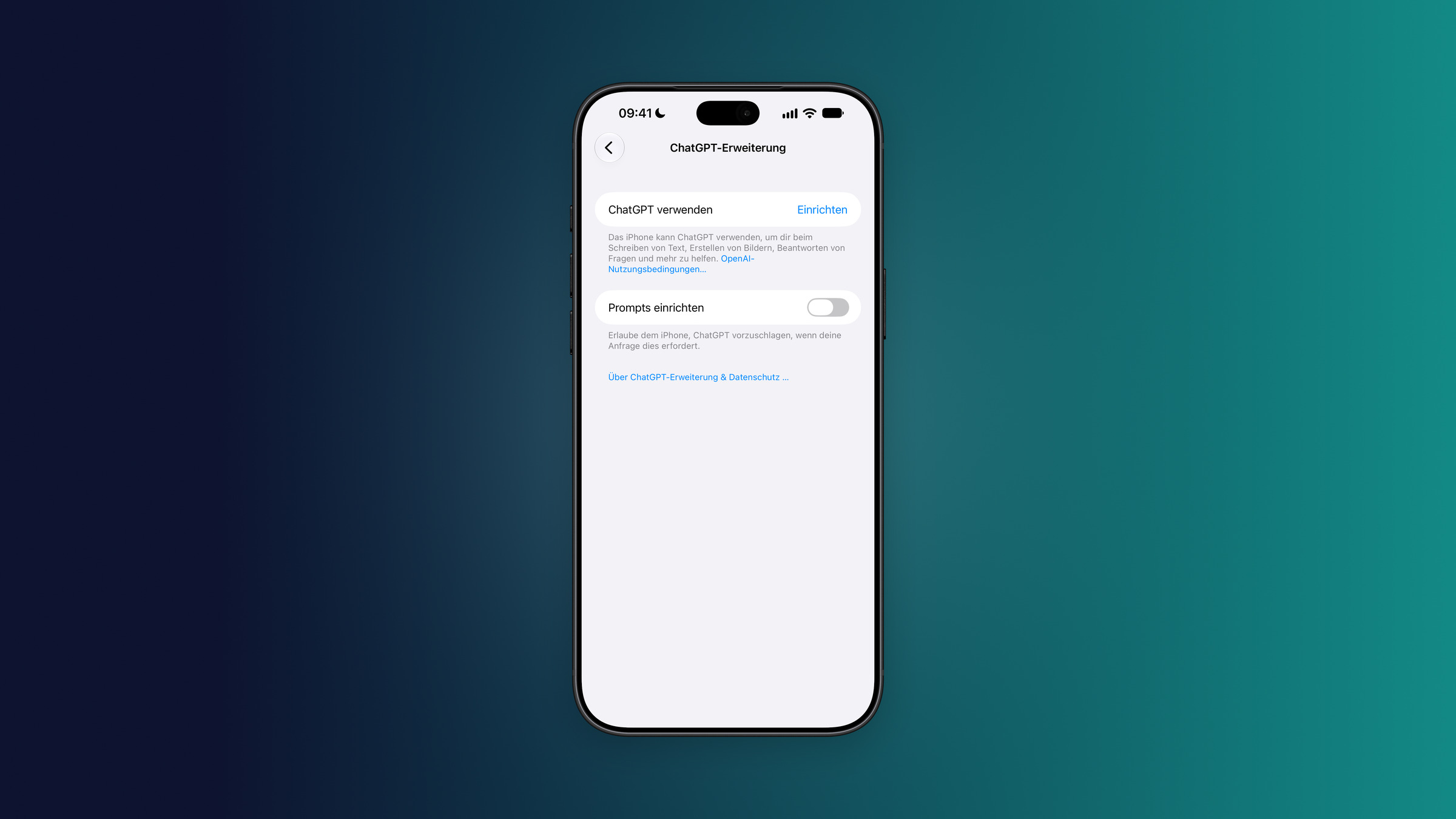
One possible cause mentioned is Apple's implementation: The ChatGPT extension was not active after the update; users had to manually configure ChatGPT in the Apple Intelligence settings. Those who didn't do this were unaware of the connection.
Even after being switched on, Siri would still ask for permission before sending a request to ChatGPT. ChatGPT thus remained an additional option on the iPhone that users had to consciously select.
German came only three and a half months later
For German-speaking users, the story begins later than for those in the US. iOS 18.2 introduced the connection on December 11, 2024, but at that time Apple Intelligence only understood English. German was added with iOS 18.4 on March 31, 2025, along with French, Italian, and Spanish.
The initial downward revision of the forecast thus falls within a period when Apple Intelligence did not yet offer German language support. The launch of German-language support occurred between this initial finding and the assessment from summer 2025. According to OpenAI, this did not change their overall assessment.
| Time | Event |
|---|---|
| June 2024 | Apple announces ChatGPT support |
| December 11, 2024 | iOS 18.2 brings the connectivity, but only in English |
| about a month later | According to input, OpenAI is lowering user forecasts |
| March 31, 2025 | iOS 18.4 brings Apple Intelligence to German |
| Summer 2025 | According to OpenAI, it is clear that integration is lagging significantly behind |
| August 2025 | X Corp and xAI are suing Apple and OpenAI |
| Mid-September 2026 | Plaintiffs withdraw their claims against Apple |
| January 2027 | planned start of the trial against OpenAI |
What OpenAI bases its application on
Low usage is just one factor. OpenAI fundamentally denies having a monopoly position, which would be a prerequisite for an antitrust violation. According to the Financial Times, the company also points out that it is losing market share to Google, Anthropic, Meta, and Grok.
A second argument concerns the plaintiffs themselves. xAI is now part of SpaceX, and according to OpenAI, its IPO registration documents contain information that directly contradicts the alleged competitive harm claimed in the lawsuit. The documents have nothing in common with the doomsday atmosphere of the proceedings, the motion states, in essence.
Furthermore, the question of a settlement between Apple and the plaintiffs remains open. OpenAI had already demanded access to the contents of the case after its withdrawal, as it could affect the remaining claims.
An admission with process calculation
The statement is a party argument, not a court finding. OpenAI has a vested interest in downplaying the partnership: A connection that brings in hardly any users is hardly sufficient evidence that Apple and OpenAI have jointly closed off the market. The redacted passages make the statement even more difficult to verify.
Nevertheless, it's not implausible. It aligns with the dissatisfaction at OpenAI, which was reported in May, and with Apple's course of action since then: Siri AI now relies on Google's Gemini models, and Apple has been engaged in a separate legal battle with OpenAI over AI hardware since July. We don't expect ChatGPT to ever again play the role on the iPhone that OpenAI had envisioned for it in 2024.
Have you ever enabled ChatGPT integration in Apple Intelligence – and do you still use it today, or do you prefer to open the app directly? Tell us in the comments how you handle it.