
This article may contain affiliate links. Learn more on our Partner Program page.
For years, users searching for a product in the Apple Store app have tapped the same magnifying glass icon. For some users, however, something different is now displayed there – and this changes more than just the symbol.
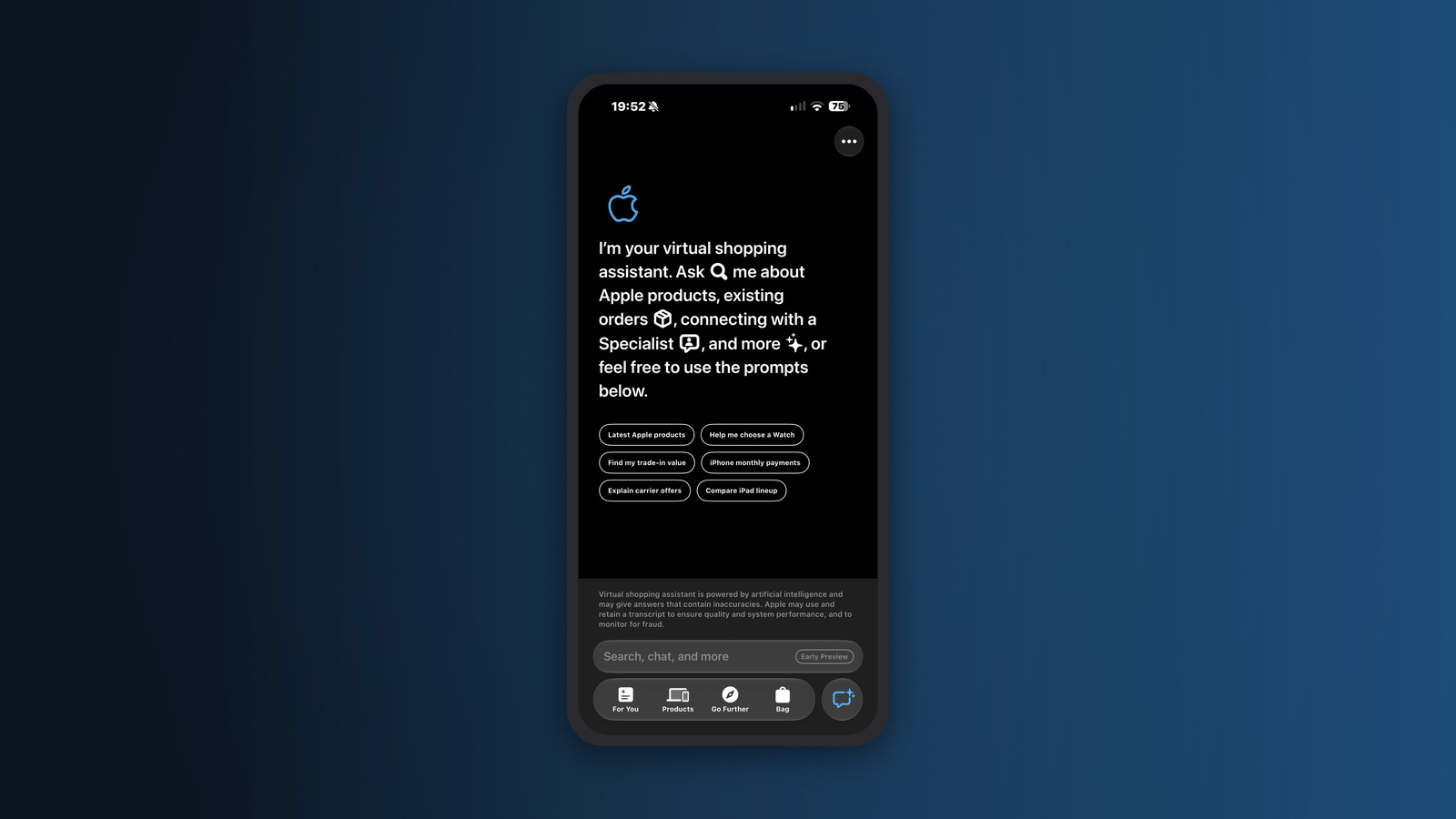
In July, it was reported that Apple was working on an AI-powered shopping assistant for its own shopping app. Now, this preparation has turned into a visible test: Leaker ShrimpApplePro shows in a post on X Images of the new interface, which Apple explicitly labels as an "Early Preview." This confirms what was previously only described as Planned shopping assistant for the Apple Store app was described.
Key Facts at a Glance
- In the lower right corner of the app, selected users will see a chat icon instead of the previous search icon.
- The site still allows users to search for products in the traditional way or to start a conversation with a virtual shopping assistant.
- Apple points out potential errors in the fine print and reserves the right to save call logs.
- Access is limited to a subset of users and is running as a preview.
What the new surface shows
The assistant introduces itself as a virtual shopping assistant and offers to answer questions about Apple products, existing orders, and to connect users with a sales representative. Below this are pre-written opening lines that demonstrate the system's purpose:
- Current Apple products
- Determine the trade-in value
- Mobile phone offers explained
- Help with choosing an Apple Watch
- Monthly installments for the iPhone
- Compare iPad models
The composition is striking. Four of the six entry points target aspects where potential buyers typically abandon their purchase: the residual value of the old device, tariff conditions, installment amount, and model selection. It's less about finding a product and more about finalizing a decision.
Apple's own reservation
In the fine print, Apple states that the assistant uses artificial intelligence and may provide inaccurate answers. Additionally, the company reserves the right to store and analyze a conversation log for quality assurance, system performance monitoring, and fraud detection.
Both of these things together are remarkable for a company that otherwise promotes its assistance features by referring to device processing and private cloud computing. Here, the processing clearly takes place on Apple's servers, and the logs initially remain there.
Why the notice is becoming mandatory in the EU
This very caveat is what makes the assistant interesting for German-speaking countries. Since August 2, 2026, Article 50 of the AI Regulation has been in effect: systems intended for direct interaction with humans must be designed in such a way that users can recognize that they are speaking to a machine. The same regulation underlies the labeling Apple Music uses to mark AI-generated tracks.
A chat window that introduces itself as a virtual shopping assistant and points out the possibility of incorrect answers already fulfills this requirement in essence. We therefore expect that Apple will not need to modify the warning when expanding its functionality, but simply translate it. The established starting point for this is the existing wording: it mentions the technology, the possibility of error, and the data usage in a single paragraph.
The question of the protocols is more open. Anyone discussing the trade-in of an old iPhone or their own installment amount discloses information that goes beyond a product search – and the storage of these conversations is subject to the General Data Protection Regulation (GDPR) in this country.
This is what Apple is shifting in the sales process
The app is already undergoing changes: at the beginning of August, Apple reorganized the accessories section in the online store and the Apple Store app, with curated collections and more refined filters. The assistant continues this trend, but goes a step further: instead of simply sorting the selection, it now provides advice.
For Apple, this is a logical step. Personal consultation has long been the main reason to visit a store, and video shopping with a specialist has provided a digital equivalent for years. A chat window scales where an employee can't – around the clock and without waiting.
The price is in the fine print. Advice that might contain inaccuracies isn't critical when choosing between two iPad models, but it is when discussing contract terms or residual values. If you get a figure from such a conversation, it's worth comparing it to the official product page – not because the system is flawed, but because Apple itself advises this. When choosing a model, a straightforward comparison is often more helpful than a recommendation, such as the one comparing the iPhone 17 and iPhone 17 Pro.
Would you accept purchase advice from a chat window when it comes to trade-ins and installment amounts – or is that precisely the moment when you want to speak to a human being? Let us know in the comments where you draw the line.
- Apple is cutting over 200 jobs at Vision Pro and Siri
- AirPods with camera: Code reveals resolution and indicator light
- Apple Music labels AI-generated songs with “Made With AI”