
This article may contain affiliate links. Learn more on our Partner Program page.
Ask a health question, get an answer with expert sources, and prepare for your next doctor's appointment: Apple is now letting up to 200,000 people try this out. The answers don't come from Apple's own technology, but from a specialist who is primarily known to doctors in the US.
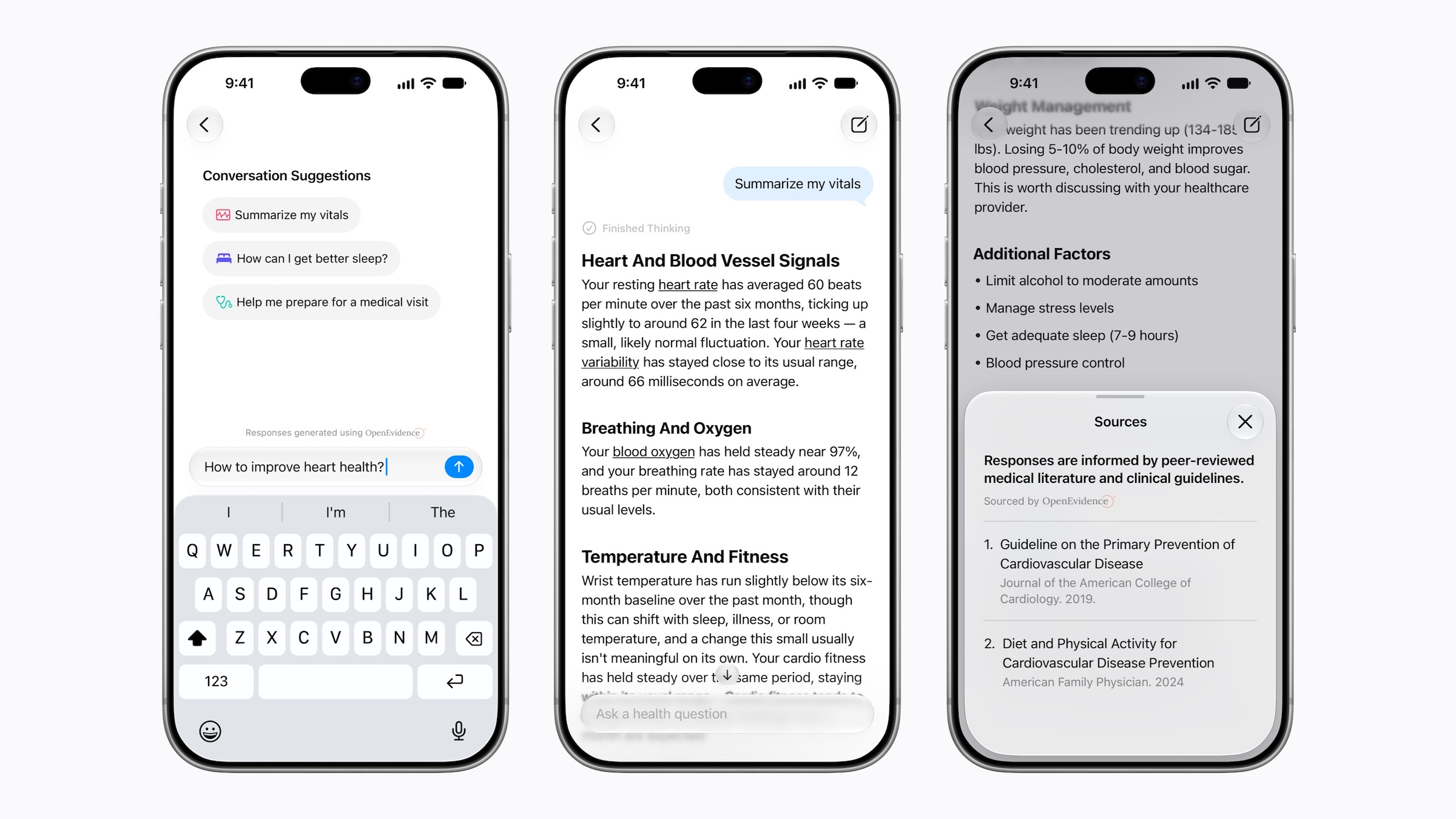
Apple has launched the Apple Health AI Usage Study, a virtual research study with its own app. It aims to determine how people interact with health AI in conversations: when they trust the answers, how well they understand them, and how they use them in everyday life. The partner is OpenEvidence, a provider of clinical AI. Apple announced the study in a newsroom post; participation is only open to residents of the US.
The study is launching as Apple completely rebuilds the Health app. The redesigned Health app, featuring longevity and health age tracking, is now included in the iOS 27.3 beta. However, German is not yet among the supported languages.
Key Takeaways
- The Apple Health AI Usage Study investigates how people use health AI, how well they understand the answers, and when they trust them.
- The answers are provided by OpenEvidence technology; each answer refers to peer-reviewed literature.
- Participants can voluntarily share health data such as resting heart rate, sleep patterns, or lab results. The study data will not be used to train AI models.
- Up to 200,000 adults aged 21 and over who live in the USA and own an iPhone 15 Pro or newer can participate.
Ask questions, check sources, prepare for doctor's appointment
In the study app, participants ask everyday health questions. The answers are designed to explain complex medical concepts in an understandable way, and for each statement, the app provides links to expert sources from peer-reviewed studies. Users can also grant the app access to HealthKit data such as resting heart rate, activity, sleep patterns, or lab results. Apple aims to determine whether personal data makes the answers more relevant and understandable.
A second focus is doctor visits. The study also examines whether health AI can help people better prepare for appointments with their doctors. Participants also use surveys to rate how well they found individual answers.
Apple explains the effort quite frankly: Health applications based on large language models can sometimes provide incomplete or unclear answers. Sumbul Desai, Apple's Vice President of Health and Fitness, explains the approach as follows:
At Apple, we believe responsible innovation starts with scientific rigor and clinical grounding. Health is deeply personal, and conducting a dedicated research study is the most thoughtful way to understand how people engage with, comprehend, and evaluate health AI in everyday life.
Why OpenEvidence provides the answers
OpenEvidence is an AI platform widely used in medicine. It bases its answers on medical sources such as the New England Journal of Medicine, the Journal of the American Medical Association, and Nature. In this study, this technology runs within an interface designed by Apple.
What's particularly interesting is who is using the technology here. OpenEvidence's own app is only available to medical professionals who must prove their status before using it. In contrast, in Apple's study, OpenEvidence's technology answers questions from laypeople.
For Robert Wachter, professor and head of the Department of Medicine at the University of California in San Francisco, this is precisely where the benefit lies:
Patients and clinicians are both turning to AI, but the tools they use are being built and tested in separate worlds. When patients and doctors draw on versions of the same trustworthy tools, patients arrive prepared, conversations improve, and next steps happen seamlessly. Connecting these tools, and rigorously studying what works, is how we'll get there.
Data protection and guidelines
According to Apple, the study was designed from the outset with data privacy, transparency, and clinical guidelines in mind. Participants themselves decide whether to share HealthKit data or survey responses. Apple states that it protects the study data, which is stored on its servers, with security measures.
The app is also designed to recognize certain potentially problematic questions and then recommend contacting a doctor or other healthcare provider. The app is not intended for diagnosis or treatment and does not replace medical advice. According to Apple, participants should discuss health-related questions and medical information with their doctors.
Who can participate in the study
The study is open to up to 200,000 participants aged 21 and over who live in the USA. A prerequisite is an iPhone with Apple Intelligence, i.e., an iPhone 15 Pro or newer running at least iOS 26. Registration takes place directly within the study app.
This study takes a different approach than Apple's previous health research. Large, long-term studies, such as the Apple Health Study launched in 2025, run in the Research app, which also provides the findings of the Apple Hearing Study on hearing health. The AI study, however, will have its own dedicated app.
| Apple Health Study | Apple Health AI Usage Study | |
|---|---|---|
| Start | February 2025 | November 2026 |
| Partner | Brigham and Women's Hospital | OpenEvidence |
| App | Research app | own study app |
| Minimum age | 18 years, higher regionally | 21 years |
| Requirement | iPhone with iOS 16 or later | iPhone 15 Pro or later with iOS 26 or later |
| Participant places | – | up to 200,000 |
| Residence | USA | USA |
Those living in Germany, Austria or Switzerland cannot participate, just like with the Apple Health Study.
Research before a product is released
I believe the study is more insightful than its format suggests. Apple itself states that the results will inform the responsible design of health AI at Apple and across the industry. A chat function that explains lab results and prepares for doctor's appointments is therefore officially a subject of research, even though Apple has not yet announced a product based on this technology.
The difference to OpenAI is significant. OpenAI launched ChatGPT Health, integrated with Apple Health, in January and has since released the feature to all authorized users in the US. In early practical tests, the AI misinterpreted heart data. Apple is taking a more cautious approach: First, it measures how people react to such responses, and the responses are based on cited scientific literature.
I expect that findings from the study will first be incorporated into the Health app, which Apple is already rebuilding around Apple Intelligence. For German-speaking users, nothing will change for the time being. The study is limited to the US, and the new Health app doesn't yet support German.
Would you share data like resting heart rate, sleep patterns, or lab results with a health AI if every answer is backed up by expert sources – or do you consider this a matter solely for the doctor's office? Tell us in the comments where you draw the line.