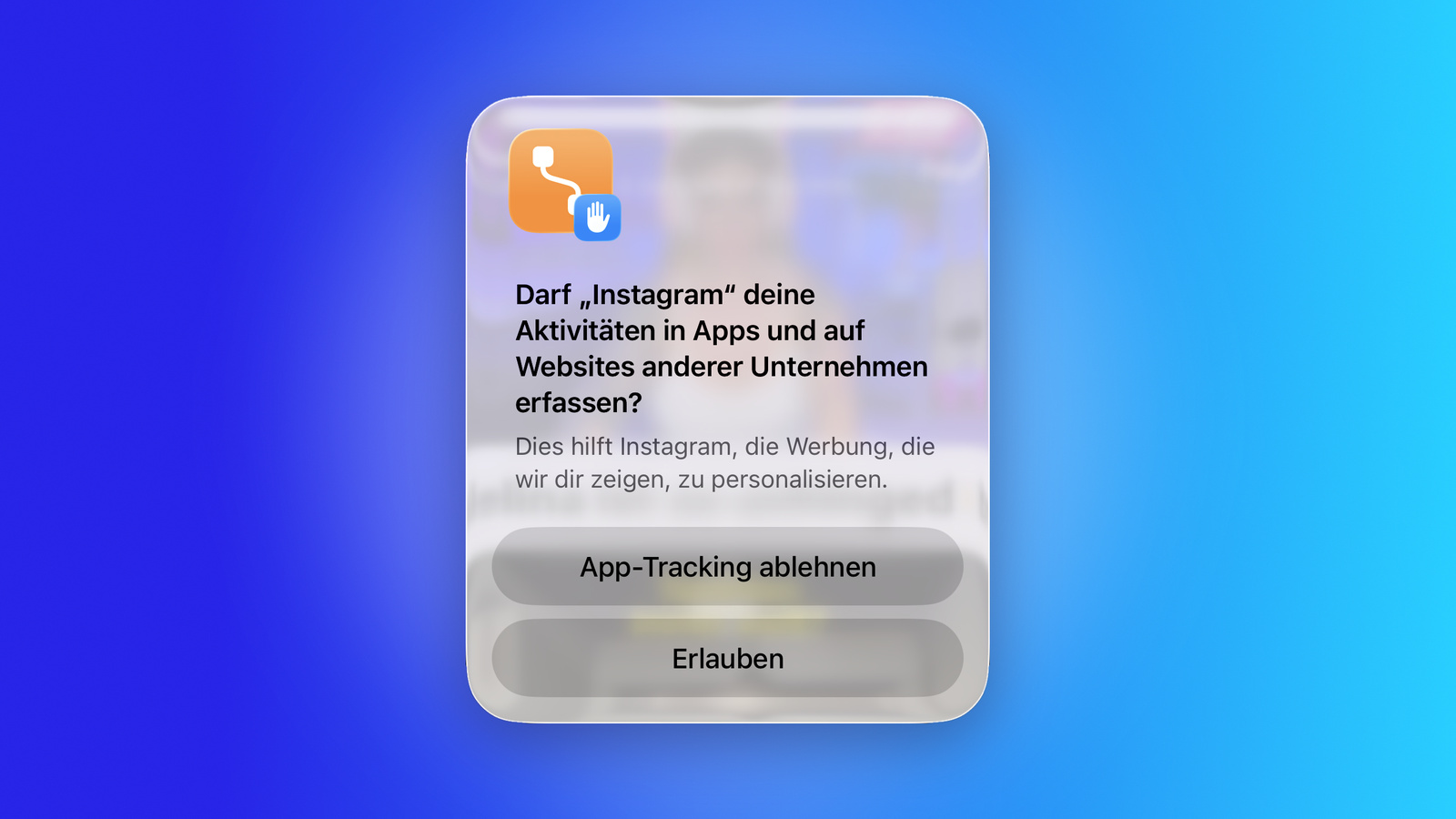
The warning hand icon disappears, as does the word "tracking." Apple has made a binding commitment to the German Federal Cartel Office to redesign the query window for third-party apps—and its own at the same time. Four years after the proceedings began, the future of the dialogue is now clear. However, only one country is affected.
Since April 2021, Apple has required app providers to obtain their own consent before they can use user data across the company for advertising purposes. German publishers and advertising associations saw this as preferential treatment for Apple's own advertising business and contacted the Federal Cartel Office. Following a market test of the commitments offered by Apple in December 2025, the authority demanded improvements. The revised commitments are now binding, and the proceedings are concluded.
Key Facts at a Glance
- According to the Federal Cartel Office, the commitments have been binding since August 13th, and the proceedings, which have been running since June 2022, are now complete.
- The warning hand and the term "tracking" disappear from the query window for third-party providers.
- App providers are now allowed to expand their explanatory text to up to 4,000 characters – Apple's previous requirement was one to two sentences.
- Apple's own window for personalized advertising is also being adjusted, not just that of its competitors.
- This change applies exclusively to Germany, linked to billing address and device location. Austria and Switzerland are excluded.
What changes in the query window
The existing dialog for third-party apps, known as ATT Prompt in Apple's terminology, uses an orange graphic resembling a warning hand. The German Federal Cartel Office considered this design to be manipulative: the symbol, color, bold text, and button layout steered users toward rejection.
Both are no longer applicable. The authority states in its Question and answer paper The warning hand icon and the term "tracking," which app developers perceived as alarming, are explicitly omitted. Furthermore, it only describes part of the process, as the rules only cover company-wide data usage.
In addition, there's more space. The area that app providers can fill themselves will now hold up to 4,000 characters. Previously, Apple's guideline limited the text to one or two sentences. Those who want to explain why their service relies on personalized advertising now have ample room to do so – including a text button that leads to a second page with more detailed settings.
Apple's own window will also be affected
Apple uses a separate window, the PA Prompt, for its own advertising. The German Federal Cartel Office noticed this window in the opposite direction: a linguistically neutral headline, a detailed explanation of the advantages, links to further information, and a sorting of options that is more likely to lead to agreement.
In the future, both windows must accurately describe the actual possible data processing. The labeling and order of the selection options will be more closely aligned. In Germany, only the revised versions will subsequently be published.
The core of the criticism was never that Apple had introduced the rules at all – the authority objected solely to their specific implementation. A noteworthy side note in the document: The German data protection authorities surveyed generally viewed the rules positively, but did not consider them necessary from a data protection perspective.
Three ways out of the double query
The second point of contention concerns the number of pop-up windows. Anyone who already requires consent under data protection law and also needs Apple's approval previously had to ask users twice. Apple itself does not request any additional consent for its own advertising.
In the future, app providers will be able to choose between three approaches:
| Variant | What happens | Advantage |
|---|---|---|
| Combination | The user's own consent request and Apple's dialog merge into one window; a single selection decides both. | Users only see one window. |
| Separated with reference | Both queries remain separate; the Apple dialog refers to the consent already given. | Existing queries coordinated with authorities will remain untouched. |
| Separated as before | No link, but the new dialogue still appears. | No conversion work required |
The medium option has a fixed restriction: If someone declines in the privacy request, the Apple dialog will not appear at all. Those who have agreed can only see it again at the earliest twelve months after the last time it was displayed.
Why the billing address determines the new dialogue
Herein lies the catch for everyone outside of Germany. According to the Federal Cartel Office, the promises apply to users whose app store billing address and device location are in Germany. Both conditions must be met.
Austria is not covered by this, even though the same European data protection regulations apply there – the proceedings were conducted under German competition law. Switzerland is outside the EU and the EEA anyway, and therefore not subject to the jurisdiction of a German authority. An Austrian or Swiss account will therefore not be subject to the new dialog, even if the purchase is made in Germany.
The situation across the border is not entirely hopeless, however. France, Italy, Romania, and Poland are conducting or have already concluded their own procedures based on the same regulations, and the German Federal Cartel Office has coordinated with them within the European network of authorities. The authority considers it possible that the German solution could influence the implementation in other member states. Our expectation: Apple will roll out the new dialogue across Europe rather than maintaining two versions in parallel indefinitely – although this decision does not make that mandatory.
Four years until the commitment
| Time | Step |
|---|---|
| April 2021 | Apple introduces the rule set with iOS 14.5. |
| June 2022 | The Federal Cartel Office is opening the proceedings following complaints from publishers and advertising associations. |
| April 2023 | Apple is classified as a corporation with paramount cross-market importance. |
| February 2025 | The authority shares its preliminary assessment: possible self-preferential treatment. |
| March 2025 | The Federal Court of Justice confirms the classification |
| December 2025 | Market test of the initial commitments; afterwards, the authority demands improvements. |
| August 13, 2026 | A decision is made in favor of the proposal; the proceedings are discontinued. |
At the same time, fines were imposed elsewhere: €150 million in France and €98.6 million in Italy. The German proceedings ended without a fine – they focused on future regulations, not on punishing past violations.
What the schedule means – and what it doesn't
From the date the decision is served, Apple has four months to implement the changes in iOS and iPadOS and to notify developers. Technical tests with app publishers will be conducted beforehand. Based on this, implementation is expected towards the end of the year; however, the regulatory authority has not specified a firm date.
The commitments are valid for seven years – starting from the date of implementation, not the date of the decision. An independent monitoring trustee verifies compliance and mediates in disputes between Apple and app providers; app publishers can contact the trustee directly.
For everyday use, this means nothing for now. Until the redesign, the familiar windows will still appear. Afterward, the number of prompts for some apps should decrease because two windows will merge into one – the explanatory text beforehand will be longer and more explicitly request consent. Those who don't want to see this at all can still disable the prompts system-wide; how app tracking can be controlled on the iPhone remains unchanged.
Do you expect the more neutral options to change your own decision – or will you simply tap "Decline" as before, no matter how politely the question is asked? Let us know in the comments how you handle this with apps.
- Apple Fitness+: Job posting hints at live content
- Apple AI model for China: The EU is still left out
- Mercenary spyware: Apple warns users in 110 countries